India, UNESCO sign MoU to bring clean sport values into classrooms nationwide
Synopsis
India has taken its anti-doping push into the classroom. A three-way MoU between the Sports Ministry, Education Ministry, and UNESCO will place a 13-language clean sport toolkit in schools nationwide — backed by a National Anti-Doping Act now in force and government plans to criminalise doping activities. UNESCO says the model could be replicated globally.
Key Takeaways
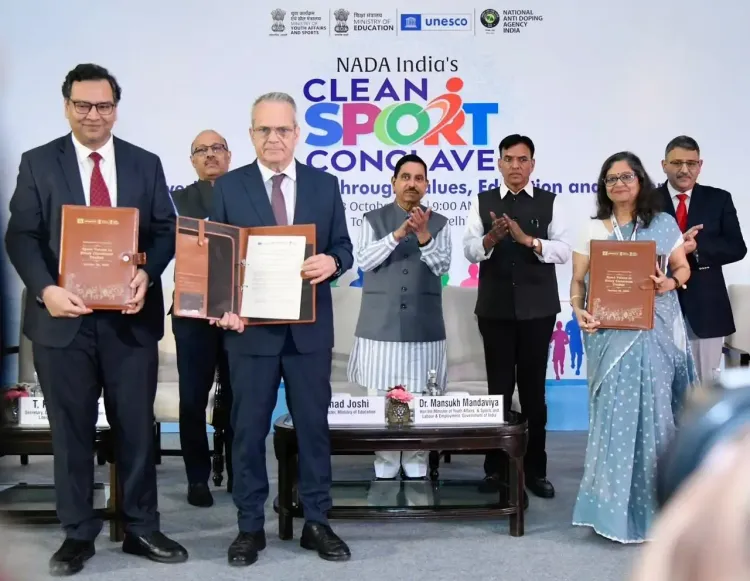
The Ministry of Youth Affairs and Sports , Ministry of Education , and UNESCO signed a clean sport MoU on 28 October 2026 in New Delhi .
The 'Sports Values in Every Classroom Toolkit' will reach students in 13 Indian languages , aligned with Khelo Bharat Niti 2025 .
NADA conducted over 7,000 doping tests and 350+ awareness sessions reaching 27,000 participants in 2025–26 .
The National Anti-Doping Act came into force in 2026 ; Parliament is set to consider provisions for criminalisation of doping-related activities .
UNESCO's Tim Curtis said the initiative could serve as a global model for integrating sport values in education.
The Ministry of Youth Affairs and Sports, the Ministry of Education, and UNESCO signed a Memorandum of Understanding (MoU) on 28 October 2026 in New Delhi to embed clean sport principles into school curricula across India through the 'Sports Values in Every Classroom Toolkit'. The initiative aims to instil integrity, fairness, and respect among school children at an early age.
The Agreement and What It Covers
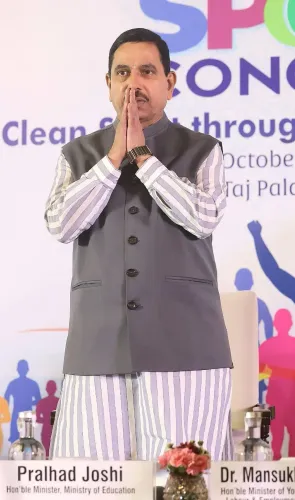
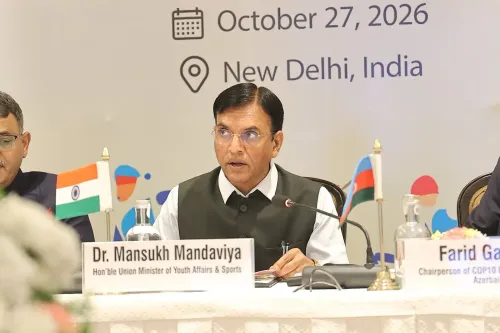
The MoU was formally exchanged at the National Anti-Doping Agency (NADA) India's Clean Sport Conclave in New Delhi, in the presence of Union Sports Minister Mansukh Mandaviya, Union Education Minister Pralhad Joshi, and UNESCO Regional Office for South Asia Director Tim Curtis. The toolkit will deploy educational resources and video modules available in 13 Indian languages to reach students nationwide. The initiative is aligned with the integration of sports and education emphasised under the Khelo Bharat Niti 2025.
What the Sports Minister Said
Mandaviya underscored the inseparability of sporting excellence and sporting integrity at the event. 'Sporting excellence and sporting integrity must go hand in hand. Talent, discipline and hard work are essential for sporting success, but integrity, fairness and credibility are equally important,' he said. He pointed to India's fourth-place finishes at the Asian Games and Asian Para Games as markers of the country's growing sporting strength, while cautioning that doping remained a serious, ongoing concern requiring sustained efforts across education, prevention, testing, and enforcement.
The Sports Minister also disclosed that during 2025–26, NADA conducted over 7,000 doping tests and more than 350 education and awareness sessions, collectively reaching 27,000 participants. He added that supplement testing facilities at the National Forensic Sciences University, Gandhinagar and the National Institute of Pharmaceutical Education and Research, Hyderabad are helping prevent inadvertent doping cases. Notably, the National Anti-Doping Act came into force this year, and the government is reportedly preparing to place provisions for the criminalisation of doping-related activities before Parliament.
Education Minister on Bridging Academics and Sport
Education Minister Pralhad Joshi described the agreement as a step towards closing a longstanding gap between academics and sport in India. He observed that students who excelled in the classroom did not always participate in sporting activities, stressing the need to expand grassroots opportunities and build stronger pathways for young athletes. 'This MoU is an important step towards strengthening the connection between education and sports, which has been missing for a long time... The values being introduced through this toolkit must spread beyond classrooms and reach every section of society,' Joshi said.
UNESCO's Role and Global Implications
Tim Curtis said the agreement marked a new chapter in UNESCO's partnership with India and could reach millions of young people, while also serving as a replicable model for other countries. 'Every child in the classroom can learn what it means to play by the rules. Through this toolkit, we are bringing three fundamental values into education and sport: respect, integrity and fairness,' he said. Curtis stressed that teachers would be central to translating the toolkit's principles into everyday behaviour, including how children interact during school activities. 'The real test of these values is whether children play fairly even when nobody is watching. That is the kind of integrity we want to nurture from an early age,' he added.
Key Attendees and Next Steps
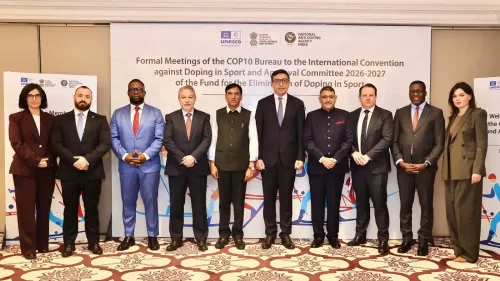
The conclave was also attended by T.K. Anil Kumar, Secretary of the Department of School Education; Hari Ranjan Rao, Sports Secretary; Anant Kumar, NADA Director General; and Indian international javelin thrower Sachin Yadav. International delegates who had attended statutory meetings of UNESCO's anti-doping conventions the previous day were also present. With the toolkit now ready in 13 languages and the National Anti-Doping Act in force, implementation across Indian schools is expected to be the critical next step in translating the MoU's intent into measurable outcomes.
Point of View
But the harder question is implementation at scale: India has over a million schools, and a toolkit in 13 languages is only as effective as the teacher training that accompanies it. The announcement comes as the government also prepares criminal doping legislation — a signal that the soft-power approach in classrooms is being paired with harder enforcement upstream. What mainstream coverage underplays is the timing: India's fourth-place finishes at the Asian Games have raised both ambition and vulnerability to doping pressure, making a culture-change push in schools more strategically urgent than it appears on the surface.
NationPress
28 Oct 2026
Frequently Asked Questions
What is the India-UNESCO clean sport MoU signed on 28 October 2026?
It is a three-way agreement between India's Ministry of Youth Affairs and Sports, Ministry of Education, and UNESCO to introduce clean sport values in school classrooms through the 'Sports Values in Every Classroom Toolkit'. The toolkit is available in 13 Indian languages and aligns with the Khelo Bharat Niti 2025 framework.
What is the 'Sports Values in Every Classroom Toolkit'?
It is an educational resource comprising learning materials and video modules in 13 Indian languages, designed to teach school children the principles of integrity, fairness, and respect in sport. Teachers are expected to play a central role in translating the toolkit's content into everyday behaviour.
How active is NADA India on anti-doping enforcement?
During 2025–26, NADA India conducted over 7,000 doping tests and more than 350 education and awareness sessions reaching 27,000 participants. Supplement testing facilities at institutions in Gandhinagar and Hyderabad also help prevent inadvertent doping cases.
What is the National Anti-Doping Act and what changes are coming?
The National Anti-Doping Act came into force in 2026, providing a statutory framework for anti-doping efforts in India. The government is additionally preparing to table provisions for the criminalisation of doping-related activities before Parliament, which would mark a significant escalation in enforcement.
Why does UNESCO see India's initiative as a global model?
UNESCO Regional Director Tim Curtis said the MoU could reach millions of young people in India and provide a replicable framework for other countries to integrate sport values into formal education. The multilingual, classroom-based approach is seen as scalable beyond India's borders.