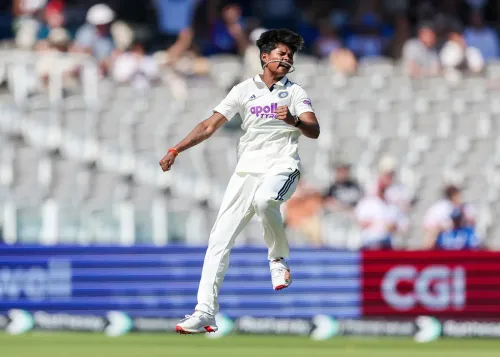
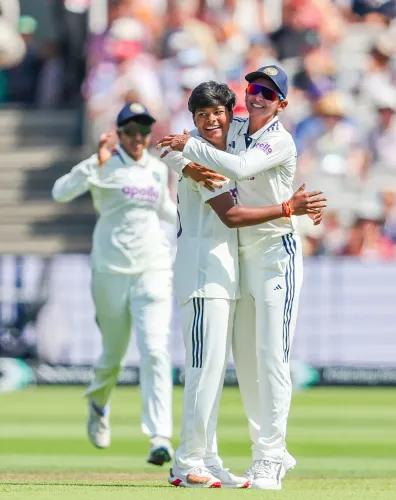
Kranti Gaud's action mirrors Shami's, says Niranjana after Lord's 5-wicket haul
Synopsis
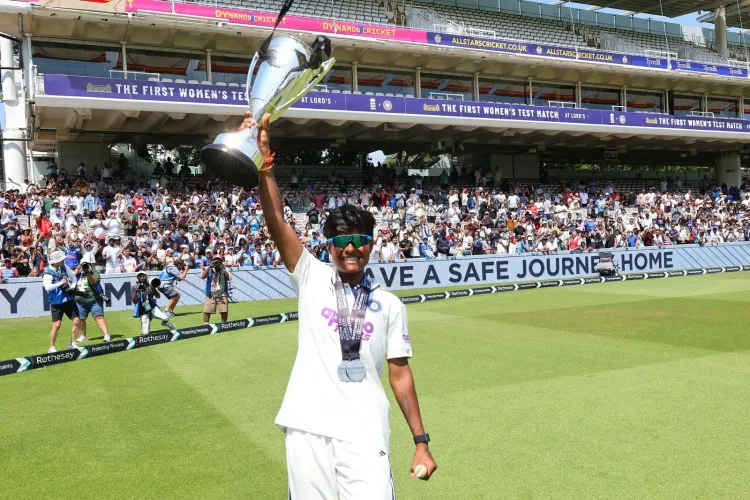
Kranti Gaud didn't just take a five-for at Lord's — she became the first woman on its Honours Board, joining Chandrasekhar, Bedi, and Kapil Dev. Former India pacer Niranjana Nagarajan sees shades of Mohammed Shami in her action, and believes India's domestic red-ball revival is the structural engine behind this historic 270-run win.
Key Takeaways
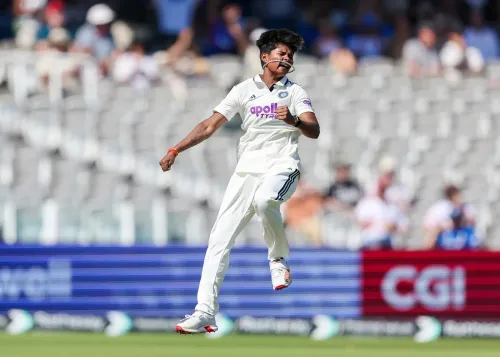
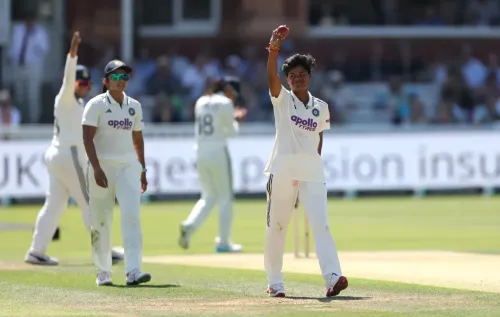
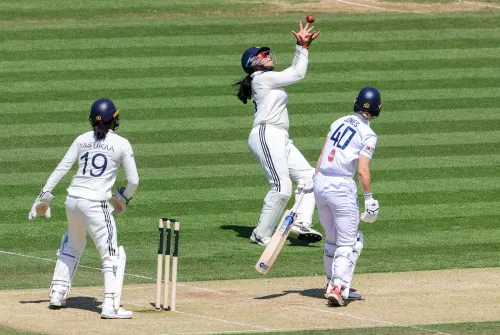
Kranti Gaud claimed 5 for 37 in 17 overs , becoming the first woman on the Lord's Honours Board .
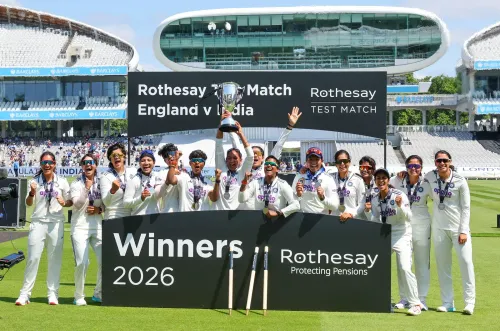
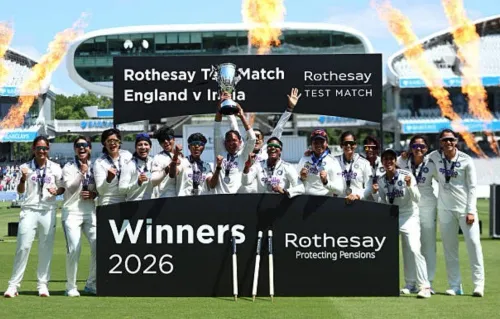
India defeated England by 270 runs in the Lord's Test , establishing a 115-run first-innings lead on day two.
Former India pacer Niranjana Nagarajan compared Kranti's bowling action to Mohammed Shami's , citing her smooth run-up and low error margin.
Yastika Bhatia scored 113 — her maiden international century and the first Test hundred by a woman at Lord's — after returning from ACL surgery .
Niranjana credited the BCCI's reintroduction of domestic multi-day cricket as a key factor in India's Test improvement.
Niranjana backed a dedicated Under-23 red-ball tournament but urged caution about extending it to the Under-19 level.
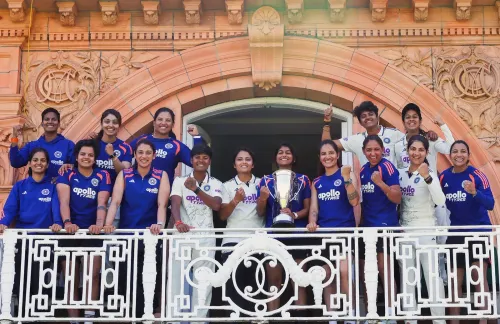
Former India fast bowler Niranjana Nagarajan has drawn a striking comparison between rising pacer Kranti Gaud and veteran men's speedster Mohammed Shami, praising Kranti's smooth run-up and clinical seam bowling after her historic 5-wicket haul powered India to a 270-run Test victory over England at Lord's on 16 July. Kranti became the first woman to earn a place on the Lord's Honours Board — a landmark that puts her alongside Indian greats BS Chandrasekhar, Bishan Singh Bedi, and Kapil Dev.
A Historic Spell at Lord's
Kranti returned figures of 5 for 37 in 17 overs, helping India establish a crucial 115-run lead by the end of day two. Her performance cemented her place in cricket history as the first woman bowler inscribed on the Lord's Honours Board. Niranjana, who herself played a significant role in India's 2014 Wormsley Test win over England, described the moment as one of deep personal pride.
'It's such a proud moment as a fast bowler for me to have Kranti Gaud writing her name on the Honours board,' Niranjana said. She recalled spotting Kranti's potential as far back as when Madhya Pradesh won the domestic one-day trophy, noting even then that the youngster had the trajectory to represent India.
The Shami Comparison
'When you look at Kranti bowl, you will see that she is very smooth. The error percentage is very less considering her action,' Niranjana said. 'I always felt that her action is a little resembling Mohammed Shami. The way she loads, the way she releases the ball and everything — it is so nice.'
Niranjana highlighted that Kranti's naturally smooth action reduces her margin for error and allows her to consistently hit the length areas. She credited 13 months of international cricket exposure and the backing of team management — including captain Harmanpreet Kaur's emphasis on building a reliable pace attack — as key factors in Kranti's rapid development. 'Her talent couldn't be ignored,' Niranjana added.
Yastika Bhatia's Century: A Story of Resilience
Alongside Kranti's bowling, Yastika Bhatia's knock of 113 — her maiden international century — made her the first woman to score a Test hundred at Lord's. The innings carried extra weight given that Yastika had missed India's victorious 2025 ODI World Cup campaign due to a knee injury requiring ACL surgery and had an indifferent run in this year's T20 World Cup.
'It is never easy to come out of injuries. You will have your self-doubts,' Niranjana said. She described Yastika's hundred as a 'surprise package' that underscored the batter's mental strength. 'She stuck to her plan and has announced herself in Test cricket. This is just a humble beginning for her,' Niranjana added.
The Role of Domestic Red-Ball Cricket
Niranjana pointed to the Board of Control for Cricket in India's (BCCI) reintroduction of the domestic multi-day tournament as a structural reason behind India's recent Test successes. She noted that the format — absent for several years including the Covid-19 period — has given players the tools to grind through long innings, leave the ball judiciously, and manage pressure over extended spells.
'When the domestic base is strong, you are able to produce good Test cricketers,' she said, drawing a parallel with the Ranji Trophy system that has long underpinned India's men's Test strength. She also suggested that the Women's Premier League (WPL) has been another catalyst in the overall elevation of women's cricket over the past five to six years.
The Road Ahead: U-23 Red-Ball Development
Asked whether multi-day red-ball structures should extend to age-group levels, Niranjana advocated a measured approach. She suggested the Under-23 level as the optimal entry point for specialised red-ball development, cautioning against introducing it at the Under-19 stage where players are still evolving. 'For them to understand what Test cricket is, it will take some time. But for the U-23 level, we can probably try,' she said.
Niranjana, who represented India in 2 Tests, 22 ODIs, and 14 T20Is, expressed confidence that Kranti has at least 7-8 more years of international cricket ahead of her — provided she stays hungry and healthy. With a landmark Lord's victory behind them, India's women's Test programme appears to be entering a new era of sustained ambition.
Point of View
Though, is structural. India's domestic red-ball revival after years of Covid-era gaps is paying dividends in real time, and the BCCI deserves credit for connecting the dots between domestic grind and Test-match temperament. The question now is whether the Board will institutionalise this pipeline — through dedicated U-23 red-ball tournaments and specialised Test camps — before the current generation of talent plateaus.
NationPress
15 Oct 2026
Frequently Asked Questions
What did Kranti Gaud achieve in the Lord's Test against England?
Kranti Gaud took 5 for 37 in 17 overs, becoming the first woman to earn a place on the Lord's Honours Board. Her spell helped India secure a 115-run first-innings lead and ultimately win the Test by 270 runs.
Why did Niranjana Nagarajan compare Kranti Gaud to Mohammed Shami?
Niranjana drew the comparison based on the similarity in how both bowlers load up and release the ball, combined with Kranti's exceptionally smooth run-up that keeps her error percentage low. She first noticed Kranti's potential when Madhya Pradesh won the domestic one-day trophy.
Who is Yastika Bhatia and why was her century significant?
Yastika Bhatia is an Indian batter who scored 113 at Lord's — her maiden international century and the first Test hundred by a woman at the ground. The knock was especially notable because she had missed the 2025 ODI World Cup due to ACL surgery and had a difficult T20 World Cup campaign.
How has domestic cricket contributed to India women's Test success?
Niranjana credited the BCCI's reintroduction of multi-day domestic cricket as a key structural factor, giving players experience in building long innings, leaving the ball, and managing pressure across extended periods — skills directly transferable to Test cricket.
Should red-ball cricket be introduced at Under-19 level for women?
Niranjana advised against it, suggesting Under-19 players are still developing maturity. She recommended the Under-23 level as the right entry point for specialised red-ball development, noting that most senior squads already feature a high proportion of under-25 players.