Rajnath Singh: Infrastructure Builds Trust, Not Just Projects
Synopsis
Union Defence Minister Rajnath Singh on July 16, 2026 stated that India's road, rail, air, and digital infrastructure push is aimed at delivering development and trust nationwide, calling strong infrastructure the foundation of a strong future.
Key Takeaways
Rajnath Singh posted on July 16, 2026 that India's connectivity expansion targets every corner of the country, not just project construction.
He described the infrastructure being built today as the future identity of India for coming generations.
The National Infrastructure Pipeline announced in 2019 envisioned a Rs 111 lakh crore outlay over five years across roads, railways, and digital networks.
Bharatmala Pariyojana targets 34,800 km of roads including border and strategic corridors.
The PM Gati Shakti National Master Plan (2021) integrates road, rail, airport, and digital planning under one framework — matching the four connectivity modes Singh cited.
Border communities and defence forces are among the primary stakeholders of frontier infrastructure investment.
Union Defence Minister Rajnath Singh on Thursday, July 16, 2026, underscored that India's expanding road, rail, air, and digital connectivity network is not merely a construction exercise but a vehicle for delivering development and trust to every corner of the nation. Posting on X, the senior BJP leader argued that the infrastructure being built today will define the identity of India for future generations.
In his post, Singh wrote: 'सड़क, रेल, हवाई और डिजिटल कनेक्टिविटी के विस्तार का हमारा लक्ष्य केवल परियोजनाओं का निर्माण नहीं, बल्कि देश के हर कोने तक विकास और विश्वास पहुँचाना है।' ('Our goal in expanding road, rail, air, and digital connectivity is not merely to build projects, but to deliver development and trust to every corner of the country.')
Context
Rajnath Singh has served as Union Defence Minister since 2019, and has previously held the offices of Chief Minister of Uttar Pradesh and Union Home Minister. In that capacity, he has consistently linked physical connectivity — particularly roads and air strips in border regions — to both civilian welfare and defence logistics. His July 2026 post extends that framing to the full spectrum of infrastructure: surface, rail, aviation, and digital networks.
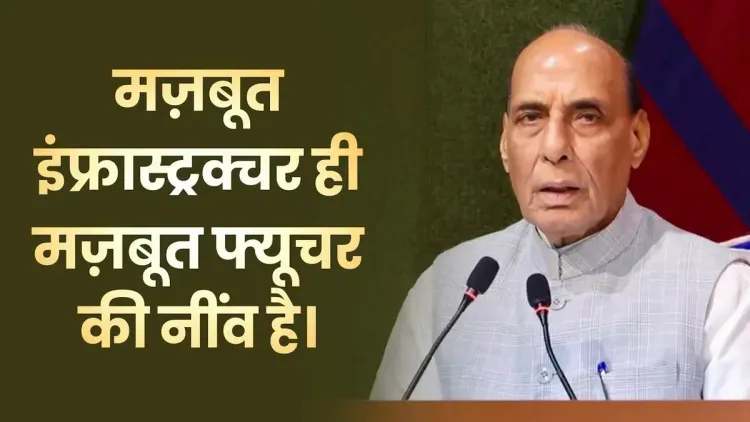
The post closes with a declarative principle: 'मज़बूत इंफ्रास्ट्रक्चर ही मज़बूत फ्यूचर की नींव है' ('Strong infrastructure is the foundation of a strong future') — a formulation that reflects the broader government communication around capital expenditure as nation-building.
Policy Backdrop
The statement sits within a well-established policy lineage. The National Infrastructure Pipeline, announced in 2019, envisioned a planned outlay of Rs 111 lakh crore over five years spanning roads, railways, and digital projects. The Bharatmala Pariyojana, launched in 2015, targets the development of 34,800 km of roads including strategic border and economic corridors.
Layered over these is the PM Gati Shakti National Master Plan, launched in 2021, which integrates multimodal infrastructure planning — roads, railways, airports, and digital networks — under a single coordinated framework. Singh's emphasis on all four connectivity modes mirrors the Gati Shakti architecture precisely.
Since 2014, successive central governments have framed physical and digital connectivity to remote and border regions as a dual instrument: an engine of economic growth and a tool of national security integration. The Defence Ministry has routinely highlighted how road and air links improve logistics for the armed forces while simultaneously opening markets for border communities.
Stakeholders and Impact
The communities most directly addressed by this vision are those in remote, hilly, and border regions — areas that have historically lagged in connectivity. Improved road and rail access translates to lower freight costs, faster emergency response, and greater access to government services for millions of citizens.
For the defence forces, road and air infrastructure in frontier zones is operationally significant, enabling faster troop and equipment movement. Digital connectivity, meanwhile, supports surveillance systems and administrative reach in areas that were previously off-grid. The convergence of civilian and strategic benefit is central to how the Defence Ministry justifies infrastructure investment in sensitive corridors.
What's Next
Attention will turn to parliamentary discussions around the next Union Budget infrastructure allocations, where capital expenditure targets and project timelines will be subject to scrutiny. Progress dashboards under the PM Gati Shakti platform are expected to reflect updated milestones across road, rail, airport, and broadband projects.
If the government's stated philosophy — that infrastructure is a carrier of trust as much as of goods and people — is to be tested, the metric will be how quickly last-mile connectivity reaches the most underserved districts. Singh's post signals that this remains a political and policy priority heading into the next budget cycle.
Point of View
He signals alignment with the PM Gati Shakti multimodal framework ahead of what is expected to be a politically significant budget cycle. The reference to 'future generations' is a rhetorical move that insulates long-gestation projects from short-term accountability. Coming from the Defence Minister, the statement also reinforces the strategic-civilian dual-use logic that has justified heavy spending on frontier infrastructure since 2014.
NationPress
16 Jul 2026
Frequently Asked Questions
What did Rajnath Singh say about infrastructure on July 16 2026?
Rajnath Singh stated that India's expansion of road, rail, air, and digital connectivity is not merely about building projects but about delivering development and trust to every corner of the country, calling strong infrastructure the foundation of a strong future.
What is the PM Gati Shakti plan that Rajnath Singh's statement relates to?
PM Gati Shakti is a National Master Plan launched in 2021 that integrates multimodal infrastructure planning — covering roads, railways, airports, and digital networks — under a single coordinated government framework.
What is the National Infrastructure Pipeline of India?
The National Infrastructure Pipeline was announced in 2019 with a planned outlay of Rs 111 lakh crore over five years, targeting roads, railways, and digital projects across the country.
Why does the Defence Ministry focus on road and rail infrastructure?
The Defence Ministry links road, rail, and air connectivity in border and remote regions to improved logistics for the armed forces as well as greater civilian access, treating frontier infrastructure as a dual-use strategic and development asset.
What is Bharatmala Pariyojana?
Bharatmala Pariyojana is a road development programme launched in 2015 that aims to build 34,800 km of roads, including border and strategic economic corridors, to improve national connectivity.