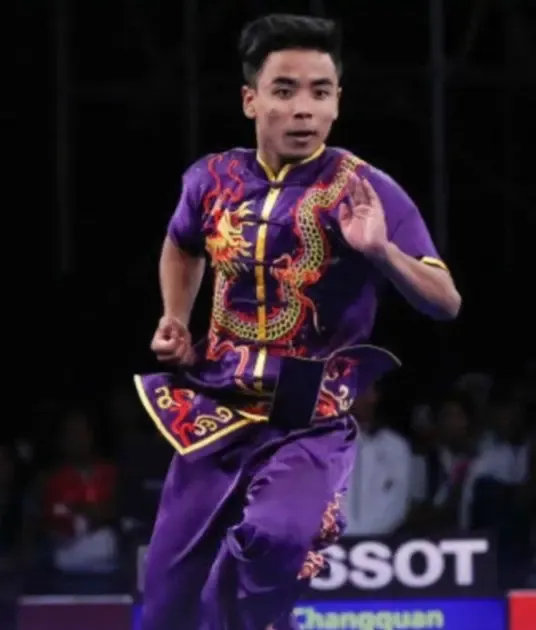
Suraj Singh Mayanglambam finishes 11th in Wushu Changquan, misses Asian Games podium by 0.040 points
Synopsis
By just 0.040 points — less than the blink of an eye in competitive sport — Suraj Singh Mayanglambam missed an Asian Games Wushu medal in Nagoya. His perfect technical and difficulty scores made the shortfall all the more agonising, hinting that a podium was genuinely within reach.
Key Takeaways
Suraj Singh Mayanglambam finished 11th in the Men's Changquan Wushu final at the Aichi-Nagoya Asian Games on 20 September .
He scored 9.683 points — just 0.040 points short of the bronze-medal position.
Suraj earned a perfect 5.00 in Quality of Movement and 2.00 in Degree of Difficulty, with zero deductions .
Gold went to Macau's Kuong Chi Hin (9.723); silver to compatriot Chi Kuan Song (9.720).
The 21-athlete final was held at the Aichi Prefectural Martial Arts Hall , with performance order set by random draw.
India's Suraj Singh Mayanglambam narrowly missed the medal podium at the Aichi-Nagoya Asian Games on 20 September, finishing 11th in the Men's Changquan Wushu final by a razor-thin margin of just 0.040 points — one of the closest near-misses of India's campaign so far at the Games.
Competing against a 21-athlete field at the Aichi Prefectural Martial Arts Hall, Suraj posted a total score of 9.683 points. He earned a perfect 5.00 in Quality of Movement (A-Score) and a full 2.00 in Degree of Difficulty (C-Score), with zero deductions recorded. His Overall Performance (B-Score) came in at 2.683, ultimately leaving him fractionally short of the bronze-medal mark.
How the Medals Were Decided
Macau's Kuong Chi Hin claimed gold with a score of 9.723 points, while compatriot Chi Kuan Song took silver with 9.720. The wafer-thin differences at the top of the leaderboard — with gold and silver separated by just 0.003 points — underscored how extraordinarily fine the margins were across the entire final. Suraj's score was only 0.040 points shy of the bronze position, a gap that, in Wushu terms, can hinge on fractions of a second or a single subtle movement.
About Changquan: One of Wushu's Most Demanding Disciplines
Changquan is widely regarded as one of the most physically demanding and technically complex events in competitive Wushu. The discipline requires athletes to execute a fast-paced routine rooted in traditional northern Chinese kung fu, incorporating explosive punches, deep lunging stances, high aerial kicks, jumps and spins — all within approximately 90 seconds. The order of performance in the final was determined by a random draw — either computer-generated or manual — rather than seeding or pre-event rankings, meaning no athlete had a positional advantage.
A Technical Performance That Fell Just Short
Suraj's perfect scores in both the A-Score and C-Score categories — with no deductions — reflected the technical soundness of his routine. The shortfall came in the B-Score (Overall Performance), a metric that assesses presentation, rhythm and overall execution quality. His 9.683 kept him within the competitive cluster in what was an exceptionally tight final. Notably, his near-flawless technical scorecard suggests the gap to a medal was a matter of presentation refinement rather than fundamental skill.
India's Broader Asian Games Campaign Continues
Despite falling short in the Changquan final, Suraj's performance adds to India's growing presence across non-traditional sports at the continental Games. Team India had a packed schedule on Sunday, with multiple qualification and medal events across disciplines. The result will be seen as motivation for India's Wushu contingent, who have been pushing for greater recognition of the sport domestically.
With competition still ongoing, India's medal tally at the Aichi-Nagoya Asian Games remains a live picture, and several events are yet to conclude.
Point of View
Yet it also reveals something encouraging: India is now competing at the margins in disciplines that rarely feature in national sports conversations. Perfect A- and C-Scores with zero deductions mean the technical gap to the world's best in Wushu is narrowing — what remains is the harder-to-coach B-Score territory of presentation and competitive poise. Whether Indian sporting infrastructure will invest in that marginal refinement, or whether Wushu remains perpetually underfunded, is the question this near-miss quietly poses.
NationPress
20 Sept 2026
Frequently Asked Questions
How did Suraj Singh Mayanglambam perform at the Asian Games Wushu final?
Suraj Singh Mayanglambam finished 11th in the Men's Changquan Wushu final at the Aichi-Nagoya Asian Games on 20 September, scoring 9.683 points. He missed the bronze-medal position by just 0.040 points in a highly competitive 21-athlete field.
Who won gold in the Men's Changquan Wushu event at the Aichi-Nagoya Asian Games?
Macau's Kuong Chi Hin claimed gold with 9.723 points, while compatriot Chi Kuan Song won silver with 9.720 points. The top two positions were separated by just 0.003 points, reflecting the extremely tight nature of the final.
What is Changquan in Wushu?
Changquan is one of Wushu's most technically demanding disciplines, based on traditional northern Chinese kung fu. Athletes perform a roughly 90-second routine featuring explosive punches, deep stances, high kicks, aerial jumps and spins, and are judged on quality of movement, degree of difficulty, and overall performance.
Why did Suraj Singh Mayanglambam miss the medal despite perfect technical scores?
Suraj earned a perfect 5.00 in Quality of Movement and 2.00 in Degree of Difficulty with zero deductions, but his Overall Performance (B-Score) of 2.683 left his total at 9.683 — 0.040 points short of the bronze mark. The B-Score covers presentation, rhythm, and execution quality, which proved the deciding factor.
How was the starting order decided in the Changquan Wushu final?
The performance order for all 21 finalists was determined by a random draw — either computer-generated or manual — rather than pre-event rankings or seeding, ensuring no athlete had a positional advantage going into the final.