Road safety tech discussed at IIT Madras: AI, geospatial data in focus
Synopsis
India loses nearly 485 lives to road accidents every day — and for the third year running, the toll has risen. At IIT Madras, the Supreme Court's road safety committee and Tamil Nadu's new Road Safety Innovation Hub convened to ask whether AI and geospatial data can finally bend the curve. The answer, the session suggested, depends less on technology and more on whether pilots can be scaled into policy.
Key Takeaways
Justice Abhay Manohar Sapre , chairman of the Supreme Court Committee on Road Safety (SCCoRS) , addressed a fireside chat at IIT Madras on 4 November 2026 .
India recorded 1,77,177 road deaths in 2024 , a 2.3% rise over 2023, according to MoRTH data placed before Parliament.
Road fatalities have increased three years in a row: 1,68,491 (2022) → 1,72,890 (2023) → 1,77,177 (2024).
Two-wheeler riders account for 46.2% of fatalities; 66.1% of victims are aged 18–45 .
The Road Safety Innovation Hub , launched by the Government of Tamil Nadu with RBG Labs , was introduced as a platform for tech-driven road safety solutions.
The Hub works with IIT Madras's Centre of Excellence for Road Safety and aligns with national frameworks including IIT Delhi's Bharat Safety initiative .
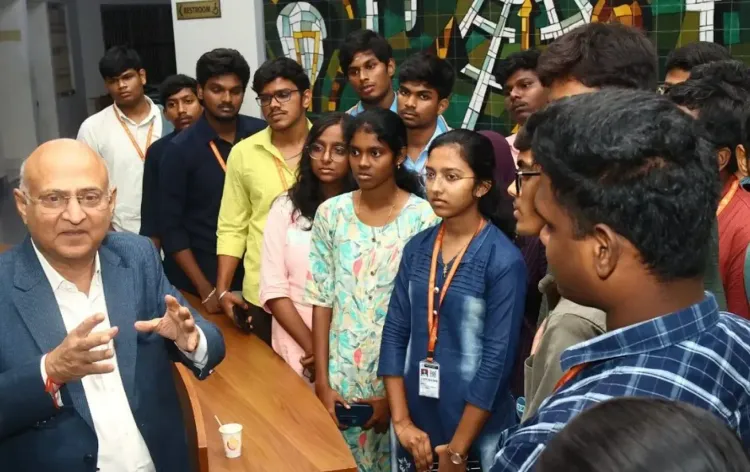
The application of Geospatial data and Artificial Intelligence (AI) to advance road safety interventions was discussed at the Indian Institute of Technology (IIT) Madras on Wednesday, 4 November 2026, during a fireside chat featuring Justice Abhay Manohar Sapre, former judge of the Supreme Court of India and chairman of the Supreme Court Committee on Road Safety (SCCoRS), and Sanjay Bandopadhyay, member of SCCoRS. The session drew students, practitioners, and innovators to explore technology-driven solutions for one of India's most persistent public health crises.
Key Causes of Road Crashes Highlighted
Justice Sapre outlined the primary factors behind road accidents in India, including overspeeding, drunk driving, wrong-side driving, jumping red lights, mobile phone use while driving, unsafe overtaking, and driver fatigue and stress. He also stressed the importance of applying first-principles thinking to build solutions that are genuinely effective rather than cosmetically compliant.
The Road Safety Innovation Hub
The session also introduced the Road Safety Innovation Hub, developed by the Government of Tamil Nadu in partnership with RBG Labs. The Hub serves as a platform for students, researchers, and entrepreneurs to share, test, and advance road safety ideas. It regularly collaborates with academic institutions, including the Centre of Excellence for Road Safety at IIT Madras, to design, test, and deploy data-driven solutions and smart mobility tools. Its core mandate covers low-cost engineering fixes, emerging safety technologies, and data-backed interventions to reduce traffic crashes and fatalities. Notably, it aligns with similar initiatives across India — such as Odisha's design-thinking capacity programmes and IIT Delhi's Bharat Safety initiative — to scale tech-driven road safety solutions nationally.
India's Road Accident Toll: A Worsening Crisis
The scale of the problem is stark. According to data shared in Parliament by the Ministry of Road Transport and Highways (MoRTH), 1,77,177 people were killed in road accidents across India in 2024 — a 2.3% increase over the previous year. That translates to roughly 485 deaths every day, or approximately 20 deaths per hour.
The trend has been consistently upward: 1,68,491 people died in road accidents in 2022, rising to 1,72,890 in 2023, and now to 1,77,177 in 2024. This is the third consecutive year of increase, underscoring the urgency behind forums like the one held at IIT Madras.
Who Bears the Heaviest Burden
The demographic data reveals a troubling pattern. Two-wheeler riders account for 46.2% of all road fatalities, while pedestrians make up 20.6%. Most alarming is the age profile: 66.1% of those killed fall within the productive age group of 18 to 45 years, and those aged 18 to 60 comprise 83.3% of all fatalities — a severe economic loss beyond the human toll.
What Comes Next
With the Road Safety Innovation Hub now operational and the SCCoRS actively engaging academic and policy stakeholders, attention will turn to whether technology pilots can be scaled into systemic interventions. The convergence of judicial oversight, state-level innovation infrastructure, and IIT-backed research represents a rare alignment that experts say could meaningfully shift India's road safety outcomes if implementation keeps pace with intent.
Point of View
Despite existing laws, cameras, and committees, should prompt uncomfortable questions about whether the problem is a lack of technology or a lack of enforcement will. The IIT Madras session rightly centres AI and geospatial tools, but the more telling detail is demographic: over 83% of victims are working-age adults, making road accidents a quiet drag on economic productivity that rarely features in GDP conversations. The Road Safety Innovation Hub is a credible institutional step, but India's graveyard of well-designed pilots that never scaled demands scrutiny of execution pathways, not just innovation pipelines.
NationPress
5 Nov 2026
Frequently Asked Questions
What was discussed at the IIT Madras road safety event?
The event at IIT Madras on 4 November 2026 focused on using AI and geospatial data to advance road safety interventions in India. Justice Abhay Manohar Sapre of the Supreme Court Committee on Road Safety led a fireside chat alongside SCCoRS member Sanjay Bandopadhyay, covering key crash causes and the role of technology in addressing them.
How many people died in road accidents in India in 2024?
According to data shared in Parliament by the Ministry of Road Transport and Highways, 1,77,177 people were killed in road accidents in India in 2024 — a 2.3% increase over 2023. This works out to roughly 485 deaths per day, or about 20 per hour.
What is the Road Safety Innovation Hub?
The Road Safety Innovation Hub is a platform developed by the Government of Tamil Nadu in partnership with RBG Labs to help students, researchers, and entrepreneurs share, test, and deploy road safety solutions. It collaborates with IIT Madras's Centre of Excellence for Road Safety and focuses on data-backed interventions, smart mobility tools, and low-cost engineering fixes.
Who is most affected by road accidents in India?
Two-wheeler riders account for 46.2% of all road fatalities in India, while pedestrians make up 20.6%. Critically, 66.1% of those killed are in the 18–45 age group, and 83.3% are aged between 18 and 60 — meaning the burden falls overwhelmingly on the working-age population.
How does the Road Safety Innovation Hub connect to national initiatives?
The Hub aligns with other deep-tech road safety frameworks in India, including Odisha's design-thinking capacity programmes and IIT Delhi's Bharat Safety initiative, as part of a broader national push to scale technology-driven solutions for reducing traffic crashes and fatalities.