ASI unearths Vijayanagara-era Vishnu and Shiva temples at Hampi
Synopsis
ASI excavations near Hampi's oldest Jain shrine have uncovered two Vijayanagara-era temples — a rare partially subterranean dwikuta Vishnu complex and a granite Shiva temple — complete with intact sanctums, guardian sculptures, and a standing Vishnu image. The find is one of the more significant structural discoveries at the UNESCO World Heritage Site in recent years.
Key Takeaways
The Archaeological Survey of India (ASI) unearthed two Vijayanagara-era temples near the Jain Temple complex at Hampi , Karnataka , announced on 14 November .
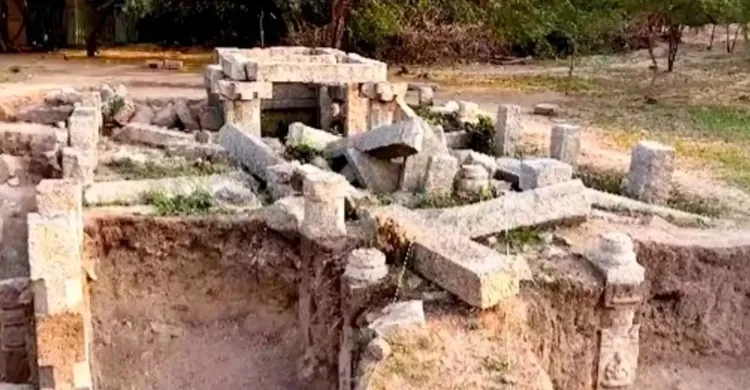
The Vishnu shrine is a partially subterranean dwikuta (two-shrined) complex built in dry-stone granite masonry, with a preserved sanctum, entrance corridor, and moulded basement.
Sculptural finds include a Garuda figure, Naga sculptures, Nagadevi and Nagadeva reliefs, and a standing Sthanaka Murti of Lord Vishnu.
The Shiva temple features a raised moulded plinth, a central chamber, and pillars with Varaha motifs.
The site adjoins the Ganagitti Temple ( 1386 AD ), the oldest Jain shrine at Hampi, built under Bukkaraya II .
The ASI says the finds shed light on Vijayanagara urban planning, settlement patterns, and multi-faith religious life.
The Archaeological Survey of India (ASI) has unearthed the structural remains of two ancient temples — one dedicated to Lord Vishnu and another to Lord Shiva — during ongoing excavations near the historic Jain Temple complex at Hampi, Karnataka. The discovery, announced on 14 November, is expected to deepen scholarly understanding of urban planning, religious coexistence, and cultural life under the Vijayanagara Empire.
What Was Found
The newly exposed Vishnu shrine is a partially subterranean dwikuta (two-shrined) temple complex built in the classic Vijayanagara architectural style. Constructed from massive dressed granite slabs using dry-stone masonry, the structure retains a well-preserved garbhagriha (sanctum sanctorum), a sunken entrance corridor known as the ardhamandapa, a decorative moulded basement (adhishthana), lime flooring, heavy supporting beams, and stone seating platforms.
Flanking the entrance at the base of the door jambs are high-relief dvarapalas — sculpted guardian figures. While the brick-built shikhara (vimana) has not survived, foundational walls, stone lintels, and door jambs remain largely intact, according to the ASI.
Key Sculptural Finds
Excavators recovered a significant cache of sculptural artefacts from the Vishnu complex. These include a headless, kneeling winged figure resembling Garuda, relief carvings of Nagadevi and Nagadeva, two Naga sculptures depicting coiled and intertwined serpents, and a stone image of Lord Vishnu in the standing posture known as Sthanaka Murti.
Alongside the Vishnu complex, archaeologists also exposed the foundational remains of a granite Shiva temple distinguished by a raised, moulded plinth and a central interior chamber. Pillars at the site carry prominent sculptural motifs, including Varaha — the sacred boar incarnation of Lord Vishnu — pointing to the intertwined Vaishnava and Shaiva iconographic traditions that characterised Vijayanagara religious art.
The Excavation Site and Its Context
The dig is located in the vicinity of the Ganagitti Temple, identified as the oldest Jain shrine at Hampi. Dating to 1386 AD, the Ganagitti Temple was built during the reign of Vijayanagara ruler Bukkaraya II by his minister Iruguppa Dandanayaka (also known as Iruga), and is dedicated to Lord Kunthunatha, the 17th Tirthankara of Jainism. The proximity of Shaiva, Vaishnava, and Jain structures within the same precinct underscores the pluralistic religious character of the Vijayanagara capital.
Notably, the ASI stated that the discoveries offer significant insights into 'regional planning, settlement patterns, and religious and cultural life' of the era — suggesting the excavation zone may reveal further remains as work continues.
Why This Discovery Matters
Hampi, a UNESCO World Heritage Site, has been the subject of archaeological study for decades, but new structural finds of this scale remain relatively uncommon. The identification of a dwikuta configuration — a twin-shrined layout — within a partially subterranean complex adds a rare architectural typology to the known inventory of Vijayanagara temple forms. The co-location of Vaishnava, Shaiva, and Jain monuments in a single excavation zone may also reshape interpretations of how different religious communities shared sacred space in the imperial capital.
As excavations continue, archaeologists are expected to publish detailed findings that could further illuminate the settlement history of this section of Hampi.
Point of View
Vaishnava, and Jain structures clustered within the same excavation zone at Hampi challenges simplified narratives of religious rivalry in medieval Deccan polities. The Vijayanagara court's patronage of multiple faiths simultaneously was a deliberate statecraft choice, and finds like these give that argument material weight. What mainstream coverage often misses is that the dwikuta configuration — a twin-shrined layout — is architecturally uncommon and may indicate a higher-status ceremonial precinct than previously mapped in this section of the site. The ASI would do well to fast-track publication of the full stratigraphic record before the monsoon season compromises the exposed foundations further.
NationPress
14 Nov 2026
Frequently Asked Questions
What did the ASI discover at Hampi?
The Archaeological Survey of India uncovered the structural remains of two Vijayanagara-era temples — one dedicated to Lord Vishnu and one to Lord Shiva — near the Jain Temple complex at Hampi, Karnataka. The finds include intact sanctums, sculpted guardian figures, Naga reliefs, and a standing Vishnu image.
What is the dwikuta temple found at Hampi?
The dwikuta is a two-shrined temple complex, partially subterranean, built in the classic Vijayanagara architectural style using dressed granite slabs in dry-stone masonry. It features a garbhagriha (sanctum), a sunken entrance corridor, a moulded basement, lime flooring, and high-relief dvarapala guardian figures at the entrance.
Where exactly is the excavation site located?
The excavation is near the Ganagitti Temple, the oldest Jain shrine at Hampi, which dates to 1386 AD. Hampi is a UNESCO World Heritage Site in Karnataka, and was the capital of the Vijayanagara Empire.
Why is the Hampi temple discovery historically significant?
The co-location of Vaishnava, Shaiva, and Jain structures within the same precinct offers rare material evidence of the pluralistic religious culture of the Vijayanagara Empire. The ASI says the finds provide insights into regional urban planning, settlement patterns, and multi-faith religious life of the era.
What sculptural artefacts were recovered from the site?
Artefacts include a headless kneeling winged figure resembling Garuda, relief carvings of Nagadevi and Nagadeva, two Naga sculptures of coiled serpents, a standing Vishnu image (Sthanaka Murti), and pillars bearing Varaha (sacred boar) motifs associated with Vaishnavism.