Assam CM Sarma launches satellite cities plan to decongest Guwahati

Synopsis
Assam is moving beyond piecemeal fixes for Guwahati's congestion — Chief Minister Himanta Biswa Sarma has announced a dedicated authority to build a ring of planned satellite cities around the capital, a structural bet on organised urbanisation that could reshape Northeast India's commercial hub.
Key Takeaways
Assam CM Himanta Biswa Sarma announced a satellite cities plan for Guwahati on 9 July .
The newly constituted Guwahati Satellite City Development Authority will plan, design and finance the satellite townships.
Focus areas include housing , industrial growth , logistics infrastructure and future-ready urban planning.
The move aims to decongest Guwahati, where rising population and traffic have strained civic infrastructure for over a decade.
The initiative is also expected to reinforce Guwahati's role as the commercial gateway to Northeast India .
Assam Chief Minister Himanta Biswa Sarma on Thursday, 9 July announced that the next phase of Guwahati's urban expansion will centre on building a network of interconnected satellite cities, aimed at decongesting the state capital and raising the quality of urban life for its growing population.
New Authority to Drive the Plan
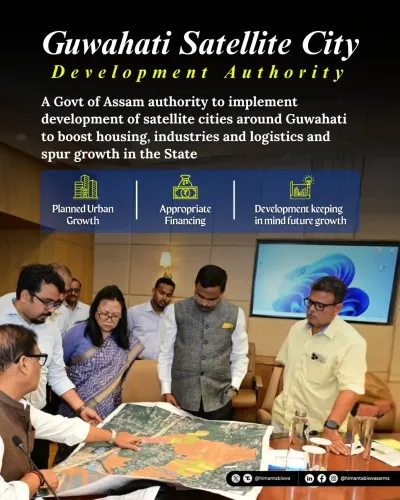
Sarma announced the formation of the Guwahati Satellite City Development Authority, a newly constituted body that will be solely responsible for planning, designing and financing the proposed satellite townships. According to an official presentation shared by the Chief Minister, the authority will coordinate with multiple state departments to deliver integrated urban expansion.
The authority's mandate covers the development of new urban centres around Guwahati, with a focus on housing, industrial growth, logistics infrastructure and future-ready urban planning. Comprehensive development plans are expected to be prepared by the authority as its first order of business.
What the Satellite Cities Will Prioritise
According to the Chief Minister, the proposed urban hubs will emphasise planned urban growth, appropriate financing mechanisms and phased infrastructure development, with future expansion built into the design from the outset. Officials argued that the satellite city model will distribute economic activity beyond Guwahati's existing city limits, reduce pressure on overstretched civic infrastructure and unlock new investment opportunities in surrounding regions.
'The next phase of Guwahati's urbanisation will be a network of thriving, interconnected satellite cities to help decongest the capital and improve the ease of living,' Sarma said in a post on social media platform X.
Why Guwahati Needs This Now
The initiative comes amid rapid urbanisation in Guwahati, where a rising population, worsening traffic congestion and surging housing demand have placed mounting pressure on civic infrastructure over the past decade. The state government has already undertaken several infrastructure projects in recent years — including new flyovers, road widening, riverfront development and improved connectivity to neighbouring areas — but officials acknowledge these measures alone are insufficient to absorb the city's pace of growth.
Notably, this is a structural shift in approach: rather than expanding the city outward incrementally, the government is now betting on planned satellite nodes to absorb future demand in an organised manner.
Broader Strategic Significance
Beyond easing congestion, the initiative is expected to strengthen Guwahati's position as the commercial gateway to Northeast India, while promoting balanced regional development through planned urbanisation. Officials said the satellite cities will support the state's long-term economic growth by creating new industrial and logistics corridors outside the capital's congested core.
With the Guwahati Satellite City Development Authority now in place, the next step will be the release of comprehensive development plans — a process that will determine whether this ambitious urban vision translates into ground-level action.
Point of View
But its success will hinge entirely on execution: whether the new authority is empowered with genuine financial autonomy, whether land acquisition moves without litigation delays, and whether the industrial and logistics nodes attract private investment or remain master-planned ghost towns. Northeast India has seen ambitious urban blueprints stall at the authority-formation stage before. The real test for the Guwahati Satellite City Development Authority is not the announcement — it is the first approved development plan and the first shovel in the ground.
NationPress
8 Oct 2026
Frequently Asked Questions
What is Assam's satellite cities plan for Guwahati?
It is a state government initiative announced on 9 July to develop a network of interconnected satellite cities around Guwahati to decongest the capital and support planned urban growth. The plan covers housing, industrial zones, and logistics infrastructure in new urban centres outside the city's existing limits.
What is the Guwahati Satellite City Development Authority?
It is a newly constituted body announced by Chief Minister Himanta Biswa Sarma to plan, design and finance the satellite townships around Guwahati. The authority will coordinate with multiple state departments and prepare comprehensive development plans for integrated urban expansion.
Why does Guwahati need satellite cities?
Guwahati has faced mounting pressure from a rising population, traffic congestion and a housing shortage over the past decade. Existing infrastructure projects such as flyovers and road widening have not been sufficient to keep pace with the city's rapid urbanisation.
How will the satellite cities benefit Northeast India?
Officials say the planned urban hubs will distribute economic activity beyond Guwahati's congested core, create new investment opportunities in surrounding regions, and strengthen Guwahati's role as the commercial gateway to Northeast India through balanced regional development.
What happens next after this announcement?
The Guwahati Satellite City Development Authority is expected to prepare comprehensive development plans as its immediate priority and coordinate with multiple departments for integrated urban expansion. No specific timeline for the first satellite city project has been publicly announced yet.