CM Himanta Plans Satellite Cities to Decongest Guwahati
Synopsis
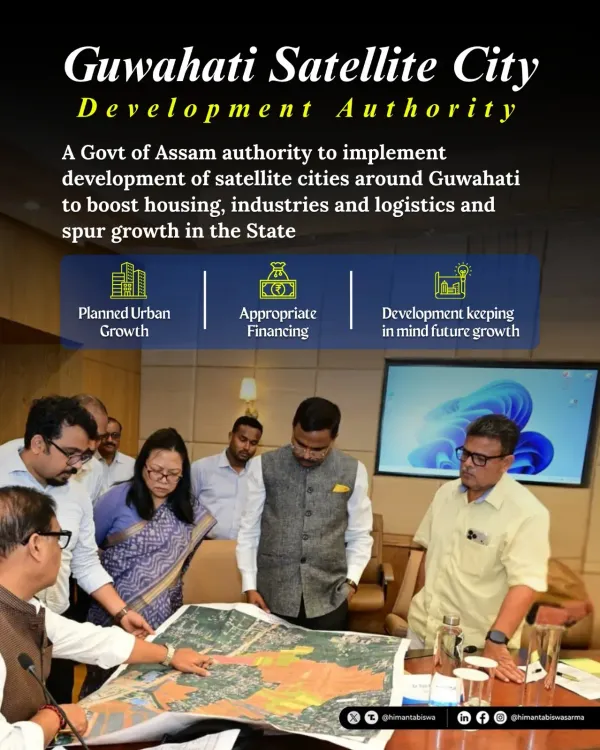
Assam Chief Minister Himanta Biswa Sarma has announced a satellite-city network around Guwahati to decongest the capital, with the Guwahati Smart City Development Authority tasked to plan, design and finance the new urban hubs under the Smart Cities Mission framework.
Key Takeaways
CM Himanta Biswa Sarma announced on 9 July 2026 that satellite cities will form the next phase of Guwahati's urbanisation.
The Guwahati Smart City Development Authority (GSCDA) has been assigned full responsibility to plan, design and finance the new urban hubs.
The stated goals are to decongest Guwahati and improve ease of living for residents.
Guwahati was selected under the Centre's Smart Cities Mission launched in 2015 , which provides the SPV framework the GSCDA operates within.
The satellite-city model mirrors approaches used around Delhi , Mumbai and Bengaluru to manage metropolitan population pressure.
Detailed master plans and land acquisition notifications from the GSCDA are the key milestones to watch next.
Assam Chief Minister Himanta Biswa Sarma on Thursday, 9 July 2026 announced that the next phase of Guwahati's urbanisation will take the form of a network of satellite cities, with the Guwahati Smart City Development Authority (GSCDA) mandated to plan, design and finance these new urban hubs to ease pressure on the state capital.
Context
Guwahati, the largest city in Assam and the commercial gateway to India's Northeast, has faced mounting population pressure and infrastructure stress as migration from surrounding districts and states has accelerated over the past decade. The Chief Minister's announcement signals a deliberate shift from piecemeal city upgrades to a structured, multi-node urban growth model designed to 'decongest the capital and improve the ease of living,' as Sarma stated in his post.
The satellite-city approach mirrors strategies adopted around Delhi, Mumbai and Bengaluru, where planned townships on the periphery have been used to absorb overflow population and distribute economic activity more evenly across a metropolitan region.
Policy Backdrop
Guwahati was selected under the Centre's Smart Cities Mission, launched in June 2015, which identified 100 cities for integrated redevelopment through Special Purpose Vehicles (SPVs) combining central and state funding. The GSCDA operates within this SPV framework, giving it independent capacity to raise finances and execute projects without routing every decision through conventional municipal bodies.
A complementary programme, the Atal Mission for Rejuvenation and Urban Transformation (AMRUT), has simultaneously channelled funds into water supply, sewerage and urban mobility upgrades across Assam, laying the utility infrastructure that satellite townships would depend on. Together, the two missions have built the institutional and financial scaffolding that makes a satellite-city push feasible at this stage.
Sarma, who has held the Chief Ministership since May 2021 and serves as convenor of the North-East Democratic Alliance (NEDA), has consistently positioned urban infrastructure as a pillar of Assam's economic growth agenda, aligning state priorities with the broader national urbanisation push.
Stakeholders and Impact
Guwahati residents stand to benefit most directly: a decongested core city would mean reduced traffic pressure, shorter commutes and more manageable demand on civic services such as water, sanitation and solid-waste management. Urban local bodies across the metropolitan fringe would gain new administrative and revenue responsibilities as satellite hubs develop.
Real-estate developers and infrastructure contractors are likely to watch the GSCDA's upcoming master plans closely, as satellite-city projects of this scale typically generate significant demand for housing, commercial space and logistics infrastructure. The announcement also carries implications for land use in peri-urban Assam, where agricultural and forest land transitions to urban zones have historically required careful regulatory management.
What's Next
The immediate next steps will centre on the GSCDA releasing detailed master plans and initiating land acquisition notifications for the proposed satellite zones. Analysts will watch whether these plans are integrated into forthcoming Assam state budget allocations or tied to extensions of central scheme funding beyond current mission timelines.
The scale and pace of execution will ultimately depend on how quickly the Authority can mobilise financing — a task the SPV model was specifically designed to enable — and on the Centre's posture toward continued Smart Cities Mission support in the Northeast. If master plans are unveiled on schedule, Guwahati's satellite network could become a template for planned urbanisation across other fast-growing Northeast capitals.
Point of View
Moving beyond incremental Smart Cities Mission upgrades toward a structural reimagining of the Guwahati metropolitan region. By vesting planning, design and financing authority in the GSCDA rather than conventional municipal bodies, the state is betting on the SPV model's agility to deliver at scale — a model that has had mixed results nationally but remains the Centre's preferred instrument. For CM Sarma, the move reinforces his identity as a development-oriented administrator in the Northeast, where urban infrastructure has historically lagged behind western India. The real test will be land acquisition and inter-agency coordination, the two variables that have most often delayed comparable satellite-township projects elsewhere in the country.
NationPress
8 Oct 2026
Frequently Asked Questions
What are the proposed satellite cities around Guwahati?
Specific locations and boundaries of the satellite cities have not yet been announced; CM Himanta Biswa Sarma stated on 9 July 2026 that the Guwahati Smart City Development Authority will plan and design the new urban hubs, with details expected in forthcoming master plans.
What is the Guwahati Smart City Development Authority?
The Guwahati Smart City Development Authority (GSCDA) is a state-level Special Purpose Vehicle set up under the Centre's Smart Cities Mission to plan, finance and execute integrated urban development projects in Guwahati.
Why does Guwahati need satellite cities?
Guwahati has faced rapid population growth and infrastructure stress as the Northeast's commercial hub, leading to congestion in the core city; satellite cities are intended to distribute population and economic activity across a wider metropolitan area.
What is India's Smart Cities Mission and how does it apply to Guwahati?
The Smart Cities Mission, launched by the central government in June 2015, selected 100 cities including Guwahati for area-based redevelopment and technology integration, providing funding and an SPV governance model that the GSCDA operates under.
When will Guwahati's satellite cities be built?
No timeline has been officially announced yet; the next steps involve the GSCDA releasing master plans and land acquisition notifications, after which construction schedules and budget allocations are expected to be formalised.