Is the Bangladeshi Government Threatening Press Freedom with Journalists' Arrests?

Synopsis
In a bold statement, an international human rights body decries the arrest of Bangladeshi journalist Anis Alamgir, accusing the Yunus-led government of authoritarianism. This incident raises critical questions about press freedom in Bangladesh at a time when global scrutiny is high.
Key Takeaways
The arrest of Anis Alamgir highlights severe issues surrounding press freedom in Bangladesh.
International rights organizations are calling attention to the authoritarian practices of the Yunus-led government.
Legal harassment of journalists undermines both national and international human rights standards.
There is a need for immediate global action to uphold freedom of expression.
The government's dual approach of projecting a positive image abroad while suppressing dissent domestically raises questions about its integrity.
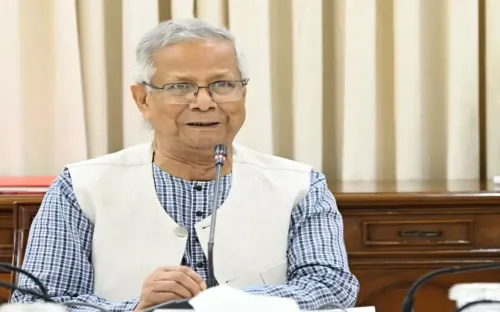
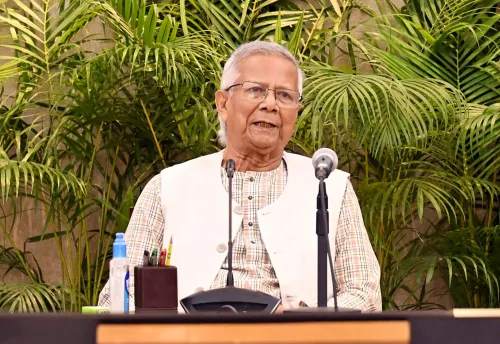
Paris, Dec 16 (NationPress) A prominent international human rights organization has vehemently criticized the interim government led by Muhammad Yunus for pursuing an authoritarian and fascistic approach in Bangladesh, alleging that it is actively undermining freedom of expression instead of safeguarding it.
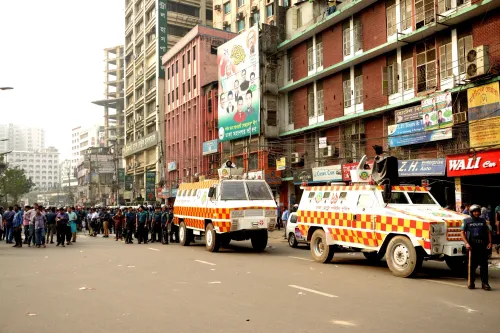
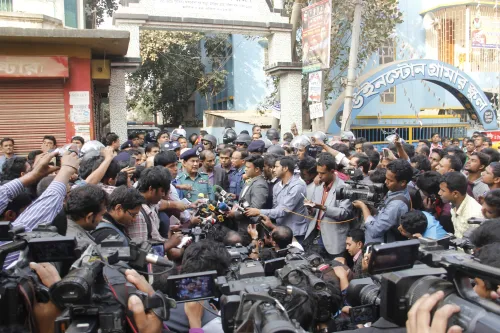
This condemnation follows the reported detention of senior Bangladeshi journalist Anis Alamgir, who was apprehended by the Detective Branch (DB) of the Dhaka Metropolitan Police (DMP) without formal charges and later arrested on Monday under the country’s Anti-Terrorism Act.
In its official statement, Justice Makers Bangladesh in France (JMBF) asserted that the arrest of Alamgir, executed under the draconian Anti-Terrorism Act for merely criticizing the Yunus-led government’s violations of human rights, highlights the administration's complete failure to depart from its oppressive authoritarian mentality, abandoning its commitment to uphold freedom of expression.
JMBF stated, "The pattern of arrests without warrants, the transformation of accusations into formal criminal charges, and the subsequent remanding of individuals illustrate a calculated effort to intimidate and silence independent journalism and dissenting opinions."
Furthermore, they noted, "This constitutes a direct infringement of the freedom of expression as enshrined in the Constitution of Bangladesh and recognized by international human rights frameworks, including the Universal Declaration of Human Rights and specifically the International Covenant on Civil and Political Rights (ICCPR)."
In a statement condemning the situation, French human rights advocate and JMBF Chief Advisor Robert Simon remarked, "Targeted assaults against journalists and human rights advocates in Bangladesh signal a systematic decline of essential freedoms."
He added, "Suppressing critical voices through intimidation, arbitrary detentions, and legal harassment is fundamentally opposed to democratic ideals and international human rights standards. The global community must take decisive and effective measures to ensure accountability and uphold freedom of expression."
The rights organization accused the interim administration of attempting to project a misleadingly positive image abroad through limited reforms and the signing of various international human rights agreements while simultaneously tightening its grip domestically by stifling journalists, human rights advocates, lawyers, opposition leaders, activists, and supporters—an approach that showcases its hypocrisy.
JMBF has called for the immediate and unconditional release of journalist Alamgir, without any stipulations or limitations, and the prompt dismissal of the politically motivated charges filed against him under the Anti-Terrorism Act.
They urged the Yunus-led interim government to halt the abuse of oppressive laws and law enforcement agencies to silence journalists and to provide credible, written guarantees for the effective and practical protection of freedom of expression and press freedom.
Point of View
Our commitment to uphold the principles of democracy and freedom of expression remains steadfast. The arrest of Anis Alamgir is not just a matter of one journalist's fate, but a reflection of the broader challenges facing press freedom in Bangladesh. We must advocate for the protection of journalists and ensure that dissent is not silenced by oppressive measures.
NationPress
19 Sept 2026
Frequently Asked Questions
What led to Anis Alamgir's arrest?
Anis Alamgir was arrested without formal charges under Bangladesh's Anti-Terrorism Act, reportedly for criticizing the government's actions.
What does the Justice Makers Bangladesh organization say about the arrest?
Justice Makers Bangladesh condemns the arrest, labeling it as a sign of the government's authoritarian tendencies and a violation of free speech.
What international human rights documents are being referenced?
The incident is said to violate the Constitution of Bangladesh and international instruments like the Universal Declaration of Human Rights and the ICCPR.
What has been the global response?
Global human rights advocates are calling for accountability and an immediate end to the suppression of press freedom by the Bangladeshi government.
What are the implications for press freedom in Bangladesh?
The arrest indicates a worrying trend of stifling dissent and could deter journalists from reporting critically on government actions.