Is Bangladesh Experiencing a Surge in Islamist Mobilisation?
Synopsis
As Bangladesh grapples with a resurgence of Tawhidi Janata, a loosely defined Islamist mobilisation, the nation faces increasing challenges to political legitimacy and law enforcement. This report sheds light on the moral populism that flourishes in the wake of institutional failure, raising critical concerns about the future of governance.
Key Takeaways
Tawhidi Janata represents a shift in moral activism within Bangladesh.
The movement thrives in the absence of strong institutions.
Public unrest is evident through recent violent incidents.
Political legitimacy is being questioned following the ousting of Sheikh Hasina.
The future hinges on reclaiming authority through democratic means.
Canberra, Jan 17 (NationPress) The resurgence of Tawhidi Janata — a loosely defined Islamist mobilisation in Bangladesh — is characterized not by structured militancy but by a morally charged brand of coercive populism that thrives in environments where institutions weaken, law enforcement deteriorates, and doubts about political legitimacy surface, according to a report.
The report further notes that by operating publicly and framing the targeting of un-Islamic values as a religious duty, this mobilisation can circumvent immediate suppression while redefining public discourse.
As detailed in an article from the Australian outlet The Interpreter, for almost 16 years, the Awami League government, led by Sheikh Hasina, has combined elections, a robust security framework, and an officially endorsed secular Bengali nationalism, while either suppressing, co-opting, or fragmenting Islamist factions and religious networks.
“While public religiosity was accepted, political Islam that fell outside government control faced strict regulation. This may have limited overt conflicts, but it did not obliterate religious politics; instead, it forced it into informal, depoliticized arenas. The political vacuum that emerged in August 2024 following Hasina’s removal highlighted a crisis of moral authority,” the report indicated.
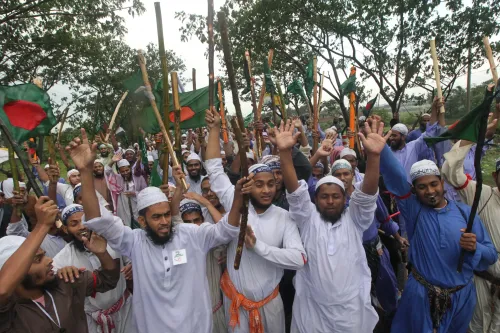
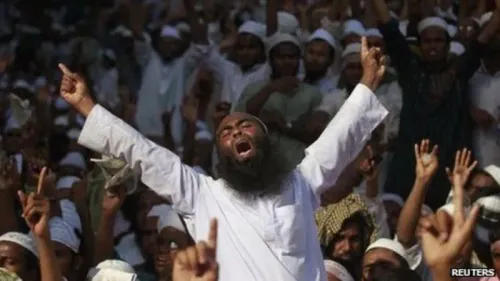
In the aftermath of Hasina’s ousting, Tawhidi Janata surfaced, appealing to religious obligations to impact societal norms.
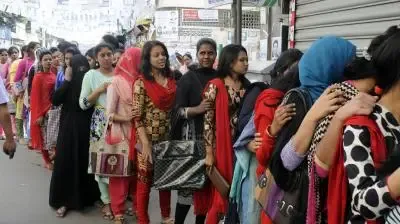
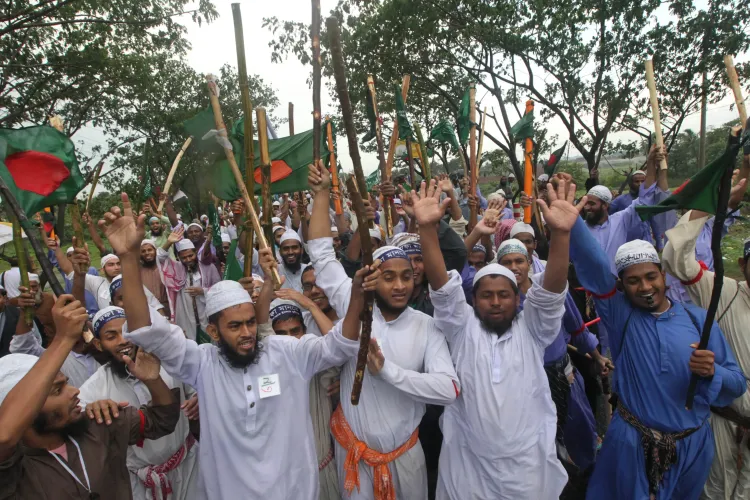
“It is not a formal group but rather a designation under which various entities unite, intervening in public affairs, regulating behavior, disrupting cultural practices, and targeting events focused on women. Its influence stems from its ambiguity: lacking leadership or structured organization, it operates through crowds, symbolism, and moral pressure rather than institutional presence,” it elaborated.
The report pointed out that alleged affiliates of Tawhidi Janata have engaged in acts of violence throughout Bangladesh.
“In September 2025, a mob clashed with law enforcement in Rajbari, attacking a shrine and exhuming and incinerating a corpse, resulting in one death and multiple injuries. In Dhaka, a crowd besieged a police station, demanding the release of a man arrested for harassing a woman over her 'inappropriate' attire, all while live-streaming the incident,” it detailed.
“These incidents signify a transition from hidden to overt moral activism. There is a strong emphasis on visibility — taking to the streets, intimidating institutions, and challenging state boundaries. Economic hardship and diminishing trust in the political system exacerbate these occurrences, particularly among the youth,” it further noted.
Asserting that the rise of Tawhidi Janata acts as a cautionary tale for Bangladesh’s evolving political landscape, the report concluded, “The dilemma is no longer solely electoral or constitutional; it is whether authority will be reasserted through law and democratic legitimacy or surrendered to those claiming moral superiority through popular support.”
Point of View
It is crucial for us to understand the delicate balance of power in Bangladesh. The emergence of Tawhidi Janata signifies a complex interplay of political legitimacy, religious influence, and public sentiment. Our commitment remains with the nation, advocating for dialogue and democratic processes that respect all voices while ensuring stability.
NationPress
23 Sept 2026
Frequently Asked Questions
What is Tawhidi Janata?
Tawhidi Janata is a loosely defined Islamist mobilisation in Bangladesh that focuses on moral populism rather than organized militancy.
What factors contribute to Tawhidi Janata's rise?
The rise of Tawhidi Janata is fueled by weakened institutions, declining law enforcement, and growing questions about political legitimacy.
How has the Awami League government responded to Islamist parties?
The Awami League government has suppressed, co-opted, or fragmented Islamist parties while promoting state-endorsed secularism.
What recent incidents are associated with Tawhidi Janata?
Recent incidents include violent clashes with police and public disruptions targeting cultural events and women.
What does the future hold for Bangladesh amidst this mobilization?
The future of Bangladesh will depend on whether authority is reclaimed through law and democratic legitimacy or surrendered to those claiming moral superiority.