Is the Vision of Prosperity from the Somnath Resolution Becoming a Reality Under Modi's Leadership?
Synopsis
The BJP draws parallels between India's economic growth and the historical reconstruction of the Somnath temple, asserting that the vision of prosperity from its consecration is nearing fulfillment under Modi's leadership. As the 1000-year anniversary approaches, the temple's restoration symbolizes India's resilience and cultural strength.
Key Takeaways
The BJP connects India's economic rise to the historical restoration of the Somnath temple.
The 2026 anniversary will mark 1000 years since the temple's first attack.
Rajendra Prasad's vision of prosperity is echoed in the current government's policies.
Sardar Patel played a pivotal role in the temple's reconstruction after independence.
The temple symbolizes India's cultural resilience and national pride.
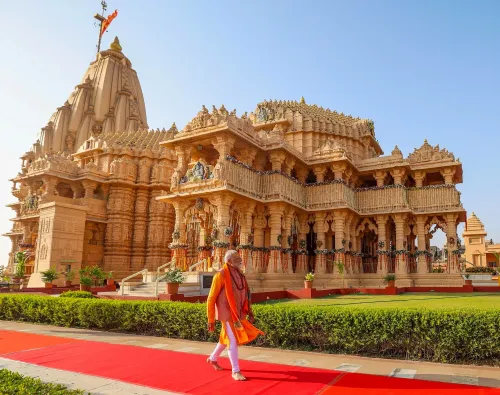
New Delhi, Jan 5 (NationPress) The Bharatiya Janata Party (BJP) highlighted a connection between India’s economic advancement under Prime Minister Narendra Modi and the momentous reconstruction of the Somnath temple, claiming that the vision of prosperity defined during the temple's consecration is now approaching realization during the current administration's period.
In 2026, we commemorate 1,000 years since the initial major assault on the Somnath temple in 1026. This event symbolizes the temple's unwavering spirit and India's cultural fortitude, showcasing how the shrine has been rebuilt multiple times after enduring invasions through the ages.
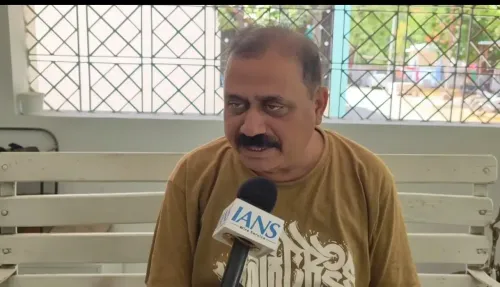
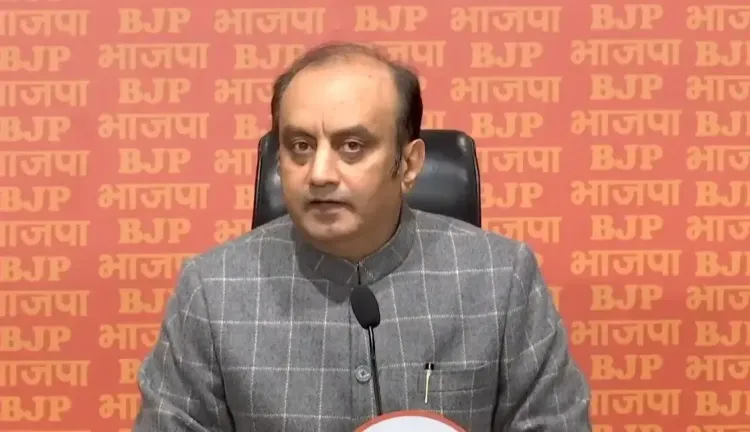
At a press conference at the BJP headquarters in New Delhi, national spokesperson Sudhanshu Trivedi reflected on the remarks made during the temple’s restoration.
“I want to remind everyone that during the Somnath reconstruction, India's first President, Dr. Rajendra Prasad, remarked that the true completion of Somnath's consecration would occur when its prosperity is restored to the level that initially attracted the attack,” Trivedi stated.
He contended that India is currently making significant strides towards that prosperity benchmark under Prime Minister Modi. Trivedi noted that the nation’s rise as the world’s fourth-largest economy reflects the realization of that long-cherished dream.
The BJP spokesperson also brought attention to the historical backdrop of the temple's renovation in 1951, asserting that it occurred despite the hesitations voiced by then Prime Minister Jawaharlal Nehru.
“Looking back across the centuries, we see that in 1951, in spite of Nehru's objections, this aspiration came to fruition in the presence of inaugural President Dr. Rajendra Prasad,” he added.
“Now, under the leadership of Prime Minister Modi, India is on a path toward prosperity, and that aspiration is nearing its achievement. The vision expressed in the Somnath resolution is close to becoming a reality,” he concluded.
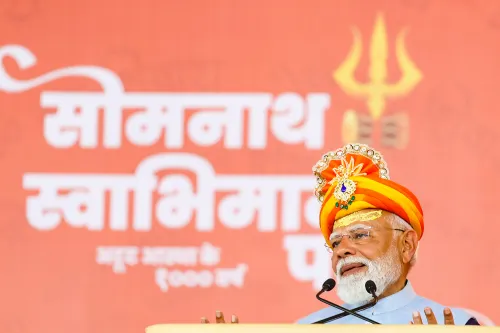
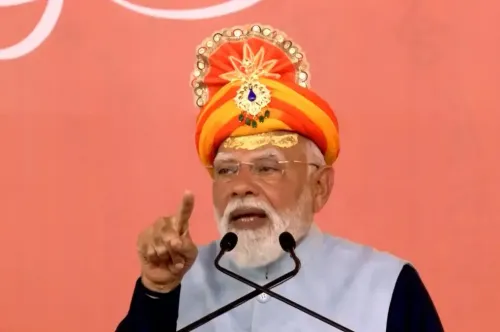
Earlier, PM Modi also reflected on the time when Pandit Nehru was not in favor of the reconstruction of the Somnath Temple and opposed the involvement of top constitutional authorities in what he deemed a secular nation.
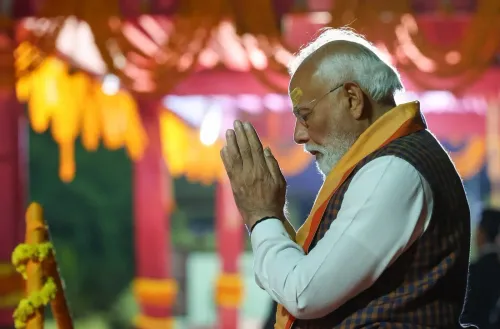
In a blog entry, the Prime Minister pointed out that the sacred task of restoring the Somnath Temple, which was attacked by invaders in 1026, was entrusted to Sardar Vallabhbhai Patel after India gained independence.
He recounted how Sardar Patel's visit to the site during Diwali in 1947 moved him deeply, leading to the decision to rebuild the temple at the same site.
“On May 11, 1951, a magnificent Somnath Temple was inaugurated for worshippers in the presence of Dr. Rajendra Prasad,” he stated.
“The esteemed Sardar Sahib wasn’t alive to witness this momentous day, but the realization of his dream stood proudly before the nation. The then Prime Minister, Pandit Jawaharlal Nehru, was not particularly pleased with this development. He expressed concerns over the involvement of the Honourable President and Ministers in this significant event, suggesting it would create a negative perception of India. However, Dr. Rajendra Prasad remained resolute, and the rest is history,” PM Modi wrote in his blog.
Despite Nehru's dissent, Sardar Patel, K.M. Munshi (who spearheaded the construction efforts), and President Rajendra Prasad were staunch supporters of the temple's revival as a national symbol. The temple was ultimately reconstructed using funds sourced from public donations rather than government financing.
Pointing out that 2026 marks the millennium since the Somnath Temple was first attacked by invaders in January 1026, PM Modi emphasized how the temple stands as an eternal testament to the Indian spirit, asserting that while hatred and fanaticism may destroy temporarily, faith and conviction in the power of goodness can create lasting legacies.
Point of View
The BJP's assertion connecting India's economic growth with the Somnath temple's history evokes a strong sense of cultural pride. While the political undertones are evident, the narrative serves to reinforce national identity and resilience amidst historical challenges. Such connections can foster unity and inspire collective aspirations for a prosperous future.
NationPress
14 Sept 2026
Frequently Asked Questions
What significance does the Somnath temple hold in India's history?
The Somnath temple represents India's cultural resilience and has been rebuilt multiple times after invasions, symbolizing the nation's enduring spirit.
How does the BJP link India's economic progress to the Somnath temple?
The BJP sees the temple's reconstruction as a metaphor for India's current economic growth under Prime Minister Modi, suggesting that the vision of prosperity articulated during the temple's consecration is now being fulfilled.
What was the response of Jawaharlal Nehru regarding the temple's reconstruction?
Jawaharlal Nehru expressed reservations about involving top officials in the temple's reconstruction, viewing it as potentially compromising the secular nature of the nation.
Who played a key role in the Somnath temple's reconstruction?
Sardar Vallabhbhai Patel was instrumental in the decision to rebuild the temple post-independence, alongside efforts led by K.M. Munshi and support from President Dr. Rajendra Prasad.
What does the upcoming 2026 anniversary signify?
The year 2026 marks 1000 years since the Somnath temple was first attacked, serving as a reminder of India’s historical challenges and cultural resilience.