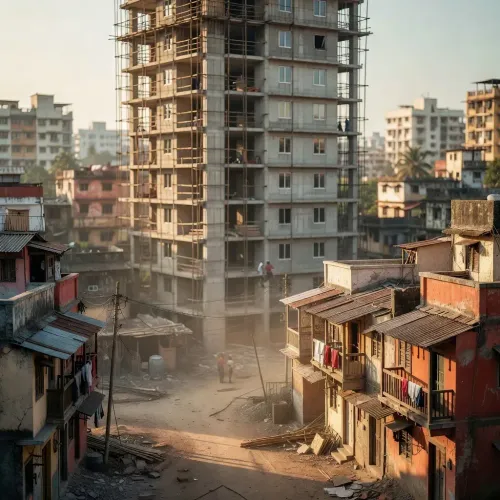
BMC orders demolition of Dawood Ibrahim's ancestral property in Mumbai

Synopsis
The BMC's 48-hour demolition order on the Musafirkhana building in Bhendi Bazaar — identified as Dawood Ibrahim's ancestral property — has collided with contested High Court stay orders, a live Waqf Tribunal hearing, and community protests inside the mosque. What looks like a civic clearance drive is fast becoming a flashpoint at the junction of terror asset seizures, religious property law, and street-level law-and-order risk.
Key Takeaways
The BMC has ordered demolition of the Musafirkhana building in Bhendi Bazaar, Mumbai , scheduled for 18–19 November .
The building is identified as the ancestral property of fugitive underworld figure Dawood Ibrahim .
Congress MLA Amin Patel says Bombay High Court stay orders from 2024 and 2025 are still in effect, rendering the demolition legally contested.
Ownership of the property is disputed — gazetted documents from 1944 and BMC records from 1991 reportedly describe it as a Waqf / mosque property; a hearing at the Waqf Tribunal is ongoing.
Patel warned of a law-and-order breakdown, noting that community members had already begun occupying the mosque in protest.
The Brihanmumbai Municipal Corporation (BMC) has issued a demolition order for the dilapidated Musafirkhana building in Bhendi Bazaar, Mumbai, widely identified as the ancestral property of fugitive underworld figure Dawood Ibrahim. The demolition is scheduled to be carried out on 18–19 November under heavy police protection, according to officials.
Opposition and Legal Objections
Congress MLA Amin Patel has strongly opposed the move, citing a series of court orders he claims place a stay on any demolition. Patel pointed to rulings from 2024 and 2025 in which the Bombay High Court reportedly granted a stay on earlier demolition notices, superseding a 2020 High Court order that the BMC is said to be relying upon.
'Citing a 2020 High Court order, the BMC put up a notice there stating that they want to carry out a demolition based on that order. I have orders showing that in 2024 and 2025, the Honourable High Court granted a stay on this demolition. Our lawyer says — and we have the order — that a stay is in place on this,' Patel said.
Waqf Board Ownership Dispute
A parallel dispute over the property's ownership is currently being adjudicated at the Waqf Tribunal. Patel contends that gazetted papers from 1944 designate the building as Waqf property, and that BMC documents from 1991 themselves describe it as a mosque. He further alleged that the Supreme Court had directed that if the property is dilapidated, it should be repaired by the Waqf Board — not demolished.
'It is for the Waqf and courts to decide. However, I have documents, gazetted papers from 1944, according to which this is a Waqf property. BMC documents from 1991 state that it is a mosque,' Patel said.
Law-and-Order Warning
Patel warned that the BMC would bear responsibility for any breakdown in law and order, noting that members of the Muslim community had already spent the night inside the mosque in protest. 'People are not going to leave the mosque — they will lay down their lives for their mosque,' he said, adding that the BMC should answer for what he called the 'mala fide intention' of the officer behind the order.
Patel also questioned why the BMC was allegedly bypassing orders from Justice Gavai, the state government, and the Mumbai Municipal Corporation (MMC) Act, calling for a probe into the circumstances of the demolition drive.
Background and Significance
The Musafirkhana building has long been at the intersection of criminal history, religious ownership claims, and civic administration. Dawood Ibrahim, designated a global terrorist and listed on India's most-wanted list for his alleged role in the 1993 Mumbai serial blasts, is believed to be in Pakistan — a charge Islamabad consistently denies. Any action linked to his assets in India carries significant political weight, particularly in the context of ongoing demands by Indian agencies to seize his properties.
With the Waqf Tribunal hearing still pending and contested court stay orders in play, the BMC's decision to press ahead with a 48-hour demolition window is set to face immediate legal challenge. The situation will be closely watched by both security agencies and community groups in the days ahead.
Point of View
The legal scaffolding appears shaky. The Congress objection isn't merely partisan noise: if the High Court stays from 2024 and 2025 are indeed on record, the demolition could be stayed within hours by any competent court, turning a high-profile action into an embarrassment. More broadly, the Waqf ownership question is unresolved, and bulldozing before that is settled sets a precedent that will be cited in every future Waqf property dispute in Maharashtra.
NationPress
18 Nov 2026
Frequently Asked Questions
What is the Musafirkhana building in Mumbai?
The Musafirkhana building is a dilapidated structure in the Bhendi Bazaar area of Mumbai, identified as the ancestral property of fugitive underworld figure Dawood Ibrahim. It is also at the centre of a legal dispute over whether it qualifies as Waqf property, with gazetted records from 1944 and BMC documents from 1991 reportedly describing it as such.
Why is the BMC demolishing Dawood Ibrahim's property?
The BMC has cited a 2020 Bombay High Court order and the building's dilapidated condition as grounds for the demolition, which is scheduled for 18–19 November under heavy police protection. The civic body has not publicly addressed the more recent 2024 and 2025 stay orders cited by Congress MLA Amin Patel.
Is there a court stay on the demolition?
Congress MLA Amin Patel claims that the Bombay High Court granted stay orders on the demolition in both 2024 and 2025, which he says supersede the 2020 order the BMC is relying upon. He also contends that the Supreme Court directed that any dilapidated Waqf property should be repaired by the Waqf Board, not demolished.
Who is opposing the demolition and why?
Congress MLA Amin Patel has formally opposed the demolition, citing contested court stays, an unresolved Waqf ownership hearing, and the risk of communal tension. Members of the Muslim community have reportedly spent the night inside the mosque to prevent the demolition from going ahead.
What happens next in the Musafirkhana case?
The Waqf Tribunal is currently hearing arguments over whether the property belongs to the Waqf Board, and that verdict has not yet been delivered. Legal challenges invoking the High Court stay orders are expected to be filed immediately, potentially pausing the BMC's 48-hour demolition schedule.