CJP protests and the global agitation template: From NEET to national upheaval
Synopsis
India's CJP protest — sparked by the NEET paper leak — forced a Union minister's resignation and drew comparisons to a recognisable global agitation playbook seen from Serbia's Otpor to Bangladesh's quota protests. The central question is not whether the grievances were real, but how they were transformed so rapidly into a movement capable of shaking the state.
Key Takeaways
The CJP protest over the NEET paper leak , unemployment, and corruption escalated into a nationwide agitation within weeks.
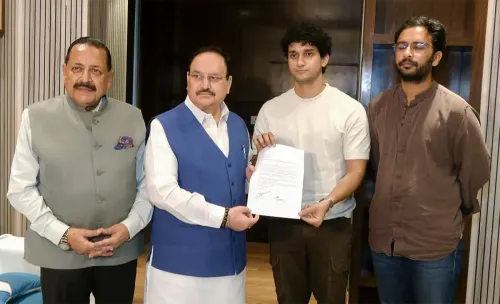
Union Education Minister Dharmendra Pradhan resigned as the movement intensified.
Abhijit Dipke , the CJP founder, coordinated the campaign while studying in the United States before returning to India.
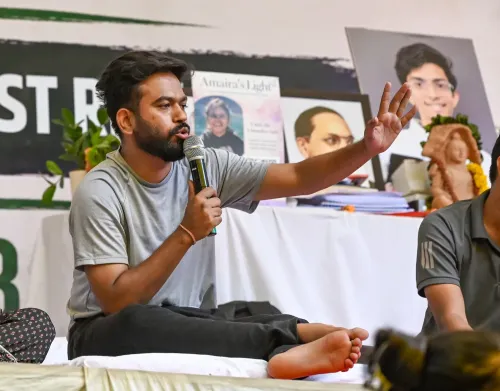
Activist Sonam Wangchuk's prolonged hunger strike boosted the movement's national visibility.
Analysts have drawn parallels with protest movements in Bangladesh , Sri Lanka , Nepal , Serbia , and Kenya between 2024 and 2026 .
Allegations of foreign financial support for the CJP agitation remain unproven ; the core debate centres on how legitimate grievances are amplified into sustained political movements.
The Cockroach Janta Party (CJP) protests in New Delhi — initially centred on the NEET paper leak, unemployment, and corruption — escalated within weeks into a nationwide political agitation, ultimately forcing the resignation of Union Education Minister Dharmendra Pradhan. Analysts are now examining whether the movement's trajectory mirrors a recognisable global template for protest mobilisation.
From Examination Outrage to National Agitation
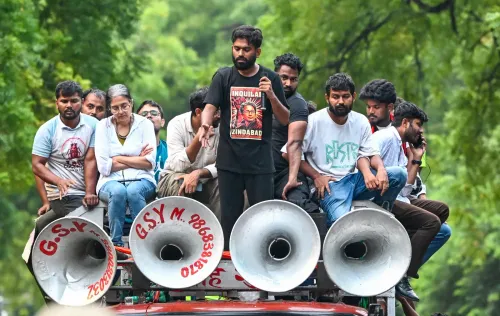
What began as targeted public anger over the NEET examination paper leak rapidly broadened into a sweeping political challenge. The CJP, led by founder Abhijit Dipke — who coordinated the campaign while studying in the United States before returning to India — amassed a massive social media following within days. The participation of activist Sonam Wangchuk, through a prolonged hunger strike, lent the movement greater national visibility and momentum.
As protests intensified, allegations surfaced in sections of the media that the agitation was receiving financial support from abroad. Those allegations remain unproven, but some observers have noted similarities with patterns seen in comparable movements elsewhere.
A Recognisable Global Pattern
Between 2024 and 2026, protest movements destabilised or toppled governments across at least three continents, including in Bangladesh, Kenya, and Serbia. Similar upheavals were witnessed in Indonesia, Madagascar, Morocco, Nepal, Peru, the Philippines, and Timor-Leste during the same period.
Analysts argue that these movements share defining characteristics: the absence of established political parties in the initial stages, politically unaffiliated and tech-savvy individuals emerging as public faces, and the strategic use of social media platforms alongside high-visibility public spaces. Although many present themselves as decentralised and leaderless, critics argue their messaging, logistics, and digital mobilisation frequently exhibit a level of coordination that has drawn scrutiny from governments and security agencies.
Historical Roots: From Serbia to the Arab Spring
The origins of this protest model are commonly traced to Eastern Europe in the early 2000s. Serbia's Otpor movement played a pivotal role in the ouster of Slobodan Milošević in 2000, and later became the subject of debate after reports that its activists had received training and organisational support from Western democracy-promotion organisations.
Ukraine's Orange Revolution of 2004 followed a comparable arc. American organisations including Freedom House, the National Democratic Institute (NDI), and the International Republican Institute (IRI) were closely associated with election monitoring, civic training, and institutional capacity-building in countries undergoing political transition. Supporters of these programmes maintain they strengthen democratic institutions; critics argue they are a mechanism for shaping political outcomes in strategically important countries.
During the Arab Spring, groups such as Egypt's April 6 Youth Movement and the Bahrain Centre for Human Rights reportedly participated in training programmes organised by international organisations claiming to promote democracy. Diplomatic cables released by WikiLeaks indicated that activists had established contact with such organisations years before the uprisings. American officials maintained the movements were driven primarily by domestic discontent, while acknowledging that training and assistance for civic participation had been provided.
Bangladesh, Sri Lanka, and Nepal: Recent Precedents
In Bangladesh, student protests centred on quota reforms escalated into a nationwide movement that led to the ouster of then Prime Minister Sheikh Hasina, despite judicial intervention. Hasina alleged foreign involvement in her removal. It was subsequently reported that organisations including USAID, NED, ITI, and NDI had, over many years, implemented programmes to strengthen democratic participation and civil society in the country.
In Sri Lanka in 2022, a protest movement fuelled by economic collapse led to the departure of then President Gotabaya Rajapaksa. Rajapaksa later wrote that the protest site at Galle Face was well supplied with food, tents, sanitation, and logistical support despite the country's severe economic distress — an account that has been contested, though questions about protest financing have persisted.
In Nepal, a movement that originated from social media reports escalated rapidly into unrest that resulted in the resignation of Prime Minister K P Oli within days, illustrating how online platforms can accelerate political outcomes in ways that traditional institutions struggle to anticipate.
The Central Question
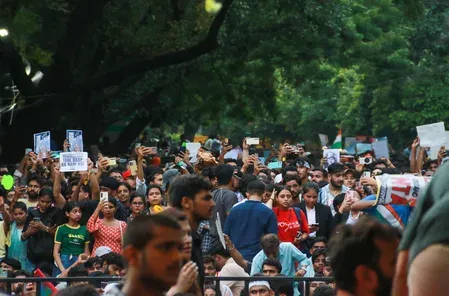
As law enforcement agencies appeared to underestimate the scale of the CJP mobilisation — with protesters marching towards Parliament and plunging the national capital into chaos — the core debate has sharpened. The issue, analysts note, is not whether the underlying grievances were legitimate: the NEET paper leak triggered genuine and widespread outrage. The more significant question, according to observers, is how legitimate grievances are transformed into sustained movements capable of destabilising governments.
As one framing has it, external actors cannot manufacture public discontent where none exists — but they can, in certain circumstances, amplify existing grievances and accelerate mobilisation. Whether that dynamic was at play in the CJP agitation remains a matter of active scrutiny and unresolved debate. How that question is answered will shape both the government's response and the movement's longer-term legacy.
Point of View
Unemployment crisis, and anti-corruption expectations are homegrown pressure points. The speed of mobilisation is new; the underlying anger is not.
NationPress
28 Oct 2026
Frequently Asked Questions
What triggered the CJP protest in India?
The CJP protest was initially triggered by the NEET examination paper leak, along with widespread anger over unemployment and corruption. Within weeks, the agitation expanded beyond these specific grievances into a broader nationwide political movement that led to the resignation of Union Education Minister Dharmendra Pradhan.
Who is Abhijit Dipke and what is his role in the CJP protest?
Abhijit Dipke is the founder of the Cockroach Janta Party (CJP) and coordinated the protest campaign while studying in the United States. He returned to India, and within days the movement had amassed a large social media following, becoming a defining feature of the agitation's rapid growth.
What is the 'global protest template' that analysts are referring to?
The global protest template refers to a pattern observed in movements across Eastern Europe, the Arab Spring, and more recently in Bangladesh, Sri Lanka, Nepal, and Kenya, where protests begin around legitimate grievances, are amplified through social media, and rapidly escalate into political movements capable of toppling governments. Between 2024 and 2026, such uprisings destabilised governments across at least three continents.
Did foreign organisations fund or support the CJP protest?
Allegations of foreign financial support for the CJP agitation emerged in sections of the media but remain unproven. Some observers have noted similarities with protest movements elsewhere that were later found to have received support from international democracy-promotion organisations, but no verified evidence of such support has been established in the CJP case.
What happened in Bangladesh and Nepal that is being compared to the CJP protests?
In Bangladesh, student protests over quota reforms escalated into a nationwide movement that ousted then Prime Minister Sheikh Hasina, despite judicial intervention. In Nepal, a movement originating from social media reports led to the resignation of Prime Minister K P Oli within days. Both cases are cited as recent examples of the global protest template that analysts are now applying to the CJP agitation in India.