Congress defends two-stanza Vande Mataram practice, cites Gandhi, Netaji, Tagore
Synopsis
The Vande Mataram row cuts deeper than a song — it is a battle over who owns India's freedom movement legacy. Congress is leaning on an 87-year-old CWC resolution and the names of Gandhi, Netaji, and Tagore to hold its ground, while the BJP's push for a full rendition in official protocol turns a historical organisational decision into a live political fault line.
Key Takeaways
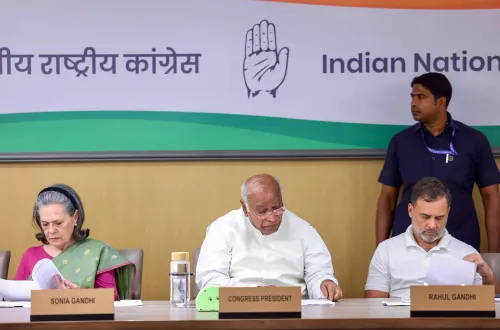
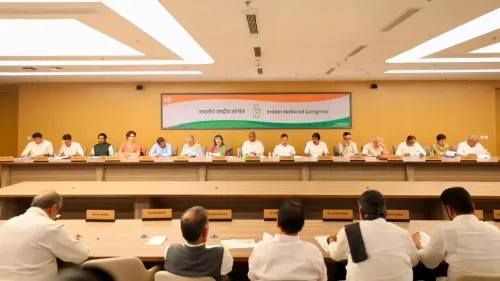
The Congress Working Committee (CWC) on Wednesday, 19 August resolved to uphold its practice of singing only the first two stanzas of Vande Mataram at party events.
The practice traces to a 1937 CWC resolution passed at the Kolkata session , backed by Mahatma Gandhi , Pandit Jawaharlal Nehru , and Rabindranath Tagore .
Congress MP Jebi Mather said the decision 'will continue forever'; spokesperson Surendra Rajput alleged Jan Sangh and RSS members informed British authorities about freedom fighters who sang the song.
The INDIA bloc , including RSP MP N.K.
Premachandran , backed the Congress position, calling the national song a tool for unity, not division.
The BJP has accused Congress of disrespecting the national song; the Centre has recently made the complete rendition of Vande Mataram part of official protocol.
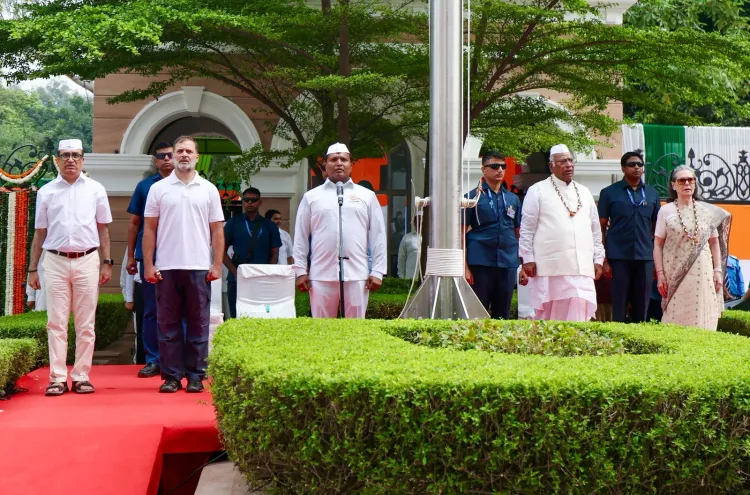
The Indian National Congress on Thursday, 20 August firmly defended its decades-old practice of singing only the first two stanzas of Vande Mataram at party events, invoking the authority of Mahatma Gandhi, Netaji Subhas Chandra Bose, and Rabindranath Tagore to counter mounting criticism from the Bharatiya Janata Party (BJP). The defence came a day after the Congress Working Committee (CWC) formally resolved to uphold a tradition rooted in a 1937 CWC resolution, even as the Centre has recently made the complete rendition of the national song part of official protocol.
The 1937 Decision at the Centre of the Row
Congress leaders stressed that the party's position on Vande Mataram is not a contemporary political stance but an organisational decision taken during the freedom struggle itself. Congress MP Jebi Mather traced the practice to the 1937 Kolkata session, where leaders including Mahatma Gandhi, Pandit Jawaharlal Nehru, and Rabindranath Tagore deliberated on the matter before the CWC passed a resolution to sing only the first two stanzas at Congress events.
'The Congress' stand on Vande Mataram is not something that has emerged today, yesterday or the day before. It dates back to the 1937 Kolkata session, when great leaders including Mahatma Gandhi, Pandit Jawaharlal Nehru and Rabindranath Tagore came together, discussed the matter and the Congress Working Committee passed a resolution that the first two stanzas of Vande Mataram would be sung,' Mather said. 'That decision continues today and will continue forever,' she added.
Congress Accuses Jan Sangh and RSS of Informing British
Congress spokesperson Surendra Rajput went further, alleging that during the freedom movement, members associated with the Jan Sangh and the Rashtriya Swayamsevak Sangh (RSS) had informed British authorities about freedom fighters who sang Vande Mataram, while Congress workers continued singing despite facing physical punishment.
'We have been singing Vande Mataram from the beginning. During the freedom movement, when we used to sing Vande Mataram, these sycophants of the British — the Jana Sangh people, the Sangh people — used to inform the British that such-and-such freedom fighter was singing Vande Mataram, and the British used to whip us on our backs,' Rajput said. He added that the party sang the same Vande Mataram that Mahatma Gandhi, Netaji Subhas Chandra Bose sang and that Gurudev Rabindranath Tagore approved. 'We sang it, we sing it, and we will continue to sing it,' he said.
Rajput also challenged the BJP directly: 'Why did these Sangh people never sing Vande Mataram in their Sakhas? We are ready to be whipped by the BJP, but we just want to know the reason behind it.'
INDIA Bloc Backs Congress Position
Revolutionary Socialist Party (RSP) MP N.K. Premachandran said the stance of both the Congress and the broader INDIA bloc on the issue was unambiguous. He argued that Vande Mataram should serve as an instrument of national unity rather than political division.
'As far as Vande Mataram is concerned, the position of Congress as well as the INDIA bloc is very clear. It is very definite that the national song is not meant for dividing the people but for uniting the people,' Premachandran said.
BJP's Criticism and the Wider Context
The BJP has accused the Congress of disrespecting the national song by restricting its rendition to two stanzas — a charge the Congress categorically rejects. The controversy has sharpened since the Centre incorporated the complete rendition of Vande Mataram into official protocol, drawing a clear institutional contrast with the Congress party's internal practice. Notably, this is not the first time the two-stanza question has surfaced as a flashpoint; the debate over the song's full rendition has periodically resurfaced since Independence, making the current row part of a longer pattern of contestation over cultural and nationalist symbolism. How the BJP and Congress navigate this dispute ahead of upcoming electoral cycles will be closely watched.
Point of View
Pre-Independence organisational decision endorsed by figures the BJP also claims as nationalist icons. But invoking Gandhi and Netaji is a defensive play, not a winning one; it concedes the BJP's framing that the full song is the patriotic norm. The more pointed question is why the Centre chose this moment to embed the complete rendition in official protocol — a move that converts a dormant party-internal practice into a live constitutional-cultural confrontation. If the BJP's intent is to make Congress look like it is at odds with national sentiment, the Congress counter-narrative of 'we sang it under British whips' is historically credible but politically insufficient without a broader public education campaign on the 1937 decision's original rationale.
NationPress
4 Oct 2026
Frequently Asked Questions
Why does Congress sing only two stanzas of Vande Mataram?
Congress sings only the first two stanzas of Vande Mataram based on a resolution passed at the 1937 Kolkata session of the Congress Working Committee, which was endorsed by leaders including Mahatma Gandhi, Pandit Jawaharlal Nehru, and Rabindranath Tagore. The party considers this a longstanding organisational tradition rooted in the freedom struggle, not a recent political position.
What did the Congress Working Committee decide on 19 August 2025?
The CWC resolved on 19 August to continue its practice of reciting only the first two stanzas of Vande Mataram at Congress events, reaffirming the 1937 resolution. The decision came amid escalating criticism from the BJP over the party's rendition of the national song.
Why is the BJP criticising Congress over Vande Mataram?
The BJP has accused Congress of disrespecting the national song by limiting its rendition to two stanzas. The controversy has intensified after the Centre made the complete rendition of Vande Mataram part of official government protocol, creating a direct contrast with Congress party practice.
What is the INDIA bloc's position on the Vande Mataram row?
The INDIA bloc, including RSP MP N.K. Premachandran, has backed the Congress position, arguing that Vande Mataram should unite people rather than divide them. Premachandran described the bloc's stance as 'very clear' and 'very definite' on this point.
What allegations did Congress make against the Jan Sangh and RSS over Vande Mataram?
Congress spokesperson Surendra Rajput alleged that during the freedom movement, members associated with the Jan Sangh and RSS informed British authorities about freedom fighters who sang Vande Mataram, leading to their punishment. The BJP has not formally responded to this specific allegation.