Congress demands LAC transparency as Defence Ministry reports PLA pullback

Synopsis
The Defence Ministry's own annual report for 2025-26 says PLA deployment along the LAC fell significantly in 2025 — yet Congress is pointing to precisely that claim to demand specifics: actual troop numbers, incursion data, fortification details, and crucially, whether India's pre-May 2020 patrolling rights in Ladakh have been fully restored.
Key Takeaways
The Ministry of Defence annual report 2025-26 states that PLA deployment along India's northern borders witnessed a significant reduction in 2025 .
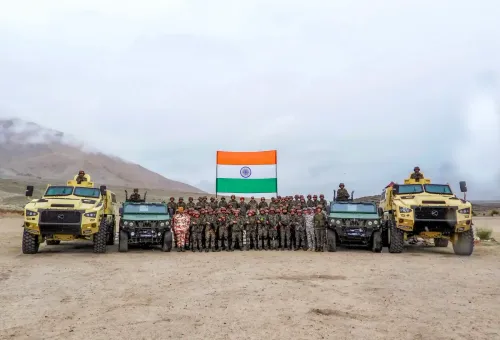
India deployed 10 Combined Arms Brigade-sized formations along the LAC , comprising infantry, armour, artillery, and air defence units.
Congress MP Karti Chidambaram demanded the government provide specifics on actual troop decreases, incursions, and border fortifications.
Congress MP Pawan Khera asked whether patrolling points in eastern Ladakh lost after May 2020 have been restored.
The Defence Ministry cited resumed political, diplomatic, and military-level interactions as contributing to greater frontier stability.
The Congress on Monday, 14 September called on the government to be transparent about the reduction in Chinese troop deployment along the Line of Actual Control (LAC), responding to a Ministry of Defence annual report for 2025-26 that stated India-China relations had improved and the People's Liberation Army (PLA) had scaled back its presence along India's northern borders. The opposition demanded specific details on troop numbers, incursions, and patrolling rights — not just broad proclamations.
What the Defence Ministry Report Said
The Ministry of Defence annual report for 2025-26 stated that Chinese forces recorded a significant reduction in deployment opposite India's northern borders during 2025, noting that 10 Combined Arms Brigade-sized forces were deployed by the PLA in areas along the LAC and in traditional training areas. The report attributed part of this shift to India's own counter-deployment of 10 brigade-sized formations — self-sustaining combined arms units comprising infantry, armour, artillery, and air defence — in corresponding sectors.
The report declared the Indian Army's deployment along all LAC sectors as 'robust, well poised and prepared to deal with any emerging contingency.' It also highlighted that interactions between the two sides at political, diplomatic, and military levels had contributed to greater stability along the frontier, with several bilateral dialogue mechanisms resumed and sustained.
Congress MP Karti Chidambaram's Demand for Specifics
Congress MP Karti Chidambaram acknowledged the complexity of the bilateral relationship but pressed the government for verifiable details. 'India and China have a complicated relationship. We have a relationship on multiple levels: we have relationships in trade, we have border disputes, and we have security concerns. Only constant engagement can address these issues. We are two very large countries, with large populations, huge economies, and significant military powers, and we are neighbours, and that can never be wished away,' he said.
Chidambaram argued that if the government was claiming a reduction in Chinese troop deployment, it owed Parliament and citizens a full accounting. 'We will have issues, and only by constant engagement and trust-building can these issues be resolved. If the government is saying so, it's only fair that they give specifics of the actual troop deployment decrease by the Chinese side, whether there are any incursions on Indian soil, and whether there are any kinds of fortifications built on the border,' he said.
He added: 'They have to be transparent with us when they give out these kinds of proclamations. But engagement is welcome; constant engagement is what will sort out issues.'
Patrolling Rights in Eastern Ladakh: Pawan Khera's Questions
Congress MP Pawan Khera raised a pointed question over the restoration of patrolling arrangements in eastern Ladakh that predate the May 2020 military standoff. 'Before May 2020, our forces were able to patrol certain patrolling points in the Ladakh region. Are they able to patrol those points now or not? Has the status quo been restored or not?' Khera said.
He called on the Defence Minister, the Defence Ministry, or the Home Minister to directly answer these questions, arguing that broad statements on improved relations do not substitute for clarity on ground-level access rights.
Broader Context and What It Means
This comes amid a gradual thaw in India-China ties that has included military-level disengagement at multiple friction points since late 2024. Notably, the Congress's demand mirrors a pattern seen after every major India-China announcement — the opposition presses for ground truth while the government emphasises process and diplomatic progress. The central unresolved question is whether India's pre-2020 patrolling rights at all designated patrol points in Ladakh have been fully restored, a benchmark that analysts and opposition leaders repeatedly return to.
How the government responds to these specific demands — particularly on patrolling access — will be closely watched by strategic affairs experts, parliamentary committees, and border communities in Ladakh.
Point of View
But the Congress has identified the right pressure point: a reduction in deployment is not the same as a restoration of pre-2020 ground realities. If India's patrol access at designated points in Ladakh remains curtailed, the optics of 'improved relations' mask an incomplete disengagement. Governments routinely conflate process milestones with outcome milestones on border disputes — and this report, by describing troop movements without addressing patrolling rights, fits that pattern precisely. The accountability test is simple: publish the patrol point access matrix before and after May 2020, and let citizens judge whether the status quo has been restored.
NationPress
14 Sept 2026
Frequently Asked Questions
What did the Defence Ministry's 2025-26 annual report say about Chinese troop deployment along the LAC?
The Ministry of Defence annual report for 2025-26 stated that the deployment of PLA forces opposite India's northern borders witnessed a significant reduction in 2025, with 10 Combined Arms Brigade-sized forces deployed in areas along the LAC and in traditional training areas. The report also said India's own 10 brigade-sized formations remained robustly deployed across all LAC sectors.
What is Congress demanding from the government on the India-China border situation?
Congress is demanding transparency and specific data — including the actual decrease in Chinese troop numbers, whether any incursions on Indian soil have occurred, and whether any fortifications have been built along the border. Congress MP Karti Chidambaram said broad proclamations are insufficient without verifiable details.
What is the significance of the May 2020 patrolling points raised by Pawan Khera?
Before the military standoff that began in May 2020, Indian forces patrolled specific designated points in the eastern Ladakh region. Congress MP Pawan Khera is asking whether access to those patrolling points has been fully restored — a question seen as the clearest ground-level test of whether the disengagement is complete.
How has India responded to Chinese military deployment along the LAC?
According to the Defence Ministry report, India deployed 10 Combined Arms Brigade-sized forces — self-sustaining units comprising infantry, armour, artillery, and air defence — in areas along the LAC. The report describes this as a 'robust' and 'well-poised' deployment prepared for any contingency.
Why does Congress say constant engagement is needed on India-China issues?
Congress MP Karti Chidambaram argued that India and China share a multi-layered relationship involving trade, border disputes, and security concerns, and that the two nations — as large, powerful neighbours — cannot disengage from each other. He said only sustained engagement and trust-building can resolve differences over time.