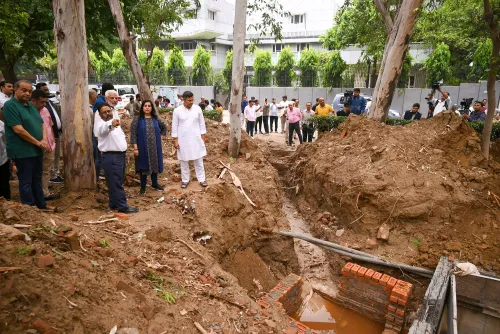
DDA clears 10,000 MT silt from Rohini trunk drain ahead of monsoon
Synopsis
Delhi's DDA has pulled more than 10,000 MT of silt from Rohini's main underground trunk drain — a 4-km-plus network of pipes that had been choked for years. With city-wide removals already crossing 57,000 MT, up 70% from last year, this is the most aggressive pre-monsoon drainage push the authority has mounted in recent memory.
Key Takeaways
The DDA removed over 10,000 MT of silt from the underground trunk outfall drain in Rohini , on directions of LG T.S.
The drain covers 4.095 km with a total pipe length of 16.50 km and 75 inspection chambers , serving Rohini Sectors 20–23, Kirari, and Begumpur.
Conventional desilting methods were inadequate; DDA deployed Super Sucker and Jetting Machines using high-pressure water jetting and vacuum suction.
City-wide silt removal this year has crossed 57,000 MT — a 70% increase over last year's 33,380 MT .
Desilting is complete in the East, South, and North Zones ; works in Narela, Rohini, and Dwarka Zones are in final stages.
The Delhi Development Authority (DDA) has removed more than 10,000 metric tonnes (MT) of accumulated silt and waste from the major underground trunk outfall drain in Rohini, officials confirmed on Tuesday, 14 July. The specialised desilting drive was undertaken on the directions of Lieutenant Governor T.S. Sandhu and is aimed at reducing waterlogging risk ahead of the monsoon season.
Scale and Scope of the Operation
The project targeted a 4.095 km-long trunk drain comprising three to five parallel pipes, each with a diameter of 2,200 mm. The total underground pipe length covered stands at approximately 16.50 km, supported by 75 inspection chambers. The drain serves Sectors 20, 21, 22 and 23 of Rohini, along with parts of Kirari and Begumpur, making it one of the most critical drainage corridors in northwest Delhi.
Why Conventional Methods Were Not Enough
According to a DDA statement, years of continuous wastewater flow and heavy silt deposition had severely choked the underground pipelines, substantially reducing their carrying capacity. The confined nature and large diameter of the pipes rendered conventional desilting methods ineffective.
To address this, the DDA deployed high-capacity Super Sucker and Jetting Machines. 'High-pressure water jetting was used to loosen compacted silt, which was then removed through powerful vacuum suction equipment. The work was executed in a planned and phased manner with all necessary safety measures in place,' the statement said.
City-Wide Desilting Push Across Six Zones
The Rohini operation is part of a larger city-wide pre-monsoon desilting campaign. Delhi has been divided into six operational zones — East, South, North, Narela, Rohini, and Dwarka — to enable focused planning and close supervision. The DDA has already completed desilting in the East, South, and North Zones, while works in the Narela, Rohini, and Dwarka Zones are in the final stages of completion.
70% Jump Over Last Year's Numbers
The scale of this year's drive marks a significant step up from previous efforts. During last year's pre-monsoon campaign, the DDA removed nearly 33,380 MT of silt from storm water drains across the city. This year, more than 57,000 MT of silt has already been cleared — an increase of more than 70 per cent, according to the authority.
With monsoon rains expected to intensify in the coming weeks, the restored carrying capacity of Rohini's trunk drain is expected to significantly ease waterlogging in the area and adjoining neighbourhoods.
Point of View
And annual pre-monsoon desilting drives have historically struggled to translate into meaningful flood relief on the ground. The deployment of Super Sucker and Jetting Machines signals a genuine operational upgrade, but the real measure will come when the rains arrive — whether Rohini's streets stay dry or revert to the seasonal flooding residents have come to expect. The LG's visible direction of the drive also fits a pattern of the Lieutenant Governor's office asserting administrative ownership over civic functions, a dynamic that continues to define Delhi's governance fault lines.
NationPress
13 Oct 2026
Frequently Asked Questions
What did the DDA do at Rohini's trunk drain?
The DDA removed more than 10,000 MT of accumulated silt and waste from the major underground trunk outfall drain in Rohini. The operation used high-capacity Super Sucker and Jetting Machines to clear pipelines that had been severely choked over the years.
Why was the Rohini trunk drain desilting necessary?
Years of continuous wastewater flow had deposited heavy silt inside the underground pipelines, substantially reducing their water-carrying capacity. Left unaddressed, this would have worsened waterlogging in Rohini, Kirari, and Begumpur during the monsoon.
Which areas does the Rohini trunk drain serve?
The drain carries storm water and discharge from Sectors 20, 21, 22, and 23 of Rohini, along with parts of Kirari and Begumpur, covering one of the largest drainage corridors in northwest Delhi.
How does this year's desilting compare to last year?
The DDA has removed more than 57,000 MT of silt city-wide this year, compared to nearly 33,380 MT during last year's pre-monsoon drive — an increase of more than 70 per cent.
Which Delhi zones have completed desilting and which are still in progress?
Desilting has been completed in the East, South, and North Zones. Works in the Narela, Rohini, and Dwarka Zones are currently in the final stages of completion.