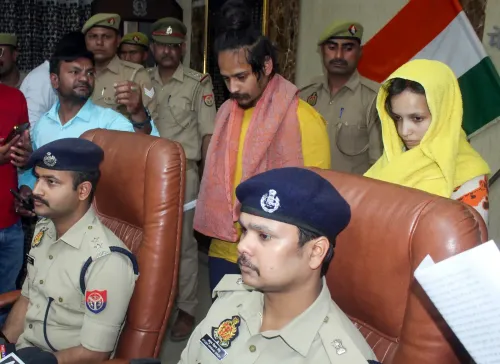
Blue drum murder: Meerut court awards death penalty to Muskan and Sahil Shukla

Synopsis
A Meerut court sentenced Muskan and her lover Sahil Shukla to death for the killing and dismemberment of former Merchant Navy officer Saurabh Rajput — a case that shocked the country when his body was found sealed inside a blue drum packed with sand and cement. The 'rarest of the rare' ruling now heads to the Allahabad High Court for mandatory confirmation.
Key Takeaways
A Meerut district court on 14 October 2026 awarded the death penalty to Muskan and Sahil Shukla for murdering former Merchant Navy officer Saurabh Rajput .
The judge classified the case as 'rarest of the rare' , the legal standard required for capital punishment under Indian law.
Rajput's body was dismembered and concealed inside a blue plastic drum packed with sand and cement .
Saurabh's mother Renu Devi and brother Rahul expressed full satisfaction with the verdict.
Family lawyer Vijay Bahadur said the verdict would 'send a strong message to society.' The death sentence must now be confirmed by the Allahabad High Court before it can be carried out.
A Meerut district court on Wednesday, 14 October 2026, sentenced Muskan and her lover Sahil Shukla to death for the murder of Saurabh Rajput, a former Merchant Navy officer whose dismembered body was found concealed inside a blue plastic drum packed with sand and cement. The presiding district judge classified the case as belonging to the 'rarest of the rare' category, the legal threshold required to award capital punishment under Indian law.
What the Court Decided
The court handed down the death penalty to both Muskan, Rajput's wife, and her alleged lover Sahil Shukla after finding them guilty of the premeditated murder and disposal of the victim's remains. The judge's invocation of the 'rarest of the rare' standard reflects the deliberate brutality involved — Rajput was killed, his body dismembered, and the parts stuffed into a blue drum that was then sealed with sand and cement to conceal the crime.
Family's Reaction
The verdict was met with relief and satisfaction by the Rajput family. Saurabh's mother, Renu Devi, told reporters, 'We are completely satisfied with the court's decision.' She added, 'Today, the court has merely pronounced the death sentence, the day the date for their execution is fixed, will be the true day of happiness for us.'
Saurabh's brother Rahul said, 'We are fully satisfied with the court's verdict. We have received justice. Our demand to the court was for Muskan and Sahil to be sentenced to death. That demand has been met, and we are now completely satisfied.'
What Lawyers Said
Family lawyer Vijay Bahadur said the verdict sends a clear message: 'The court has truly delivered justice in this case. This verdict will send a strong message to society and also instill fear in the minds of criminals.' Outside the district court complex, lawyers distributed sweets and celebrated, remarking that the punishment was commensurate with the gravity of the crime.
Background: How the Case Unfolded
The case drew national attention after Saurabh Rajput's body was discovered inside a blue plastic drum. Investigators established that Rajput was killed by Muskan in alleged connivance with Sahil Shukla. His body was subsequently dismembered, and the parts were stuffed into the drum, which was then filled with sand and cement in an apparent attempt to permanently conceal the crime. The gruesome nature of the killing and the methodical effort to destroy evidence contributed to the court's characterisation of it as an exceptionally heinous act.
What Happens Next
Under Indian law, a death sentence awarded by a sessions court must be confirmed by the respective High Court before it can be carried out. The case will now move to the Allahabad High Court for mandatory confirmation proceedings, where both the prosecution and the defence will be heard again. The convicts also retain the right to appeal to the Supreme Court and, thereafter, to file a mercy petition before the President of India. The process can take months or years before any execution date is fixed.
Point of View
Making this ruling a notable departure. Yet the hardest part of the process is still ahead — High Court confirmation and potential Supreme Court appeals mean years may pass before the sentence is carried out, if ever. India's rate of actual executions following death sentences remains extremely low, and the gap between a court's verdict and the gallows is where the justice system most frequently stalls.
NationPress
14 Oct 2026
Frequently Asked Questions
What is the blue drum murder case?
The blue drum murder case involves the killing of Saurabh Rajput , a former Merchant Navy officer from Meerut, by his wife Muskan and her lover Sahil Shukla . After killing him, the duo dismembered his body and concealed it inside a blue plastic drum packed with sand and cement. The case drew national attention when the drum was discovered.
What sentence did the Meerut court award to Muskan and Sahil Shukla?
The Meerut district court awarded the death penalty to both Muskan and Sahil Shukla on 14 October 2026 , classifying the case as 'rarest of the rare.' It is one of the most severe judgments possible under Indian criminal law.
What happens after a sessions court awards a death sentence in India?
Under Indian law, every death sentence awarded by a sessions court must be mandatorily confirmed by the relevant High Court — in this case, the Allahabad High Court — before it can be executed. The convicts can also appeal to the Supreme Court and file a mercy petition with the President of India, a process that can take years.
How did Saurabh Rajput's family react to the verdict?
The family welcomed the verdict with relief. Saurabh's mother Renu Devi said they were 'completely satisfied' with the court's decision, while his brother Rahul confirmed all their demands had been met. However, Renu Devi noted that the 'true day of happiness' would come only when an execution date is actually fixed.
Why did the court call this case 'rarest of the rare'?
The court used the 'rarest of the rare' classification — the legal threshold set by the Supreme Court for awarding capital punishment — because of the premeditated nature of the killing, the subsequent dismemberment of the body, and the deliberate effort to conceal evidence by sealing the remains in a drum packed with sand and cement. These factors collectively pointed to exceptional cruelty and planning.