How Did Delhi CM Rekha Gupta Critique Previous Governments on the First Anniversary?
Synopsis
Delhi Chief Minister Rekha Gupta marked her government's first anniversary with a strong critique of previous administrations. She emphasized the current BJP-led government's focus on tangible results, contrasting it with the past's emphasis on publicity. Gupta's address highlighted significant initiatives and a commitment to transforming Delhi's future.
Key Takeaways
Focus on tangible results over mere announcements.
Implementation of the Fee Regulation Act for private schools.
Initiatives in pollution control and waste management.
Transition from confrontation to cooperation in governance.
Commitment to transforming Delhi's future through accountability.
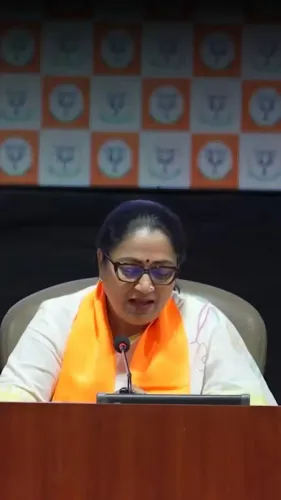
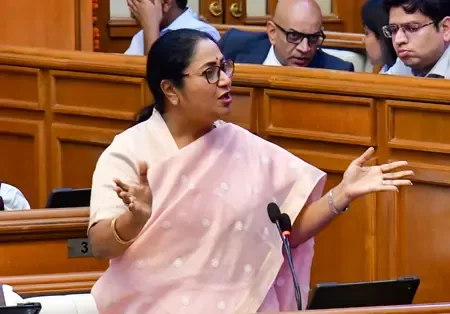
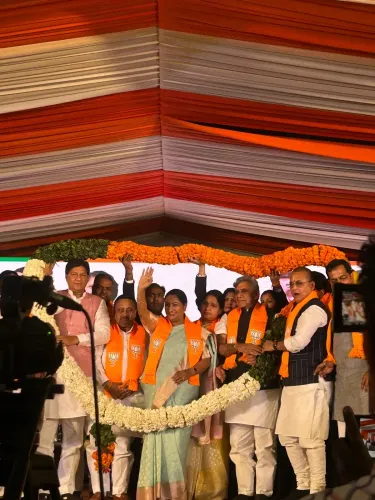
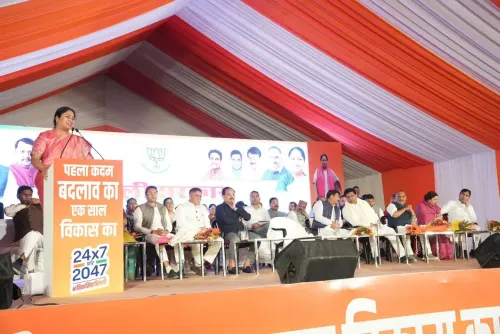
New Delhi, Feb 20 (NationPress) Delhi's Chief Minister Rekha Gupta launched a pointed critique of former administrations as her government celebrated its inaugural anniversary on Friday.
She emphasized that the current BJP regime is centered on tangible results rather than mere promises and announcements.
The Chief Minister pointed out that during the 15 years of Congress and 11 years of the Aam Aadmi Party, the focus was largely on publicity-driven politics.
"In contrast, my administration is grounded in the ethos of 'less paperwork, more work,'" she stated.
Together with her Cabinet colleagues, Chief Minister Gupta unveiled a detailed report card commemorating one year of BJP governance in Delhi, underscoring significant initiatives aimed at the capital's development, efficient governance, and public welfare.
She sent a strong message that the past year was not about mere announcements but about achieving visible results.
"The past 365 days have been dedicated to transitioning Delhi from stagnation to momentum, from confrontation to cooperation, and from publicity to performance," CM Gupta noted.
Guided by Prime Minister Narendra Modi's principle of 'Sabka Saath, Sabka Vikas, Sabka Prayas', the Delhi government has implemented concrete measures across major sectors, including health, education, infrastructure, pollution control, Yamuna rejuvenation, and governance reforms.
She described this report not just as an account of a year's successes but as the start of a significant shift in Delhi's trajectory, expressing confidence that the upcoming years will further improve the capital's situation.
CM Gupta pointed out that under previous governments, Delhi experienced more noise and fewer solutions.
"The politics of accusations, delays, and confrontation hindered administrative progress," she added.
In contrast, the current BJP-led administration has embraced a timeline-oriented working model, prioritizing accountability, allowing for on-ground results instead of a focus on tweets and advertisements.
Addressing the issue of Yamuna cleanliness, the Chief Minister expressed that for decades, there were announcements but minimal real improvement.
She argued that during the 15 years of Congress rule and 11 years of AAP governance, no substantial efforts were made to rejuvenate the river, leading to its deteriorating condition.
"Upon taking office, the current Delhi government initiated upgrades to sewage treatment facilities, drain tapping, and the execution of new projects, resulting in significant progress in pollution control," she stated.
On waste management, CM Gupta criticized past administrations for not enhancing processing capabilities in line with daily waste production, which led to landfill mountains.
She announced that biomining capacity has been significantly increased, with a clear goal to process all daily waste on the same day.
Regarding pollution control, she highlighted that while previous governments relied on slogans and press briefings, the current Delhi government has developed a scientific roadmap—encompassing short-term, mid-term, and long-term strategies—and begun its implementation.
In education, she noted that past governments emphasized publicity over structural reforms.
"Since my government took office, a Fee Regulation Act has been enacted to curb arbitrary practices by private schools, something that had not been accomplished previously," she remarked.
This initiative has provided relief to countless parents in Delhi.
Discussing administrative culture, CM Gupta stated that confrontation was once prevalent in governance, while the current Delhi government prioritizes dialogue and collaboration.
She observed that former administrations lacked transparency and accountability, while the present Delhi government has reinforced systems through digital methods, fiscal discipline, and institutional reforms.
CM Gupta remarked that previous governments viewed power as a means of comfort, while the current administration perceives it as a tool for service.
Taking aim at former Delhi Chief Minister Arvind Kejriwal, she noted that he would appear promptly with cheques when political gain was evident, yet assistance for families of government employees and doctors who perished during Covid-19 remained unresolved for years.
The present Delhi government, according to CM Gupta, has addressed all such issues.
She expressed confidence that within a year, the governance direction has shifted, promising that the national capital will witness thorough transformation in the coming years.
Point of View
CM Rekha Gupta's address serves as a critical reflection on the past governance of Delhi. Her emphasis on accountability, tangible outcomes, and the need for reform resonates with the public's desire for effective leadership. As the BJP government charts a new course, the focus on performance over politics could redefine Delhi's future.
NationPress
3 Oct 2026
Frequently Asked Questions
What were the key achievements of Delhi's BJP government in its first year?
The BJP government highlighted significant initiatives in health, education, infrastructure, pollution control, and governance reforms as key achievements during its first year in office.
How did CM Rekha Gupta compare her government to previous administrations?
CM Rekha Gupta criticized previous governments for their focus on publicity and announced that her administration prioritizes measurable outcomes and accountability.
What is the Fee Regulation Act mentioned by CM Gupta?
The Fee Regulation Act aims to curb arbitrary practices by private schools and has been implemented to provide relief to parents in Delhi.
What steps has the government taken towards pollution control?
The Delhi government has developed a scientific roadmap for pollution control and initiated projects to improve waste management and rejuvenate the Yamuna River.
Why does CM Gupta emphasize the need for a shift in governance?
CM Gupta believes that previous administrations prioritized confrontation over cooperation, and her government aims to foster dialogue and transparency.