Delhi-NCR heavy rain alert Monday: IMD warns 19 states, AQI very poor

Synopsis
The IMD has placed 19 states on heavy rain alert for 17 August, with Delhi bracing for thunderstorms and winds up to 40 kmph. Even as rain approaches, Delhi's AQI sits firmly in the very poor zone — Anand Vihar at 335 — highlighting how the capital's air crisis persists even mid-monsoon.
Key Takeaways
IMD has forecast heavy rain and thunderstorms for Delhi-NCR on 17 August , with winds of 30–40 kmph .
Alerts have been issued across 19 states , with wind speeds up to 80–85 kmph in some areas.
Two upper-air cyclonic circulations — over southwestern Rajasthan and the northwestern Bay of Bengal — are driving the weather system.
27 districts in Uttar Pradesh are under thunderstorm warning; winds may reach 70–75 kmph .
Delhi's AQI remains very poor ; Anand Vihar recorded the highest reading at 335 .
Delhi's maximum temperature is expected at 34°C ; Lucknow at 29°C .
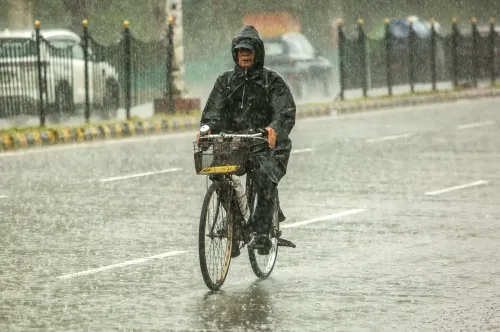
The India Meteorological Department (IMD) has forecast heavy rainfall and thunderstorms for New Delhi on Monday, 17 August, with gusty winds of 30–40 kmph expected to accompany the downpour. The capital is likely to record a maximum temperature of around 34°C and a minimum of 28°C, even as air quality in the city remained in the very poor category.
IMD Alert Covers 19 States
The weather office has issued alerts for heavy rain, thunderstorms, and strong winds across 19 states, including Uttar Pradesh, Bihar, Rajasthan, Haryana, Himachal Pradesh, Uttarakhand, Punjab, Jammu and Kashmir, Jharkhand, Odisha, West Bengal, Sikkim, Assam, Madhya Pradesh, Chhattisgarh, Kerala, Gujarat, and Maharashtra. Wind speeds of up to 80–85 kmph are anticipated in some areas, with isolated hailstorms also forecast in parts of the country.
Weather Systems Driving the Rainfall
Two upper-air cyclonic circulations are influencing conditions: one persisting over southwestern Rajasthan and adjoining areas, and another positioned over the northwestern Bay of Bengal. Together, they are channelling moisture across a broad swathe of western and central India, sustaining the intense rainfall spell.
Uttar Pradesh on High Alert
In Uttar Pradesh, the IMD has specifically warned 27 districts — including Noida, Meerut, Agra, Kanpur, Lucknow, Bareilly, and Varanasi-adjacent zones — of heavy rain and thunderstorms accompanied by winds reaching 70–75 kmph. Lucknow is expected to see a maximum of 29°C and a minimum of 27°C.
Delhi AQI Remains Very Poor
Despite the incoming rain — which typically offers temporary relief from pollution — Delhi's air quality index remained in the very poor category ahead of the weather event. The worst readings were recorded at Anand Vihar (335) and Bawana (240). Other stations including Rohini (136), Mundka (134), IIT Delhi (132), Chandni Chowk (131), Dwarka Sector-8 (124), Nehru Nagar (117), CRRI Mathura Road (113), Sonia Vihar (112), Ashok Vihar (108), North Campus (104), and Patparganj (103) also reported elevated pollution levels. This comes amid Delhi's persistent struggle with poor air quality during the monsoon transition period, when intermittent rains have not been sufficient to flush out accumulated particulate matter.
What Residents Should Expect
Authorities and weather experts advise residents to avoid waterlogged roads and open spaces during thunderstorm warnings. The IMD's multi-state alert signals that the current monsoon trough remains active and may sustain heavy spells through the week. Any improvement in Delhi's AQI is likely to be short-lived unless sustained rainfall clears the atmosphere over consecutive days.
Point of View
But the more telling detail is Delhi's AQI reading of 335 at Anand Vihar — in the very poor band — even as rain is imminent. Monsoon showers offer only episodic relief; the capital's structural air quality problem persists through the wet season, not just the winter smog cycle. The co-existence of heavy rain warnings and very poor AQI in mid-August should prompt a harder look at year-round pollution sources, not just stubble burning.
NationPress
1 Oct 2026
Frequently Asked Questions
What has the IMD forecast for Delhi on 17 August?
The IMD has forecast heavy rainfall and thunderstorms for Delhi on 17 August, accompanied by gusty winds of 30–40 kmph. The maximum temperature is expected to be around 34°C and the minimum around 28°C.
Which states are under IMD rain alert?
The IMD has issued alerts for heavy rain, thunderstorms, and strong winds across 19 states, including Uttar Pradesh, Bihar, Rajasthan, Haryana, Himachal Pradesh, Uttarakhand, Punjab, Jammu and Kashmir, Jharkhand, Odisha, West Bengal, Sikkim, Assam, Madhya Pradesh, Chhattisgarh, Kerala, Gujarat, and Maharashtra.
What is causing the heavy rainfall across India?
Two upper-air cyclonic circulations are responsible — one over southwestern Rajasthan and adjoining areas, and another over the northwestern Bay of Bengal. These systems are channelling moisture and sustaining intense rainfall across western, central, and northern India.
Why is Delhi's AQI in the very poor category despite monsoon rain?
Delhi's AQI remained in the very poor category with Anand Vihar recording 335, indicating that intermittent monsoon showers have not been sufficient to clear accumulated particulate matter. Sustained, heavy rainfall over consecutive days is typically needed to significantly improve air quality.
Which areas of Delhi have the worst AQI readings?
Anand Vihar recorded the highest AQI at 335, followed by Bawana at 240. Other stations including Rohini (136), Mundka (134), IIT Delhi (132), and Chandni Chowk (131) also reported elevated levels.