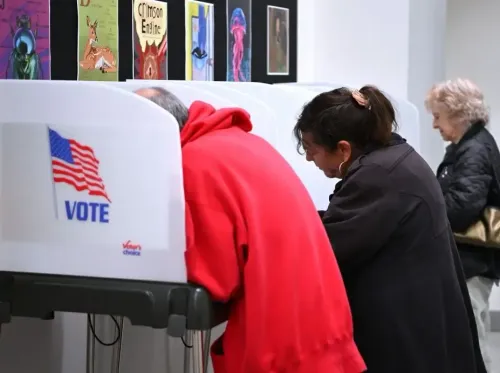
Democrats lead 8 of 10 key 2026 midterm races, forecast brief shows

Synopsis
A midterm forecast brief from Psifos Advisory Group gives Democrats the edge in 8 of 10 key 2026 US midterm races, including 5 Senate contests, as voting begins on 3 November. The model blends electoral fundamentals with bias-corrected online sentiment across 12 platforms — and its creators openly flag where the data is thin, making today's results a live credibility test for the methodology.
Key Takeaways
Psifos Advisory Group projects Democrats to lead in 8 of 10 key 2026 US midterm races, including 5 of 7 Senate contests.
Democrats are favoured in Texas, Ohio, North Carolina, Georgia and Michigan ; Republicans in Iowa and Florida .
Republican Ashley Hinson is projected at 51.3% two-party vote share in Iowa ; Republican Ashley Moody at 53.0% in Florida .
Georgia's Senate race is rated 'Solid' Democrat with only a 2% upset probability; Ohio is rated 'Tilt' with a 48% upset chance.
The model uses electoral fundamentals plus sentiment analysis across 12 online platforms , with five predictions locked on 2 November for post-election scoring.
The firm acknowledges its online-sentiment weighting has no prior track record , and some races rest on sparse polling.
Democrats are projected to hold an edge in eight of the ten closely watched races in the 2026 US midterm elections, including five of seven Senate contests and both US House of Representatives races, according to a midterm forecast brief released by Psifos Advisory Group, a division of Newark, New Jersey-based Gateway Group One. The forecast was issued as voting got underway on Tuesday, 3 November 2026.
Key Races and Projected Outcomes
Among the seven Senate races tracked in the brief, Democratic candidates are forecast to lead in Texas, Ohio, North Carolina, Georgia and Michigan. Republicans, by contrast, are projected to hold an advantage in Iowa and Florida. Democrats are also favoured in both monitored US House contests and in the race for Georgia Governor.
The calls range from 'Solid' — used for Georgia's Senate race, which the brief assigns just a 2 per cent chance of an upset — to 'Tilt,' applied to Ohio (48 per cent upset probability) and Iowa, where Republican chances are pegged at 62 per cent. In Iowa's open US Senate seat contest, the model gives Republican Ashley Hinson a projected two-party vote share of 51.3 per cent over Democratic state Representative Josh Turek. In Florida, Republican incumbent Ashley Moody is projected to receive 53.0 per cent of the two-party vote against Democratic challenger Angie Nixon.
The Methodology Behind the Forecast
Rahul Mehta, Managing Partner at the Psifos Advisory Group, outlined what he described as four distinguishing features of the firm's approach. 'It starts from evidence, not opinion. Each seat begins from fundamentals: the last presidential vote adjusted for the national mood, incumbency, primary strength and primary turnout. The weights are learned from past races, not set by judgement. It weighs polls by quality. Larger and newer polls count more, pollsters with a partisan lean count less, and thin polling is used but flagged,' Mehta said.
On the online sentiment component, Mehta noted: 'We judge posts for or against each candidate across 12 platforms, correct for each platform's habitual lean, and compare races with one another. Where the volume is too one-sided to compare fairly, as in Minnesota's 5th (46 posts about one candidate for every one about the other), we leave the conversation out rather than let it distort the forecast.'
Mehta added that five sets of predictions were locked on 2 November, with a 2-point rule set in advance for deciding outcomes, and that the firm would score every reading against the actual results after election day.
Accountability and Stated Limits
Kurus J. Elavia, also a Managing Partner at Psifos, said the methodology draws on 20 years of building and operating digital democracy solutions. He emphasised that online sentiment is treated as evidence to be measured and corrected, not as a proxy for votes. 'We have seen how volume, organised campaigns and audiences outside a district can distort it,' he said.
Elavia was candid about the model's limitations. 'New Jersey's 7th rests on one older poll, and Minnesota's 5th has none. We state these limits in the brief because a forecast serves a client best when it shows where it is strong and where it is thin,' he said, adding that the standard the firm holds itself to is whether it can show clients 'how far to trust a number, not just which way it points.'
Context and What to Watch
The 2026 US midterms are widely viewed as a referendum on the current political environment in Washington, with control of the Senate and select House seats in play. Forecast models from consultancies such as Psifos add to a crowded field of election analytics tools, though most carry explicit uncertainty ranges. Notably, the firm's online-sentiment weighting is self-described as having 'no track record yet,' making the post-election scoring exercise a live test of its predictive validity. Results from the races covered in the brief are expected to begin emerging on the night of 3 November 2026.
Point of View
Including a race with zero current polls. What is notable here is the transparency: publishing uncertainty ranges and platform-level lean corrections is a higher methodological bar than most electoral commentary sets. The real story will be written on the morning of 4 November, when the model's post-election scoring — locked in advance against a stated 2-point rule — either validates or discredits its online-sentiment weighting. In an era of poll misses and model failures, that accountability mechanism deserves as much attention as the horse-race projections themselves.
NationPress
3 Nov 2026
Frequently Asked Questions
What does the 2026 midterm forecast brief by Psifos Advisory Group show?
The brief projects Democrats to hold an advantage in 8 of 10 key 2026 US midterm races, including 5 of 7 Senate contests and both monitored House races. Republicans are favoured in Iowa and Florida.
Which Senate races are Democrats projected to win in 2026?
According to the Psifos forecast, Democratic candidates are projected to lead in Texas, Ohio, North Carolina, Georgia, and Michigan. Republicans hold the edge in Iowa and Florida.
How does Psifos Advisory Group build its election forecast?
The model starts from electoral fundamentals — prior presidential vote, incumbency, primary strength and national mood — combined with quality-weighted polling and bias-corrected online sentiment measured across 12 platforms. Predictions were locked on 2 November and will be scored against actual results after voting.
What are the closest races in the 2026 midterm forecast?
Ohio is rated 'Tilt' Democrat with a 48% Republican upset probability, making it the most competitive Democratic-leaning call. Iowa is rated 'Tilt' Republican, with the GOP given a 62% chance. Georgia's Senate race is the firmest Democratic call, with only a 2% upset probability.
What limitations does the Psifos forecast acknowledge?
The firm openly states that its online-sentiment weighting has no prior track record, that New Jersey's 7th district rests on a single older poll, and that Minnesota's 5th has no current polling at all. Managing Partner Kurus J. Elavia said the brief is designed to show clients both where the data is strong and where it is thin.