DHS chief calls 2026 FIFA World Cup '78 Super Bowls in 38 days'
Synopsis
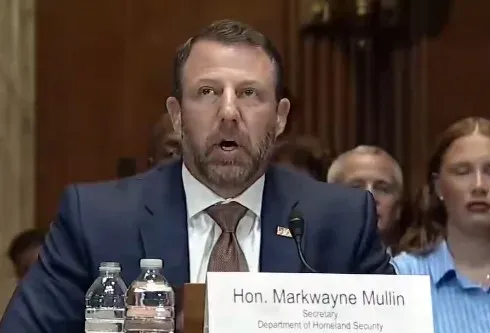
Calling the 2026 FIFA World Cup '78 Super Bowls in 38 days', DHS Secretary Markwayne Mullin laid out an unprecedented security blueprint — stadium sweeps, expanded perimeters, killed choke points and cooperation even from sanctuary cities. The 48-team, tri-nation tournament will be the largest in history, and the biggest peacetime security test the US has faced in years.
Key Takeaways
DHS Secretary Markwayne Mullin described the 2026 FIFA World Cup as ‘ 78 Super Bowls in 38 days ’.
He spoke at a Senate Appropriations Subcommittee hearing on the FY2027 DHS budget request.
DHS is locking down stadiums, expanding perimeters and coordinating with sanctuary cities.
The tournament, co-hosted by the US, Canada and Mexico , will feature 48 teams — the largest edition ever.
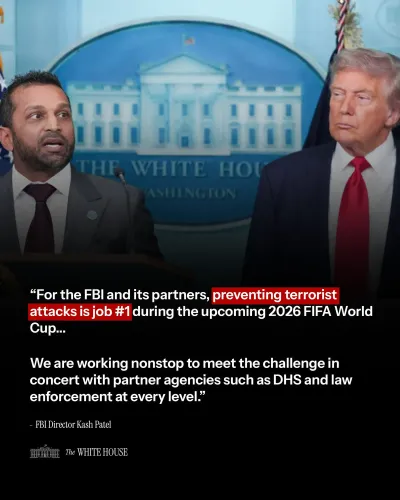
Agencies including the FBI , CBP and Secret Service are involved in layered security planning.
The US Department of Homeland Security is preparing an unprecedented security operation for the 2026 FIFA World Cup, Secretary Markwayne Mullin told a Senate panel on Tuesday, likening the scale of the tournament to ‘78 Super Bowls in 38 days’. Millions of fans are expected to travel across the United States, Canada and Mexico for the expanded 48-team event.
What the DHS chief told the Senate
Speaking at a Senate Appropriations Subcommittee hearing on the department's fiscal year 2027 budget request, Mullin said federal, state and local agencies were already deep into planning. ‘I've learned more about it than I ever have in my life when it comes to football or soccer, what we call it here in the US,’ he told lawmakers.
Senator Bill Hagerty of Tennessee pressed the Secretary on readiness, noting the wave of visitors arriving in the coming months. ‘How are we going to protect our homeland, given the fact?’ Hagerty asked.
Inside the security playbook
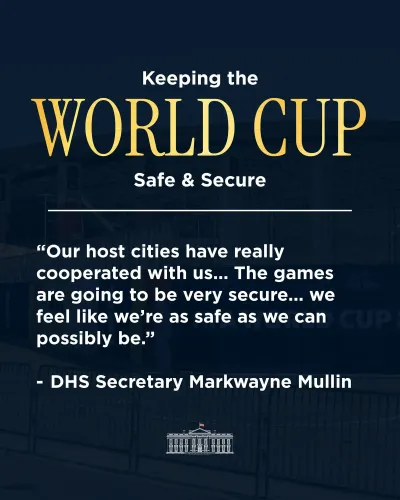
Mullin said DHS was coordinating with host cities to lock down venues and manage crowd flows. ‘We are going to be prepared and we're working every single day on it and we're locking down stadiums with sweeps, we're pushing out perimeters, we're killing choke points, creating traffic control,’ he said.
He added that even politically contentious jurisdictions were cooperating: ‘We're working with the states. And every city we're working in, they have cooperated with us, even in sanctuary cities, because I think all of us want to highlight the greatness of the United States during this World Cup.’
Why the scale is unique
The 2026 World Cup will be the largest edition in the tournament's history, jointly hosted by the US, Canada and Mexico, with a record number of matches across multiple North American cities. The expansion to 48 teams sharply increases the venue footprint compared with the 32-team formats of previous editions.
Federal agencies including DHS, the FBI, Customs and Border Protection, the Secret Service and local police departments have reportedly been developing layered security plans for years. The threat matrix spans terrorism, cyberattacks, crowd crushes and transportation disruption.
Shutdowns and lingering risks
Mullin acknowledged that previous government shutdowns had complicated some preparatory work but insisted the department remained focused on delivering an incident-free tournament. ‘We have 78 Super Bowls in 38 days, and hopefully we'll pull it off with complete safety,’ he said.
What's next
With kick-off approaching, attention now turns to inter-agency drills, perimeter rollouts at host stadiums and cross-border coordination with Canadian and Mexican authorities. The tournament is expected to draw millions of international visitors and generate billions of dollars in economic activity.
Point of View
Single stadium, single day — the 2026 World Cup is a distributed, cross-border operation with three sovereign jurisdictions, multiple legal regimes and uneven federal-local trust, particularly around sanctuary cities. The real question isn't stadium security, which the US does well; it's transit corridors, fan zones and the cyber layer, where past mega-events have repeatedly been caught off-guard. Past government shutdowns have already eaten into planning runway, and that cost rarely shows up until something goes wrong.
NationPress
23 Oct 2026
Frequently Asked Questions
What did DHS Secretary Markwayne Mullin say about 2026 World Cup security?
Mullin told a Senate Appropriations Subcommittee on Tuesday that the US is preparing an unprecedented security operation for the 2026 FIFA World Cup, calling it '78 Super Bowls in 38 days'. He said DHS is locking down stadiums, expanding perimeters and managing choke points in coordination with state and local authorities.
Why is the 2026 FIFA World Cup considered a major security challenge?
The tournament will be the largest in history, jointly hosted by the US, Canada and Mexico with 48 teams playing a record number of matches across multiple cities. The sheer number of venues, visitors and cross-border movements multiplies risks ranging from terrorism and cyberattacks to crowd and transport management.
Which US agencies are involved in World Cup security planning?
The Department of Homeland Security is leading the effort, working alongside the FBI, Customs and Border Protection, the Secret Service and local law enforcement departments across host cities. Planning has reportedly been underway for years.
Have sanctuary cities cooperated with DHS on World Cup security?
Yes. Mullin said every host city, including sanctuary jurisdictions, has cooperated with federal authorities on security preparations. He attributed the cooperation to a shared interest in showcasing the United States during the tournament.
How have government shutdowns affected World Cup preparations?
Mullin acknowledged that previous shutdowns had complicated some planning efforts. However, he insisted DHS remained fully focused on ensuring the tournament proceeds without major security incidents.