White House Backs DHS to Secure 2026 FIFA World Cup
Synopsis
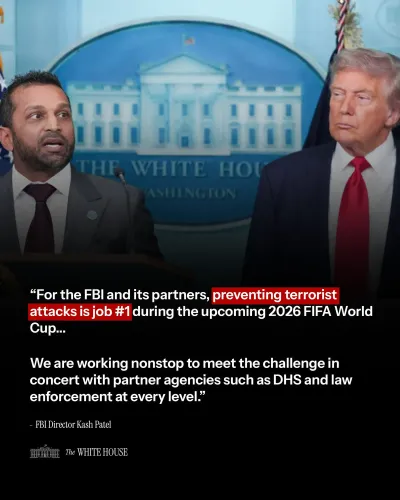
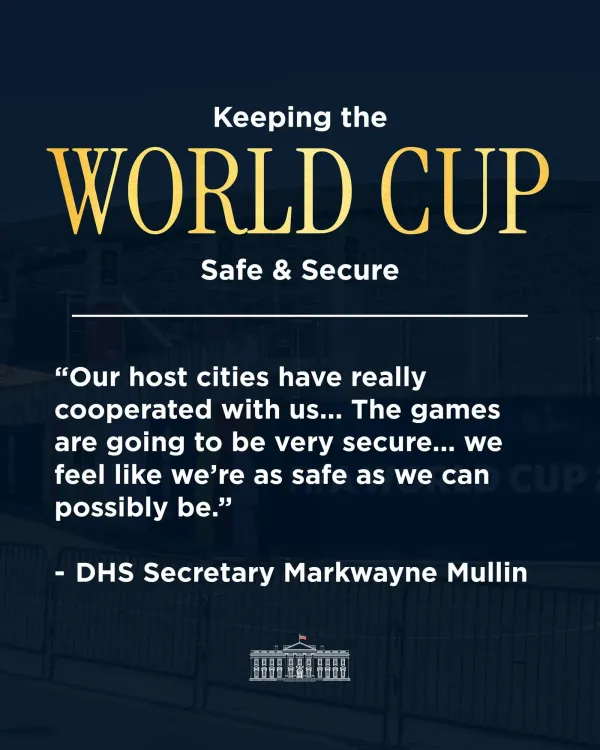
The White House on June 12, 2026, publicly endorsed the Department of Homeland Security to lead security for the 2026 FIFA World Cup, co-hosted by the United States, Canada, and Mexico, calling global security at the tournament 'paramount' in a direct post addressed to DHS.
Key Takeaways
The White House on June 12, 2026 , declared maintaining global security at the 2026 FIFA World Cup 'paramount.' The post directly endorsed @DHSgov (Department of Homeland Security) as the lead agency for tournament security.
The 2026 FIFA World Cup is co-hosted by the United States , Canada , and Mexico , spanning multiple cities across three nations.
DHS was established in 2002 after the September 11 attacks to centralise federal coordination for large-scale domestic security events.
The trilateral hosting arrangement requires cross-border security coordination across three different national jurisdictions and law enforcement systems.
Joint security exercises and congressional funding measures tied to the 2026 tournament remain key developments to watch.
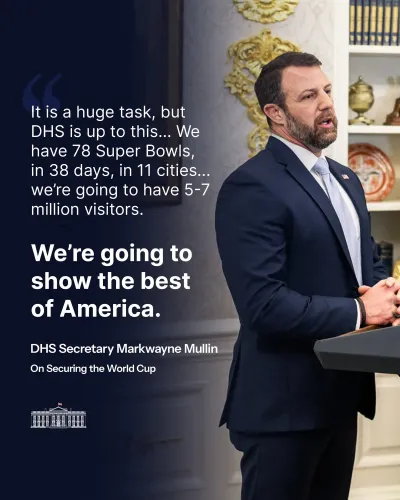
The White House on Friday, June 12, 2026, publicly backed the Department of Homeland Security (DHS) to lead security operations for the 2026 FIFA World Cup, co-hosted across the United States, Canada, and Mexico, affirming that maintaining global security at the tournament is 'paramount.'
Context
The White House post, addressed directly to @DHSgov, stated: 'Maintaining global security at the World Cup is paramount. @DHSgov is up to the task.' The message, brief but deliberate, signals that the administration is treating the 2026 FIFA World Cup as a national security priority, not merely a sporting event. The tournament, running from June to July 2026, is the largest in FIFA history by participating nations and host cities.
The 2026 World Cup was awarded to the joint United States-Canada-Mexico bid by FIFA in 2018, triggering years of trilateral planning across law enforcement, border security, and intelligence agencies. Dozens of matches will be played across multiple American cities, making coordination across jurisdictions especially complex.
Policy Backdrop
The Department of Homeland Security was established in 2002 in the aftermath of the September 11 attacks to centralise domestic security coordination, particularly for large-scale public gatherings that could be considered high-value targets. Since its creation, DHS has played a lead federal role in securing major international events on American soil, from Olympic Games to previous FIFA tournaments.
The United States previously hosted the 1994 FIFA World Cup, which predated DHS. The post-9/11 security architecture now in place represents a significantly more integrated federal response capability, drawing on intelligence sharing, border management, and real-time threat assessment across agencies.
The trilateral nature of the 2026 tournament adds cross-border dimensions: Canada and Mexico each host matches, requiring coordinated security protocols that span three national jurisdictions, immigration systems, and law enforcement cultures.
Stakeholders and Impact
The most immediate stakeholders are the millions of event attendees — including a large number of international visitors — expected across host cities in all three nations. For Indian football fans and the broader global audience, the White House statement signals that federal resources are being committed to ensure a safe tournament environment.
Host-city law enforcement agencies, state-level police, and federal bodies such as the FBI and Secret Service are expected to operate under a DHS-coordinated umbrella. The public affirmation from the White House also carries a diplomatic dimension, reassuring co-hosts Canada and Mexico — as well as participating nations — that the American federal government is actively engaged in event security.
What's Next
Analysts and lawmakers will watch for joint U.S.-Canada-Mexico security exercises and any congressional funding measures tied specifically to 2026 event protection in the weeks and months leading up to the opening matches. The White House's public endorsement of DHS's readiness is likely to be followed by more detailed operational briefings as match schedules solidify.
With the tournament already underway in June 2026, the administration's statement serves as both a reassurance to the public and a signal to security agencies that political support from the highest levels of the executive branch is firmly in place.
Point of View
Designed to reassure both domestic audiences and international partners that the federal government is in command of event security. It fits a well-established post-9/11 pattern of treating major public gatherings as national security events requiring visible federal leadership, not just local law enforcement management. For the trilateral host arrangement with Canada and Mexico, such statements also carry a diplomatic function, signalling that the U.S. executive branch is an active and committed partner. The brevity and directness of the message — addressed straight to DHS — suggests a deliberate communications strategy of projecting calm authority rather than detailed operational disclosure.
NationPress
27 Oct 2026
Frequently Asked Questions
Who is responsible for security at the 2026 FIFA World Cup in the US?
The Department of Homeland Security (DHS) is the lead federal agency coordinating security for the 2026 FIFA World Cup matches held in the United States , working alongside the FBI, Secret Service, and local law enforcement agencies.
Which countries are hosting the 2026 FIFA World Cup?
The 2026 FIFA World Cup is co-hosted by the United States , Canada , and Mexico , with matches spread across multiple cities in all three nations from June to July 2026 .
Why did the White House post about DHS and the World Cup?
The White House posted on June 12, 2026 , to publicly affirm federal commitment to security at the 2026 FIFA World Cup , calling it 'paramount' and endorsing DHS as the agency 'up to the task.'
When was the Department of Homeland Security created and why?
DHS was established in 2002 following the September 11, 2001 attacks to centralise domestic security coordination, including the protection of large-scale public events considered potential targets.
When did FIFA award the 2026 World Cup to the US, Canada, and Mexico?
FIFA awarded the 2026 World Cup hosting rights to the joint United States-Canada-Mexico bid in 2018 , setting off years of trilateral security and infrastructure planning.