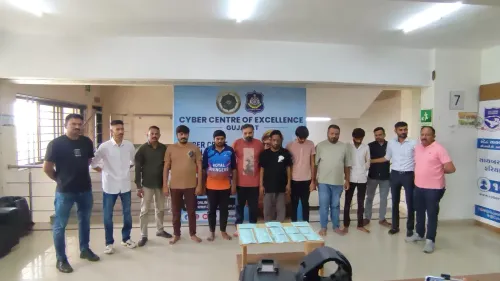
Gujarat Police bust ₹2,289 crore cyber fraud network, 638 arrested under Operation Mule Hunt 1.0

Synopsis
Gujarat Police's Operation Mule Hunt 1.0 exposed ₹2,289 crore in cyber fraud through a single-month blitz — 638 arrests, 913 mule accounts targeted, and cheque withdrawals slashed 80%. The operation doubles as a proof-of-concept for a national AI-backed mule-detection framework the RBI is now rolling out.
Key Takeaways
Gujarat Police launched Operation Mule Hunt 1.0 from 1–31 December 2025 , exposing ₹2,289 crore in cyber fraud.
Authorities registered 565 FIRs , made 638 arrests , and initiated proceedings against 913 mule accounts .
Investigators identified 4,052 cybercrime-linked cases, including 491 within Gujarat.
Monthly cheque withdrawals fell from ₹126 crore to ₹25 crore — an 80% drop; ATM withdrawals declined 66% .
The RBI is deploying AI-based risk-classification systems via IDPIC and a dedicated registry mulehunter.ai for inter-bank mule-account intelligence sharing.
Gujarat Police have dismantled a ₹2,289 crore cyber fraud network through a month-long statewide operation targeting mule bank accounts, resulting in 638 arrests, 565 FIRs, and action against 913 mule accounts. Operation Mule Hunt 1.0, conducted through December 2025, marks one of the largest coordinated cyber-financial crackdowns in the state's history.
What Operation Mule Hunt 1.0 Targeted
The operation, led by the Cyber Centre of Excellence of Gujarat Police, ran from 1 December to 31 December 2025 and involved district crime branches, cyber police stations, and supervisory officers at commissionerate and range levels across the state.
The primary targets were 'mule accounts' — bank accounts used, knowingly or unknowingly by their holders, to receive, transfer, or launder proceeds of cyber fraud. These accounts function as transit nodes, routing illicit funds through multiple layers to obstruct detection and asset recovery.
Scale of Enforcement Action
Investigators identified 4,052 cybercrime-linked cases in total, including 491 cases originating within Gujarat, based on consolidated intelligence inputs. The operation drew on data from the Indian Cyber Crime Coordination Centre (I4C), the National Cyber Crime Reporting Portal (NCRP), the Samanvay portal, and the national cybercrime helpline 1930.
District-level nodal officers coordinated field response teams, while banks were integrated into a structured framework for real-time sharing of transaction alerts and account-level information. Officials said this combined data-intelligence and inter-agency approach enabled targeted action against mule networks operating across state lines.
Impact on Suspicious Financial Activity
The enforcement push produced measurable shifts in banking transaction patterns, according to authorities. Cheque-based withdrawals reportedly declined by 75%, with monthly cheque withdrawals falling from ₹126 crore to ₹25 crore — an 80% reduction. First-layer mule accounts decreased by approximately 30% between August and December 2025, while ATM withdrawals recorded a 66% decline between September and December 2025.
This comes amid a broader national pattern of rising cyber-enabled financial fraud, with digital payment volumes expanding rapidly and fraudsters exploiting gaps in account-opening and transaction-monitoring frameworks.
RBI's AI-Based Monitoring Push
In parallel with enforcement, the Reserve Bank of India (RBI) has proposed deploying artificial intelligence-based systems to classify transactions by risk level — categorised as low, medium, or high — to help banks flag potentially fraudulent activity at an early stage. The framework is being implemented through the Indian Digital Payment Intelligence Corporation (IDPIC), designated as the nodal agency.
A dedicated registry, mulehunter.ai, has also been established to enable inter-bank information sharing on suspected mule accounts and related entities.
What Comes Next
Officials indicated that Operation Mule Hunt 1.0 will feed into sustained preventive monitoring efforts and improved real-time detection of cyber fraud networks operating through financial intermediaries. The operation is expected to serve as a template for similar coordinated drives in other states as India's digital financial ecosystem continues to expand.
Point of View
289 crore in exposed fraud, 638 arrests, all within a single calendar month — signals that mule-account infrastructure has become a systemic risk, not an edge problem. What is notable is the shift from reactive FIR-filing to data-led, inter-agency targeting using I4C and NCRP feeds; this is the architecture India needs, but it has taken years to operationalise. The RBI's parallel push on AI-based transaction classification and the mulehunter.ai registry suggests regulators now accept that law enforcement alone cannot keep pace with the velocity of digital fraud. The real accountability question is whether banks, which profit from account-opening volumes, will apply the same urgency to mule-account detection as police units have demonstrated here.
NationPress
16 Oct 2026
Frequently Asked Questions
What is Operation Mule Hunt 1.0?
Operation Mule Hunt 1.0 is a statewide cyber-financial crackdown conducted by Gujarat Police's Cyber Centre of Excellence throughout December 2025. It targeted mule bank accounts used to receive and launder proceeds of cyber fraud, resulting in 638 arrests, 565 FIRs, and action against 913 accounts linked to ₹2,289 crore in fraud.
What is a mule bank account?
A mule account is a bank account used — knowingly or unknowingly by its holder — to receive, transfer, or launder money obtained through cyber fraud. These accounts act as transit points across multiple layers, making it harder for investigators to trace and recover illicit funds.
How much cyber fraud was uncovered in Gujarat's Operation Mule Hunt 1.0?
Authorities linked ₹2,289 crore in fraudulent transactions to the mule account networks dismantled during the operation. The crackdown also identified 4,052 cybercrime-linked cases nationally, including 491 cases within Gujarat.
What role is the RBI playing in tackling mule accounts?
The Reserve Bank of India has proposed AI-based systems to classify banking transactions as low, medium, or high risk, helping banks detect fraud early. The framework is being implemented through the Indian Digital Payment Intelligence Corporation (IDPIC), with a dedicated inter-bank intelligence registry at mulehunter.ai.
What impact did the operation have on suspicious banking activity?
According to authorities, cheque-based withdrawals fell 75–80%, with monthly cheque withdrawals dropping from ₹126 crore to ₹25 crore. ATM withdrawals declined 66% between September and December 2025, and first-layer mule accounts fell by roughly 30% over the same period.