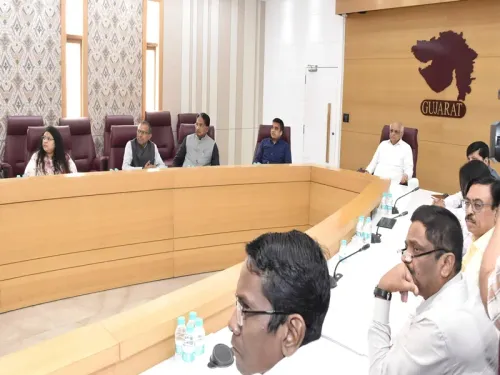
Gujarat digitises grain supply chain: 250 warehouses, 17,000 fair price shops under GPS tracking

Synopsis
Gujarat has quietly built one of India's most comprehensive digital food-supply surveillance systems — GPS on every grain truck, 7,000 cameras in warehouses, geofencing at 17,000 fair price shops, and biometric checks on farmer procurement. It is a full-stack overhaul of a system historically prone to leakage, and a potential template for national replication.
Key Takeaways
GSCSCL has deployed an ICT Logistics Software system covering 250 warehouses and approximately 17,000 fair price shops across Gujarat .
All transport vehicles carry GPS trackers ; the system alerts authorities instantly on route deviation or signal loss.
Around 7,000 CCTV cameras — including ANPR and PTZ units — have been installed at warehouses, with a Video Wall for live monitoring.
Geofencing and Electronic Proof of Delivery (EPOD) verify that consignments reach designated fair price shops.
The Farmer Procurement Portal digitises MSP purchases using Aadhaar , biometric, and land-record verification, with SMS updates at every stage.
The system is integrated with the FCI's Anna Darpan portal and managed from a centralised Command-and-Control Centre at GSCSCL headquarters.
Gujarat has placed its entire public food distribution network under real-time digital surveillance, deploying GPS-tracked transport vehicles, machine-learning-based route optimisation, and approximately 7,000 CCTV cameras to monitor the movement of foodgrains from storage facilities to consumers across the state. The initiative, rolled out by the Gujarat State Civil Supplies Corporation Ltd (GSCSCL), covers 250 warehouses and around 17,000 Pandit Deendayal Grahak Bhandar fair price shops statewide.
What the ICT Logistics System Does
At the heart of the overhaul is an ICT Logistics Software system that digitises the entire supply chain — from Food Corporation of India (FCI) depots through state warehouses and onward to fair price shops. Every transport vehicle is fitted with GPS, and the system triggers immediate alerts if a vehicle deviates from its designated route or if its GPS signal is interrupted. Route planning itself is driven by machine-learning algorithms that determine and monitor optimal paths in real time.
Geofencing has been activated at both warehouses and fair price shops, and Electronic Proof of Delivery (EPOD) is used to verify that consignments reach their intended destinations. A centralised Command-and-Control Centre at the GSCSCL headquarters provides continuous oversight, with the ability to flag and track suspicious activity as it occurs.
Surveillance Infrastructure at Warehouses
Security at storage facilities has been substantially upgraded with the installation of around 7,000 CCTV cameras — including Bullet, Dome, PTZ, and Automatic Number Plate Recognition (ANPR) units. A Video Wall system enables live viewing of camera feeds simultaneously. Monitoring access has been extended beyond the head office to the offices of Deputy District Managers and District Supply Officers, decentralising oversight while keeping it connected to the central command.
The Public Distribution System (PDS) portal displays live warehouse stock data and generates daily, weekly, and monthly dashboard reports. It has been integrated with the ICT Logistics Project and the FCI's Anna Darpan portal, creating a unified data environment across the supply chain.
Digital Procurement Directly from Farmers
The digitisation effort extends upstream to procurement. The Farmer Procurement Portal (FPP) now handles grain purchases at the Minimum Support Price (MSP), with farmer registration requiring verification of Aadhaar details, bank account information, and land ownership documents. Both demographic and biometric authentication are used in the verification process.
Farmers receive SMS updates at each stage of registration and procurement, keeping them informed of transaction progress in real time — a step that aims to reduce uncertainty and improve trust in the system.
Government's Stated Objective
The initiative is being implemented under the supervision of Food and Civil Supplies Minister Raman Solanki. According to officials, the primary goals are strengthening monitoring and verification within the Public Distribution System (PDS), curbing theft and adulteration, and improving delivery efficiency for beneficiaries. This comes amid broader national efforts to plug leakages in subsidised food distribution — a long-standing challenge for state governments across India.
With real-time tracking, geofencing, and biometric verification now embedded across the chain, Gujarat's model could serve as a reference point for other states looking to modernise their PDS infrastructure.
Point of View
But the real test is operational discipline — cameras and GPS trackers are only as effective as the humans monitoring them. India's PDS has historically suffered not from a lack of data but from a lack of accountability when data reveals wrongdoing. The integration with Anna Darpan is a meaningful step toward a national audit trail, yet the farmer-side biometric requirement, while reducing fraud, risks excluding marginalised cultivators without clean land records or stable Aadhaar linkages. Whether this becomes a genuine anti-leakage model or a well-documented status quo depends entirely on enforcement follow-through.
NationPress
16 Oct 2026
Frequently Asked Questions
What is the ICT Logistics Software system introduced by Gujarat for grain distribution?
It is a digital supply-chain management platform deployed by the Gujarat State Civil Supplies Corporation Ltd (GSCSCL) to track foodgrain movement across 250 warehouses and around 17,000 fair price shops in real time. The system uses GPS-fitted vehicles, geofencing, Electronic Proof of Delivery, and machine-learning route optimisation to monitor and verify every stage of the Public Distribution System.
How many CCTV cameras have been installed under Gujarat's grain monitoring initiative?
Approximately 7,000 CCTV cameras — including Bullet, Dome, PTZ, and Automatic Number Plate Recognition (ANPR) units — have been installed at warehouses across Gujarat. A Video Wall system at the Command-and-Control Centre enables live simultaneous viewing of feeds.
How does the system prevent diversion of foodgrains in transit?
The system triggers immediate alerts if a GPS-tracked vehicle deviates from its assigned route or if the GPS signal is cut. Geofencing at warehouses and fair price shops, combined with Electronic Proof of Delivery (EPOD), ensures consignments are verified at every transfer point.
How does the Farmer Procurement Portal work under this initiative?
The Farmer Procurement Portal (FPP) allows grain procurement at the Minimum Support Price (MSP) directly from farmers, with registration verified through Aadhaar details, bank account information, and land ownership documents using both demographic and biometric authentication. Farmers receive SMS notifications at each stage of the procurement process.
Which government minister is overseeing Gujarat's grain digitisation programme?
The initiative is being implemented under the supervision of Food and Civil Supplies Minister Raman Solanki. The GSCSCL, a state government joint venture, is the executing agency, with oversight centralised at a Command-and-Control Centre at its headquarters in Gandhinagar.