Is the Hong Kong Election a 'Sham' as Criticized by Human Rights Watch Amidst Beijing's Control?
Synopsis
Human Rights Watch has condemned the upcoming Legislative Council election in Hong Kong as a 'sham'. This criticism highlights Beijing's increasing power and the elimination of pro-democracy voices. The article explores implications for governance and civil liberties in Hong Kong, calling attention to the urgent need for restoration of democratic values.
Key Takeaways
HRW condemns Hong Kong elections as a sham .
No pro-democracy candidates present.
Beijing's control over the LegCo has increased significantly.
Concerns about governance due to lack of democratic institutions.
Recent incidents, like the Tai Po fire , emphasize the need for accountability.
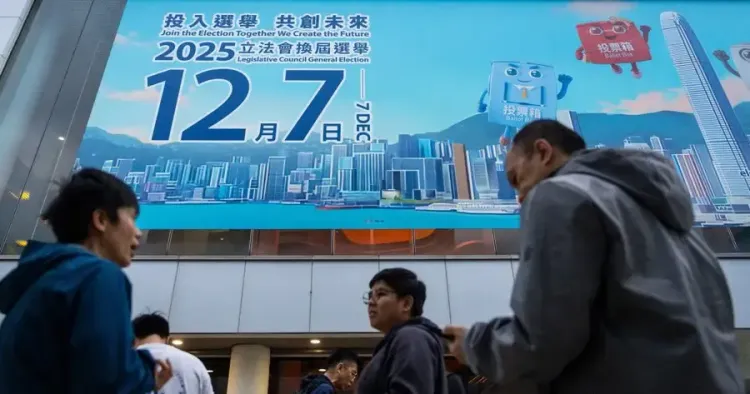
New York, Dec 6 (NationPress) Human Rights Watch (HRW), an advocacy organization based in the United States, has labeled the upcoming Legislative Council election in Hong Kong, set for Sunday, as a “sham”, asserting that it reveals the increasing dominance of Beijing.
The rights group pointed out that the absence of any pro-democracy candidates makes it evident that the Chinese government's portrayal of the LegCo as a legitimate body “hardly deceives anyone”.
HRW noted that many residents of Hong Kong silently boycotted the last election in 2021, resulting in an unprecedentedly low voter turnout.
“After five years of a sweeping crackdown, Beijing has taken complete charge of the LegCo. They altered laws to ensure that only loyalists to the Chinese Communist Party could participate, reduced the number of directly elected seats from 35 to 20 out of 90, disqualified democratically elected lawmakers, and imprisoned numerous leaders from the city's pro-democracy movement. Pro-democracy parties have dissolved, with the last active group, the League of Social Democrats, disbanding in June,” the rights organization reported.
Furthermore, the HRW underscored that Beijing is not only dismantling the entire pro-democracy faction; just days before the candidacy deadline, at least 22 senior pro-Beijing legislators announced their decision not to run for re-election. Analysts suggest that “Beijing orchestrated this upheaval to position individuals even more loyal to the party”.
The HRW highlighted that the current LegCo includes an increasing number of officials from the mainland with strong connections to the Chinese government but minimal understanding of Hong Kong. It remarked that election debates—which were once vibrant—now seem as “hollow and stilted” as the election itself.
“Authorities in Hong Kong are intensifying their crackdown on individuals challenging the façade. At least eight people have been arrested for incitement; others for urging people to abstain from voting. In November, a national security judge sentenced a woman to a year in prison for advocating for the Hong Kong Parliament, a diaspora-led project aimed at creating an unofficial democratic legislature outside of China,” the HRW added.
The HRW also pointed to the recent tragic Tai Po fire in Hong Kong, which has raised alarms about governmental negligence, indicating that the absence of democratic institutions has tangible repercussions—not just in terms of lives but also in effective governance.
“Calls for government accountability following the fire seem to be unnerving Beijing. Instead of escalating repression in Hong Kong at a significant cost, the Chinese government ought to take steps to restore the openness that once characterized Hong Kong’s dynamic and prosperous society,” the HRW asserted.
Point of View
I believe it's crucial to focus on the implications of this situation. The lack of a democratic process in Hong Kong raises serious questions about governance and accountability. The HRW's report illustrates the dire consequences of Beijing's control, urging a reconsideration of the fundamental values that the region once stood for. It's important for us to remain vigilant in these pivotal times.
NationPress
6 Oct 2026
Frequently Asked Questions
What did Human Rights Watch say about the Hong Kong elections?
Human Rights Watch criticized the upcoming Legislative Council elections in Hong Kong as a 'sham', indicating that it reflects Beijing's growing control over the region.
Why is there no pro-democracy candidate in the elections?
The absence of pro-democracy candidates is a result of laws revised by Beijing that restrict participation to only Chinese Communist Party loyalists.
What was the turnout in the last election?
The last election in 2021 saw a significant boycott from Hong Kong residents, leading to a record-low voter turnout.
What are the implications of the current LegCo composition?
The current composition of the LegCo includes many mainland officials with strong ties to the Chinese government, raising concerns about effective governance and representation.
What recent incidents have highlighted the government's negligence?
The Tai Po fire incident has raised alarms regarding governmental negligence and the tangible costs of lacking democratic institutions.