Transforming India-Africa Relations: From Solidarity to Strategic Partnership
Synopsis
Discover how the India-Africa partnership is evolving from historical solidarity into a strategic alliance aimed at fostering a fair global order, as discussed at a recent conference hosted by the Chintan Research Foundation.
Key Takeaways
India-Africa engagement is transitioning from historical solidarity to a strategic partnership.
South-South cooperation is essential for addressing challenges like climate change and supply chain disruptions.
Trade targets aim for $200 billion by 2030, enhancing economic ties.
Key areas for collaboration include digitization and critical minerals .
The inclusion of the African Union in the G20 marks a significant milestone in the partnership.
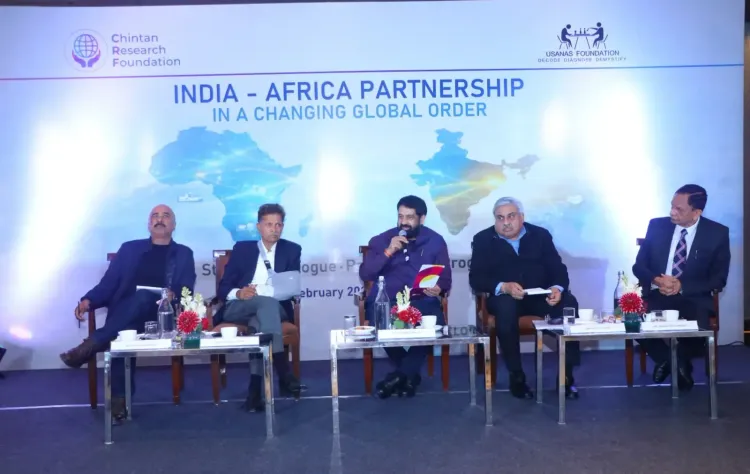
New Delhi, Feb 23 (NationPress) As global power dynamics shift, the relationship between India and Africa is evolving from historical unity to a proactive alliance aimed at fostering a fairer and multipolar world order, as highlighted by delegates at a conference hosted by the Chintan Research Foundation (CRF) on Monday.
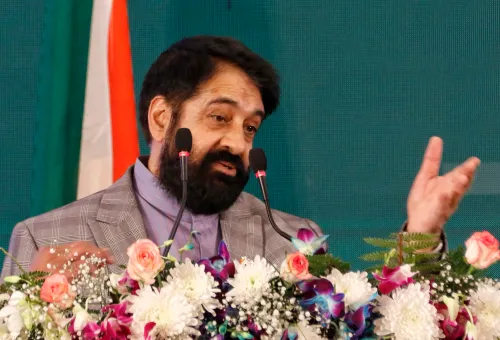
During the keynote address, Sudhakar Dalela, Secretary (Economic Relations) in the Ministry of External Affairs, remarked, "In these challenging times marked by supply chain disruptions, there is a pressing need for south-south cooperation focused on energy transition and climate action."
Emphasizing Africa's pivotal role in India's economic diplomacy and South-South cooperation, Dalela's speech illustrated the expanding Indian diplomatic presence in Africa, rooted in the ethos of Vasudhaiva Kutumbakam (the world is one family).
The conference, themed "India–Africa Partnership in a Changing Global Order", was organized by the CRF in partnership with the USANAS Foundation, Udaipur. It convened ambassadors, senior diplomats, policymakers, scholars, and strategic analysts to discuss the evolving dynamics of India–Africa engagement in a rapidly changing global environment.
Panelists stressed the necessity for the India–Africa partnership to broaden into emerging fields such as digitization, critical minerals, and climate action, while reinforcing cooperation in trade, interpersonal connections, and security risks.
In his welcoming remarks, Shishir Priyadarshi, CRF President, and Dr. Abhinav Pandya, Founder & CEO of the USANAS Foundation, highlighted the importance of fortifying the India-Africa trade relationship. They noted that the current global fragmentation and unpredictability in trade could hinder growth in the India-Africa partnership and emphasized the historical significance and the need for resilient global institutions and security frameworks to promote South-South cooperation.
During the discussions, panelists pointed out that enhancing the India-Africa partnership in trade, technology, and transnational connectivity presents both opportunities and challenges. With India and Africa achieving over $100 billion in trade for 2024-25, targeting $200 billion by 2030, it was urged that India should engage more cohesively with Africa to further boost trade.
The High Commissioner of South Africa to India, Anil Sooklal, underlined three crucial aspects of technological collaboration, including the sharing of agricultural innovations for food security and support in capacity building and skill enhancement, which should be factored into the upcoming fourth India-Africa Forum Summit (IAFS). He emphasized the need for India to develop a structured approach for engagement with the broader African continent while exploring the transformative potential of the African Continental Free Trade Area (AfCFTA).
In discussions about the growth of India–Africa industrial cooperation, it was noted that India's contribution to Africa's industrialization is vital, as it combines financing, expertise, and skills.
Ambassador Anil Wadhawa pointed out that cooperation in technology, ports, and infrastructure between India and Africa is about more than just building assets; it’s about co-creating futures in a shifting global landscape. He also stressed the necessity of sharing India’s digitization experiences.
The conference further examined strategies to reinforce and navigate the India–Africa partnership within the current global context.
Ambassador Dr. Desire Boniface Some of Burkina Faso noted the emergence of a new world structure with the rise of President Donald Trump in the US and emphasized the need to focus on how India–Africa cooperation can yield mutually beneficial outcomes.
Discussions also explored how the India-Africa partnership can be fortified amid engagement with great powers in Africa. Speakers acknowledged the inclusion of the African Union in the G20 as a significant achievement in the India–Africa partnership, particularly in addressing strategic alignments in a dynamic global order.
Point of View
The focus on cooperation in technology, trade, and sustainable development is vital for fostering a more equitable world order.
NationPress
27 Sept 2026
Frequently Asked Questions
What is the theme of the recent India-Africa conference?
The theme of the conference was 'India–Africa Partnership in a Changing Global Order.'
What are the key areas of focus for the India-Africa partnership?
Key areas include trade, technology, climate action, and critical minerals, among others.
Who organized the India-Africa conference?
The conference was organized by the Chintan Research Foundation in collaboration with the USANAS Foundation.
What trade targets were discussed for India and Africa?
Both regions aim to reach $200 billion in trade by 2030, having surpassed $100 billion in 2024-25.
What role does technology play in India-Africa cooperation?
Technology is crucial for collaboration in sectors like agriculture, capacity building, and industrialization.