India-EU free trade pact driven by strategic necessity, not just economics: Report
Synopsis
The India-EU free trade pact is less a conventional trade deal and more a geopolitical hedge — built on the wreckage of Europe's old dependencies on the US, Russia, and China. Researcher Tobias Scholz's new report argues the deal's deliberate incompleteness is a feature, not a flaw, reflecting how strategic necessity now shapes economic architecture between two major non-Western-aligned powers.
Key Takeaways
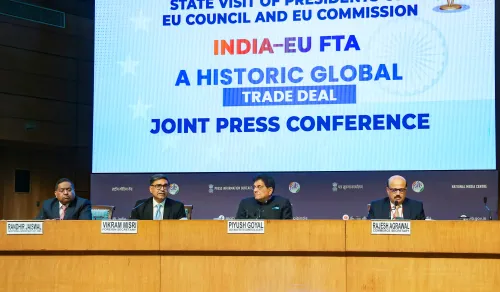
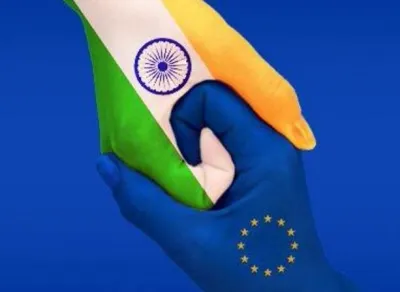
The India-EU free trade agreement is described as the first major bilateral trade deal between two of the world's largest economic entities.
The pact only partially liberalises agriculture , excludes government procurement , and leaves many non-tariff barriers in place.
Tariff reductions in the automobile sector are phased over 10 years .
Researcher Tobias Scholz argues the deal's limited scope reflects a strategic partnership driven by necessity, not a failure of ambition.
Europe's loss of its three legacy dependencies — US security , Chinese markets , and Russian energy — is identified as the primary catalyst for the EU pivot toward India.
India's deadly border clashes with China in Ladakh and its China+1 economic positioning accelerated the convergence with Europe .
The India-European Union free trade agreement represents the first major bilateral trade deal between two of the world's largest economic entities and is projected to deliver a sharp rise in bilateral trade volumes, according to a new report published on 8 October 2026. However, the agreement's scope is deliberately constrained — and researchers argue that constraint is itself the point.
What the Deal Covers — and What It Doesn't
The trade pact only partially liberalises sensitive sectors such as agriculture, leaves government procurement outside its ambit, and keeps many non-tariff barriers intact. In the automobile sector specifically, tariff reductions are to be phased in over a period of 10 years, reflecting the political sensitivity of the sector on both sides.
According to researcher Tobias Scholz, this measured approach should not be read as a failure of ambition. 'This apparent gap between political ambition and limited liberalisation should not simply be understood as a shortcoming of the trade deal. Rather, the nature of the agreement illustrates a defining feature of the emerging EU-India relationship,' the article states.
Strategic Necessity Over Economic Logic
Unlike many of Europe's traditional partnerships — which were anchored in commercial convenience — the EU's engagement with India is reportedly driven by a strategic imperative that both parties now pursue out of necessity. The report notes that major international disruptions have placed both Europe's and India's economic models under pressure, compelling both sides to diversify trade relationships, reduce geo-economic vulnerabilities, and cultivate new partnerships.
The report identifies three dependency-turned-liability moments for the EU: its security reliance on the United States, its dependence on the Chinese export market, and its heavy use of cheap fossil energy from Russia. 'Within a few years, all three dependencies turned into liabilities,' the article observes. The election of Donald Trump as US President, the Russia-Ukraine war, and China's assertive posture in the Indo-Pacific are cited as the proximate triggers that pushed the EU toward New Delhi.
The China Factor and India's Positioning
On the Indian side, the convergence with Europe accelerated following India's first deadly border clashes with China in decades in the Ladakh sector. Beyond the security dimension, India also recognised an economic opening — positioning itself as a China+1 manufacturing and supply chain partner for European companies seeking to reduce exposure to Beijing.
The report traces the formal intellectual architecture of this shift: the EU's joint communication on China in 2019 labelled Beijing as simultaneously a partner, competitor, and rival. The subsequent EU Indo-Pacific Strategy elevated relations with New Delhi as a strategic priority, providing the institutional momentum for the trade talks that ultimately produced the current agreement.
Significance and Outlook
Analysts note that the agreement's architecture — deliberately incomplete, phased, and politically calibrated — is consistent with how major powers negotiate when the primary goal is relationship-building rather than pure market access. This is the first time the EU has concluded a comprehensive bilateral trade deal with a major non-Western democracy of India's scale and strategic weight. The coming years will test whether the strategic logic that drove the deal can also deliver the economic dividends both sides are counting on.
Point of View
But it is really a geopolitical insurance policy for both sides. Europe is scrambling to rebuild dependencies it naively allowed to concentrate in Washington, Moscow, and Beijing simultaneously — a historic strategic miscalculation now being unwound in a hurry. For India, the deal is advantageous precisely because it asks for less: limited agricultural liberalisation and a decade-long auto tariff glide path are small prices for being institutionally embedded in Europe's supply chain diversification story. The deeper risk is that strategic convenience is not a substitute for genuine market opening — and if the non-tariff barriers and procurement exclusions remain entrenched, the 'sharp rise in trade' the report projects may prove as elusive as many previous bilateral optimism cycles.
NationPress
8 Oct 2026
Frequently Asked Questions
What is the India-EU free trade agreement?
The India-EU free trade agreement is a bilateral trade pact between India and the European Union, described as the first major such deal between two of the world's largest economic entities. It is projected to significantly boost trade between the two sides, though it only partially liberalises several sensitive sectors.
Why is the India-EU trade deal considered strategically driven?
According to researcher Tobias Scholz, the deal reflects a strategic partnership born out of necessity rather than purely commercial logic. Both sides are seeking to diversify trade relations and reduce geo-economic risks — the EU because its traditional dependencies on the US, Russia, and China have turned into liabilities, and India following its border tensions with China in Ladakh.
Which sectors are excluded or only partially covered in the India-EU trade deal?
Agriculture is only partially liberalised, government procurement is excluded entirely, and many non-tariff barriers remain in place. In the automobile sector, tariff reductions are phased in over 10 years to manage political and economic sensitivities on both sides.
How does the China factor influence the India-EU relationship?
The EU's 2019 joint communication on China officially labelled Beijing as a partner, competitor, and rival simultaneously, providing early momentum for closer EU-India ties. India's deadly border clashes with China in the Ladakh sector and its positioning as a China+1 supply chain alternative for European firms further accelerated the strategic convergence.
What does the EU Indo-Pacific Strategy have to do with the India trade deal?
The EU Indo-Pacific Strategy explicitly emphasised the importance of the EU's relationship with New Delhi, providing an institutional framework that underpinned the trade negotiations. It signalled a formal EU acknowledgement that India is a priority strategic partner in the region, laying the groundwork for the bilateral deal.