India needs 9.25% annual growth to become developed by 2047: NITI Aayog
Synopsis
NITI Aayog Vice-Chairman Ashok Kumar Lahiri has put a precise number on India's Viksit Bharat ambition: 9.25% average nominal growth every year for 21 years, lifting per capita income sixfold to $18,000 by 2047. The math is demanding — and so is the reform agenda he says is non-negotiable to get there.
Key Takeaways
NITI Aayog Vice-Chairman Ashok Kumar Lahiri said India needs 9.25% average nominal annual growth to become a developed country by 2047 .
Per capita income must rise from $2,813 in 2026 to approximately $18,000 by 2047 — a more than sixfold increase.
India's gross fixed capital formation has stayed below 30% of GDP , versus 35% or more for East Asian peers.
India's savings rate recovered to 35% in 2025 but still trails China by 10–15 percentage points ; the current account deficit stood at $16.5 billion in 2025.
Lahiri identified land and capital market imperfections , ease of doing business, education, health, infrastructure, and a faster justice system as key reform priorities.
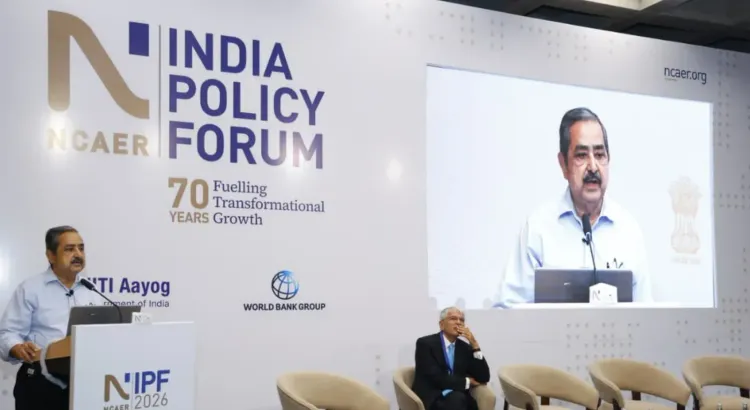
NITI Aayog Vice-Chairman Ashok Kumar Lahiri on Thursday, 6 August said India's goal of becoming a developed nation by 2047 is achievable, but only through rapid and sustained reforms. Speaking at an event organised by the National Council of Applied Economic Research (NCAER) in New Delhi, Lahiri laid out the scale of the challenge: India must increase its per capita income more than sixfold — from $2,813 in 2026 to roughly $18,000 by 2047 — requiring an average nominal annual growth rate of 9.25% over the next 21 years.
The Growth Benchmark
Lahiri drew on the development trajectories of Japan, South Korea, Taiwan, Hong Kong, Singapore, and China to argue that such a leap is not unprecedented. 'Others have done it, so can India, but it needs support through rapid reforms,' he said. These economies sustained comparable growth rates during their own transitions to developed-nation status, offering India a replicable, if demanding, template.
Capital Formation and Efficiency Gap
A key structural concern Lahiri flagged was India's gross fixed capital formation, which has remained below 30% of GDP for most years — well short of the 35% or more recorded by East Asian economies at comparable stages of development. He noted, however, that India deploys capital relatively efficiently, with an incremental capital output ratio (ICOR) of 4.5 to 5, a metric that compares favourably with China's. The problem, he argued, is not just the quantum of investment but the economy's absorptive capacity. 'An economy does not grow so much because it does not invest enough, but because its dynamism is not strong enough to enable it to apply more investment efficiently,' Lahiri observed.
Savings Rate and Current Account Deficit
On the savings front, Lahiri noted that India's savings rate peaked at 37% in 2007, fell to 29% in 2020, and has since recovered to 35% in 2025 — yet still trails China by 10 to 15 percentage points consistently. He attributed part of this gap to a persistent current account deficit, which stood at $16.5 billion in 2025, contrasting sharply with surpluses maintained by China, South Korea, and Singapore. FDI inflows have also remained limited relative to these peer economies, he added.
Reform Priorities Identified
Lahiri identified factor market imperfections in land and capital as significant structural bottlenecks. He underscored the need to ease doing business at the grassroots level to unlock investment. On long-term growth drivers, he listed education, health, infrastructure, and entrepreneurship, alongside administrative reforms, law and order improvements, and a faster justice system as essential priorities. This comes amid broader policy discussions on India's Viksit Bharat vision, with multiple government bodies aligning programmes to the 2047 target. Whether the reform pace can match the ambition remains the central question.
Point of View
Geopolitical, and trade conditions. More telling is his admission that the problem is not a shortage of investment ambition but a deficit of absorptive capacity — which points squarely at institutional quality, not just policy announcements. India's savings rate trailing China by 10–15 points for decades, combined with a persistent current account deficit, suggests structural consumption patterns that cannot be reformed by decree. The 2047 target risks becoming another aspirational headline unless the reform agenda he outlined — land markets, capital access, justice delivery — moves from conference rooms to legislation.
NationPress
21 Sept 2026
Frequently Asked Questions
What growth rate does India need to become a developed country by 2047?
India needs an average nominal annual growth rate of 9.25% over the next 21 years, according to NITI Aayog Vice-Chairman Ashok Kumar Lahiri. This would lift per capita income from $2,813 in 2026 to around $18,000 by 2047 — a more than sixfold increase.
Why does Lahiri say rapid reforms are essential for India's 2047 target?
Lahiri argues that India's growth is constrained not by a lack of investment intent but by insufficient economic dynamism and absorptive capacity. Factor market imperfections in land and capital, a below-par savings rate, and ease-of-doing-business gaps at the grassroots level are among the structural barriers he identified.
How does India's capital formation compare with East Asian economies?
India's gross fixed capital formation has remained below 30% of GDP for most years, compared with 35% or more recorded by East Asian countries such as China, South Korea, and Singapore during their high-growth phases. Lahiri noted India uses capital relatively efficiently, with an ICOR of 4.5 to 5.
What is India's current savings rate and how does it compare with China?
India's savings rate recovered to 35% in 2025 after dipping to 29% in 2020, but it has consistently trailed China by 10 to 15 percentage points. India also ran a current account deficit of $16.5 billion in 2025, contrasting with surpluses in China, South Korea, and Singapore.
Which countries did Lahiri cite as models for India's development ambition?
Lahiri cited Japan, South Korea, Taiwan, Hong Kong, Singapore, and China as economies that achieved comparable high-growth trajectories on their way to becoming fully developed nations, arguing that India can replicate this path with the right reforms in place.