Is India's Strategic Autonomy Redefining Global Partnerships?
Synopsis
India's recent diplomatic engagement with Russia showcases its intent to redefine global relations on its terms. This article explores how Prime Minister Modi's actions signify a shift in India's strategic approach, emphasizing autonomy and partnership without apology.
Key Takeaways
India's strategic autonomy emphasizes independent decision-making in foreign policy.
The recent Modi-Putin meeting showcases India's influence in shaping geopolitical relations.
India aims for a $100 billion trade target with Russia by 2030.
Policy implications highlight the need for the West to engage with India as an equal.
India's diplomatic approach may lead to a reshuffling of alliances on the global stage.
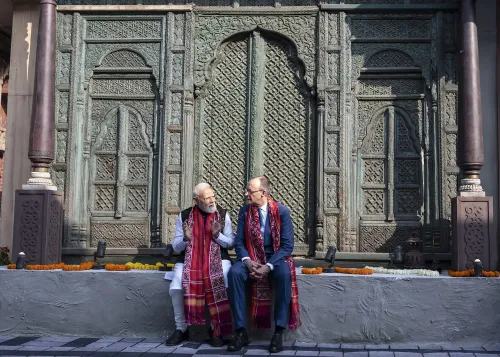
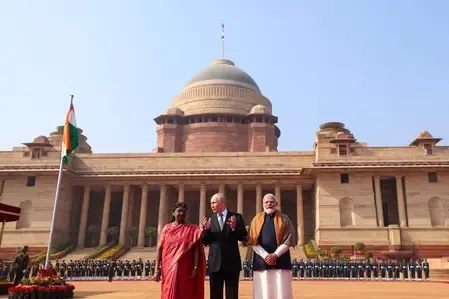
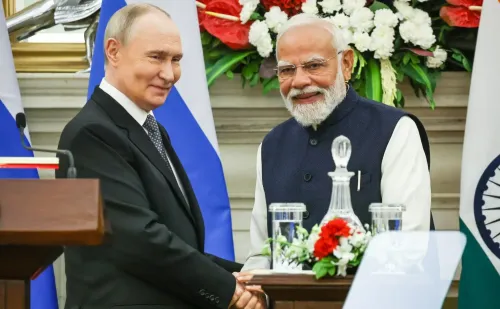
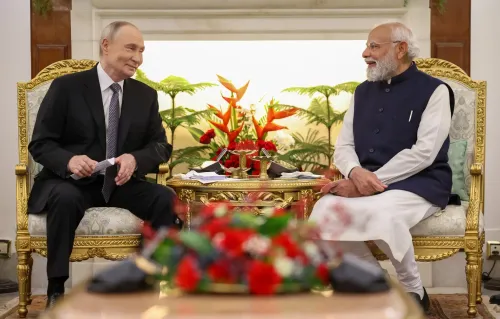
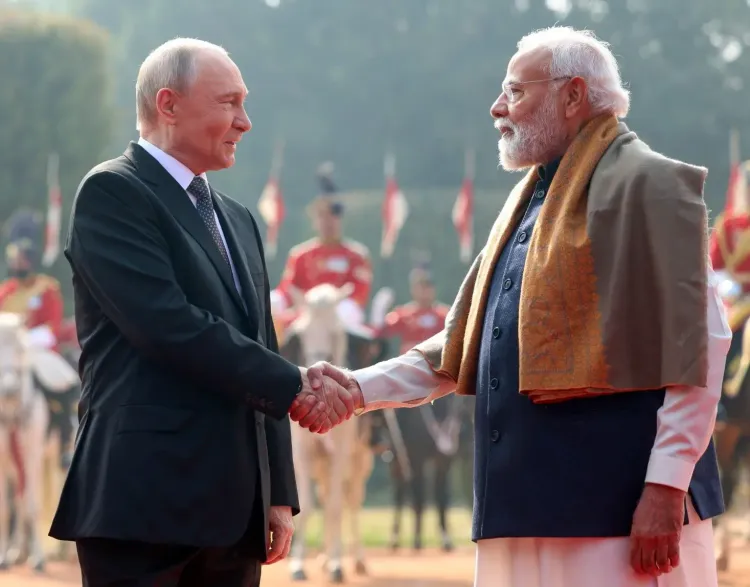
New Delhi, Dec 8 (NationPress) The bond shared between Russian President Vladimir Putin and Prime Minister Narendra Modi during the latter's recent visit to India was not a provocation against the West, nor a regression to Cold War dynamics, but rather a clear indication that New Delhi's strategic autonomy is an active principle — engaging widely, dissenting gracefully, and making choices unapologetically, as reported on Monday.
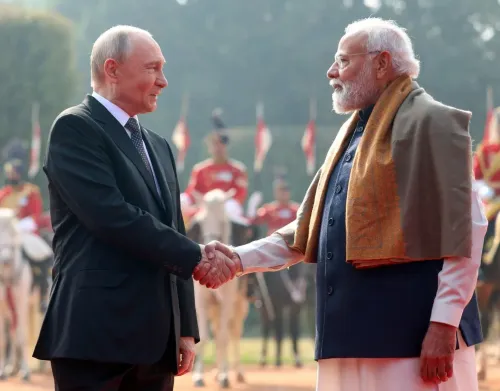
This report highlighted that their heartfelt embrace encapsulated a crucial reality the global community has found challenging to acknowledge — India is no longer merely adapting to geopolitical shifts; it is actively shaping them.
"When Prime Minister Modi broke traditional protocol on the evening of December 4, 2025, to personally greet President Putin on the tarmac of Palam Air Base, the moment lasted a significant eight seconds on live television. In diplomacy, eight seconds can feel like an eternity. It was sufficient for the world to recognize that India had just set off a quiet thermonuclear signal in the depths of the Western sanctions framework. The embrace was warm, unhurried, and entirely intentional. It echoed loudly in the silence that Washington and Brussels have not heard in years," articulated former Indian diplomat Sanjay Kumar Verma in India Narrative.
"The subsequent choreography was pure theatricality, with underlying strength. An Indian-manufactured vehicle transported the two leaders from the tarmac. A private dinner at Hyderabad House extended late into the night. President Droupadi Murmu raised a toast to 'eternal friendship' beneath the chandeliers of Rashtrapati Bhavan. The joint statement outlined a goal of $100 billion in trade by 2030, nuclear reactors at Kudankulam, collaborative AI research, and Arctic shipping through the warming Arctic, among various other initiatives. While these may not seem groundbreaking on paper, they are transformative in context," noted Verma, the current Chairperson of the Research and Information System for Developing Countries (RIS).
According to the report, it is rare for a single diplomatic visit to ignite such a flurry of official statements, leaked briefings, anonymous quotes, and social media reactions, with global responses occurring in real time.
The policy ramifications for the West are stark — threats fail, tariffs backfire, and moral lectures only elicit eye-rolls.
"Should Washington seek India's assistance in managing China (a nearly unanimous bipartisan objective), it must treat India as an equal. This entails accepting defense industrial connections with Russia, energy ties with the most affordable suppliers, and technological partnerships based on merit rather than ideology. Brussels faces a similar dilemma; otherwise, it may witness India gravitating towards an expanded BRICS where its voting power surpasses that of the entire European Union combined," the report concluded.
Point of View
This report highlights India's evolving role on the global stage, emphasizing the importance of strategic autonomy in foreign policy. While maintaining relationships, India asserts its independence, a crucial stance in today's polarized geopolitical landscape.
NationPress
3 Oct 2026
Frequently Asked Questions
What does India's strategic autonomy mean?
India's strategic autonomy refers to its ability to make independent policy decisions in foreign relations, allowing it to engage with multiple partners without being beholden to any single power.
How does the India-Russia relationship impact the West?
The strengthening of India-Russia ties challenges Western narratives and signals that India prioritizes its national interests over alignment with Western agendas.
Why is the recent Modi-Putin meeting significant?
The meeting symbolizes India's assertive diplomatic stance and its capability to influence global geopolitical currents, highlighting a departure from traditional dependencies.
What are the implications of India's trade goals with Russia?
India's ambitious trade targets with Russia could enhance economic ties and reduce reliance on Western markets, fostering a more multipolar global economy.
What is the BRICS alliance?
BRICS is an alliance of emerging economies - Brazil, Russia, India, China, and South Africa - aimed at promoting peace, security, and development in a multipolar world.