India and US Prepare for Key Trade Discussions Starting April 20
Synopsis
As India prepares for pivotal trade discussions in Washington, D.C., the outcome may reshape trade dynamics significantly. With newly imposed tariffs and ongoing investigations, both nations are set to navigate complex negotiations that could redefine their economic partnership.
Key Takeaways
India's delegation arrives in Washington on April 20.
Negotiations will cover the Bilateral Trade Agreement (BTA).
Recent tariff changes are influencing the trade landscape.
Ongoing investigations by the US Trade Representative are part of the agenda.
India aims for $500 billion in imports from the US over five years.
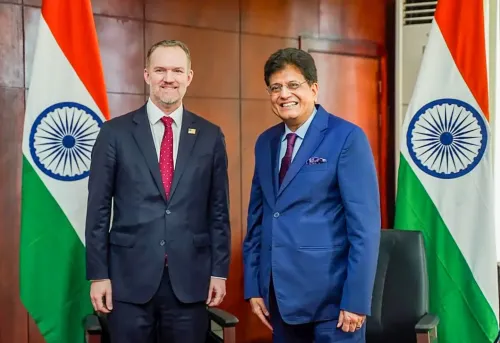
New Delhi, April 19 (NationPress) A delegation comprising around twelve Indian officials is scheduled to touch down in Washington, D.C. on April 20 for a crucial three-day negotiation session with US officials, representing a significant advancement in talks concerning the initial phase of a proposed Bilateral Trade Agreement (BTA).
The discussions, taking place from April 20 to 22, will be directed by India’s chief negotiator, Darpan Jain, who serves as an additional secretary in the Department of Commerce, alongside members from the customs department and the ministry of external affairs.
These forthcoming negotiations are set against the backdrop of noteworthy changes in the US tariff system.
In light of a recent US Supreme Court ruling that invalidated extensive tariffs previously enforced by President Donald Trump through emergency powers, the current US administration has enacted a temporary 10% tariff on imports from all nations for 150 days starting February 24.
This development has reshaped the trade dynamics and is anticipated to encourage both parties to reassess the agreement's framework, which was initially unveiled on February 7.
Officials have indicated that the updated tariff conditions may require a reevaluation of the proposed deal.
Previously, the US had consented to lower tariffs on Indian imports to 18% from a maximum of 50%, which included the elimination of certain penalties associated with India’s acquisition of Russian oil.
However, the implementation of a uniform 10% tariff across all trading partners has weakened India’s competitive edge under the earlier framework, making renegotiation imperative.
Alongside tariff-related issues, the agenda will cover two ongoing unilateral investigations initiated by the US Trade Representative under Section 301 of US trade legislation.
India has firmly dismissed the allegations stemming from these investigations, asserting that they lack sufficient grounds and has called for their cessation.
The original BTA framework encompassed India’s proposal to considerably reduce or eliminate tariffs on a diverse array of US industrial and agricultural products.
This included commodities like soybean oil, tree nuts, fruits, wine and spirits, as well as animal feed products.
India had also conveyed its ambition to escalate imports from the US, aiming for purchases valued at $500 billion over five years across various sectors such as energy, aviation, technology, precious metals, and coking coal.
Point of View
This development is crucial as it may significantly affect economic relations between India and the US. Both nations face challenges that require careful negotiation, with the potential for far-reaching implications on global trade. It is a pivotal moment that demands close attention.
NationPress
28 Sept 2026
Frequently Asked Questions
What is the purpose of the upcoming trade talks?
The trade talks aim to advance discussions on the initial phase of a proposed Bilateral Trade Agreement (BTA) between India and the US.
Who is leading the Indian delegation?
The Indian delegation is led by Darpan Jain, the chief negotiator and an additional secretary in the Department of Commerce.
Why are tariffs a focus in these discussions?
Tariffs are a focus because recent changes in the US tariff regime could impact the terms of the proposed trade agreement.
What are the ongoing investigations mentioned?
The investigations are unilateral probes launched by the US Trade Representative under Section 301 of US trade law, relating to trade practices.
What are India's goals regarding imports from the US?
India aims to increase imports from the US to a target of $500 billion over five years in various sectors.