How is India's Pinaka Enhancing Defence Capabilities?
Synopsis
The recent deployment of India's Pinaka Long Range Guided Rocket (LRGR-120) marks a significant shift in military strategy, moving towards precision strikes. This development not only strengthens India's defence capabilities but also positions it strategically against regional threats. Discover the implications of this groundbreaking technology in modern warfare.
Key Takeaways
Pinaka LRGR-120 represents a significant shift in Indian military strategy.
Enhanced targeting capabilities with precision strikes .
Utilizes advanced Inertial Navigation System (INS) .
Potential for international demand and exports.
Future variants aim to extend range significantly.
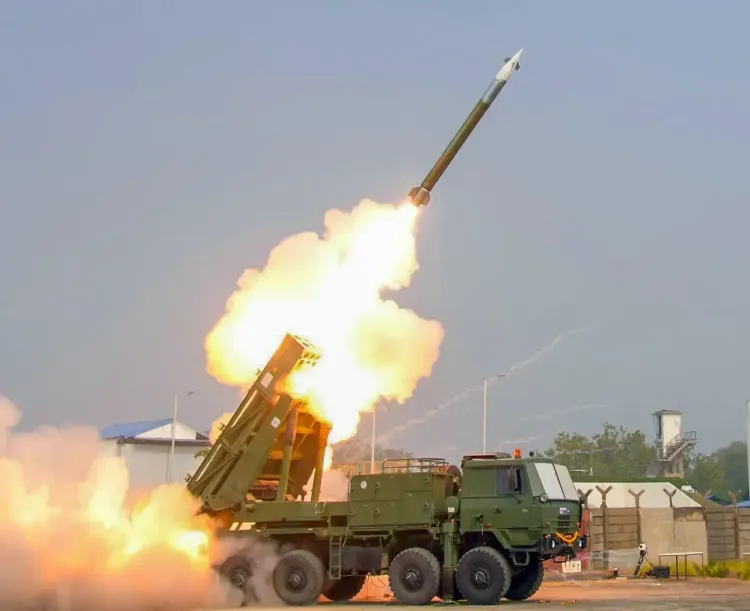
Washington, Jan 13 (NationPress) The introduction of India's Pinaka Long Range Guided Rocket (LRGR-120) signifies a pivotal transformation for the Indian Army, moving from “volume saturation to precision strike”, according to a report released on Tuesday.
The report highlights that by evolving from near-front impact strategies to deep operational effects, the new LRGR-120 redefines tube artillery support as a standoff deterrence tool.
As per an article in the US-based magazine The National Interest, this advanced weapon system is set to revolutionize Indian Army warfare and will be deployed against potential threats from Pakistan or China that jeopardize India's interests in the imminent future.
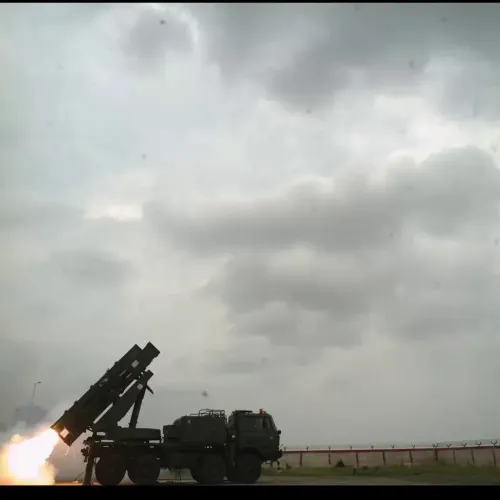
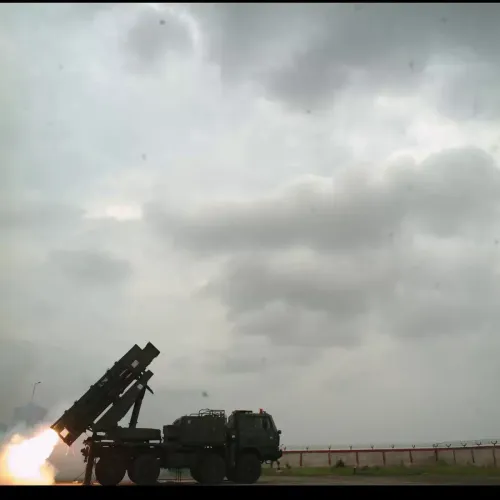
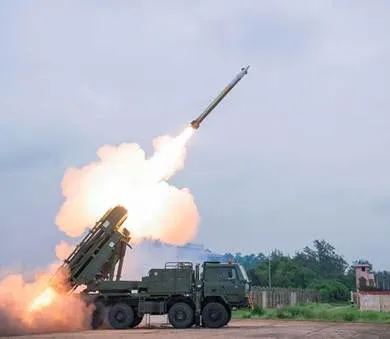
The Defence Research and Development Organisation (DRDO) of India successfully conducted tests for the Pinaka Long Range Guided Rocket (LRGR-120) towards the end of last year. According to various sources, the weapon achieved targets up to 120 kilometres away with remarkable precision. It is a fully domestically produced system that enhances the long-range strike capabilities of the Indian Army—these rockets can be launched from existing Indian launchers, thereby reducing overall costs.
The LRGR-120 utilizes an Inertial Navigation System (INS) featuring mid-course updates and terminal guidance to ensure exceptional accuracy.
Furthermore, the Pinaka Multi Barrel Rocket Launcher (MBRL) can fire salvos of up to eight guided rockets, designed specifically for standoff precision strikes aimed at enemy command posts, artillery, and logistical centers.
The report also notes that France has expressed interest in procuring the Pinaka system from India, highlighting its rising demand in the global arms market.
Despite the fact that HIMARS has greater ranges than the Pinaka, the new weapon developed by the DRDO provides India with a crucial enhancement in its long-range fire capabilities—ensuring that India's domestic arms production thrives by keeping production within the country.
The report mentions that the Indian development teams have indicated that the Pinaka is not a static weapon, with plans for upgraded variants over time.
Future iterations of the Pinaka are expected to extend its range significantly, with discussions around 200–300-kilometre variants among DRDO designers. Thus, New Delhi is dedicated to making this weapon system as competitive and lethal as possible in light of the dual threats posed by neighboring China and Pakistan.
IANS
scor/as
Point of View
This advancement in India's military technology underscores the nation's commitment to strengthening its defense posture in a volatile regional landscape. The Pinaka LRGR-120 not only enhances India's deterrence capabilities but also reinforces its self-reliance in defense production.
NationPress
30 Sept 2026
Frequently Asked Questions
What is the Pinaka Long Range Guided Rocket?
The Pinaka Long Range Guided Rocket (LRGR-120) is an advanced artillery system developed by India's Defence Research and Development Organisation (DRDO), capable of striking targets up to 120 kilometers away with high precision.
How does the LRGR-120 improve military strategy?
The LRGR-120 shifts India's military strategy from volume saturation to precision strikes, allowing for more effective targeting of enemy installations and reducing collateral damage.
What technologies does the LRGR-120 use?
The LRGR-120 utilizes an Inertial Navigation System (INS) with mid-course updates and terminal guidance to ensure accuracy in targeting.
Is the Pinaka system being considered for export?
Yes, there is growing international interest in the Pinaka system, with countries like France expressing a desire to acquire it.
What future developments are planned for the Pinaka?
Future variants of the Pinaka are expected to enhance its range significantly, with discussions around 200-300-kilometer capabilities.