Trump Declares Iran Conflict Approaching Resolution
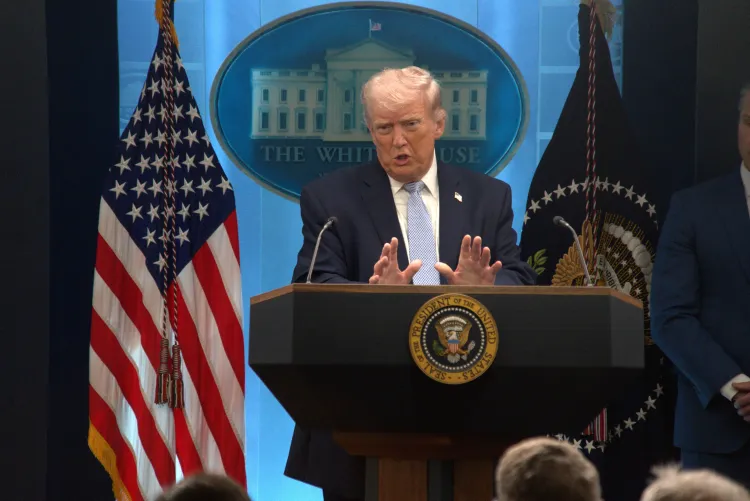
Synopsis
US President Donald Trump claims the conflict with Iran is nearing an end, highlighting significant impacts on Tehran amid escalating tensions. He emphasizes the importance of preventing nuclear arms acquisition, while also projecting economic recovery and financial market optimism.
Key Takeaways
President Trump believes the Iran conflict is nearing an end.
A blockade of Iranian ports is fully implemented.
The U.S. maintains a strong stance against Iran's nuclear ambitions.
Short-term economic disruptions are expected, yet recovery is anticipated.
Oil prices and financial markets are projected to stabilize post-conflict.
Washington, April 15 (NationPress) President Donald Trump has indicated that the conflict with Iran is "approaching a conclusion," emphasizing that a comprehensive blockade of Iranian ports is now fully operational and that Tehran has been "significantly impacted" due to rising tensions surrounding its nuclear objectives.
In a recent interview with Fox News from the White House, Trump remarked on the strong U.S. response, saying, "It's been truly remarkable... we've decimated them," and added that the final outcome would hinge on future developments. "Ultimately, the end result is what counts... and perhaps it will occur quite soon."
He reaffirmed that stopping Iran from acquiring nuclear weapons is the primary goal. "They must not possess a nuclear weapon. If they are to develop one, we will have to coexist with that possibility for a limited time. However, I am uncertain how much longer they can endure," Trump stated.
The President noted that the U.S. retains the ability to escalate its actions if necessary, but has opted for restraint. "We could eliminate all of their bridges in just one hour… every power plant… We prefer not to do that because someday, rebuilding will be necessary,” he explained.
Trump asserted that Iran’s military strength has been significantly weakened. "They lack a navy, an air force… no anti-aircraft systems… no radar," he claimed, describing the current Iranian leadership as "a new regime" that he views as "fairly reasonable… by comparison."
On the international front, Trump stated there has been no significant opposition from major global powers or regional players. "No, I received none," he said when questioned about any reactions from China or Saudi Arabia.
Addressing the economic implications, Trump recognized immediate disruptions but anticipated a swift recovery. "There may be a setback because… we encounter it for about six weeks. There will be an impact, but recovery will follow," he noted.
He pointed out oil prices as a crucial metric, indicating they are lower than anticipated despite the ongoing crisis. "If you had told me that we would only be at $92 a barrel… I would have been quite surprised," he remarked, adding that prices are expected to drop further once the conflict concludes. "Gasoline prices are set to decrease significantly and soon."
Trump expressed optimism regarding the financial markets. "Once this is resolved, I believe the stock market will surge," he mentioned, referring to previous gains in key indices.
In response to a query, the president defended his advocacy for a Republican-led reconciliation package, characterizing it as a method to enact essential measures without requiring Democratic cooperation.
He underscored tax reforms, including "no tax on tips… no tax on social security… no tax on overtime," and claimed that tax refunds were already being issued to households. "People are receiving refunds of $5,000, $8,000, and $11,000 that they were not aware they were entitled to," he stated.
He also emphasized the importance of funding for border security while keeping the legislation "relatively concise" to facilitate its passage.
These comments come amid rising global concerns regarding the Strait of Hormuz, a pivotal point for international oil supplies. Any prolonged disruptions there could have immediate ramifications for energy-importing nations, including India, which heavily depends on Gulf crude.
The U.S. has long maintained that Iran must not develop nuclear capabilities, a view echoed by several Western allies. In contrast, Tehran has consistently denied seeking nuclear arms, even as tensions surrounding its program have periodically escalated into military confrontations.
Point of View
The remarks made by President Trump highlight the ongoing geopolitical tensions with Iran and the implications for global stability, particularly in relation to nuclear proliferation and energy markets. They emphasize the administration's strategic approach while navigating complex foreign relations.
NationPress
18 Sept 2026
Frequently Asked Questions
What is the current status of the Iran conflict?
President Trump stated that the conflict with Iran is close to resolution, with a full blockade in place.
How has the U.S. responded to Iran's actions?
The U.S. has taken significant measures, claiming to have severely degraded Iran’s military capabilities.
What are the economic implications of the conflict?
Trump predicts short-term disruptions but expects a rapid recovery in the economy and stock market.
What is the U.S. stance on Iran's nuclear ambitions?
The U.S. maintains that Iran must not develop nuclear weapons capability.
How are oil prices affected by the conflict?
Despite the crisis, oil prices are lower than expected, with predictions of further declines once the conflict ends.