Are there over one lakh daily wage earners and casual workers employed in the various government departments in J&K?
Synopsis
In a significant update, Jammu and Kashmir's Chief Minister Omar Abdullah disclosed that over one lakh daily wage and casual laborers are currently employed in various government departments. He emphasized the government's commitment to a legally viable regularization process while addressing the concerns of these workers.
Key Takeaways
Over 100,501 workers are registered in J&K's government departments.
A high-level committee is reviewing the regularization process.
Workers include casual laborers, daily rated, seasonal laborers, and more.
The government is committed to a legally sustainable approach.
Engagement with representatives is encouraged to address concerns directly.
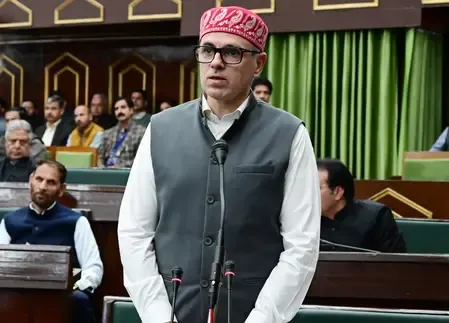
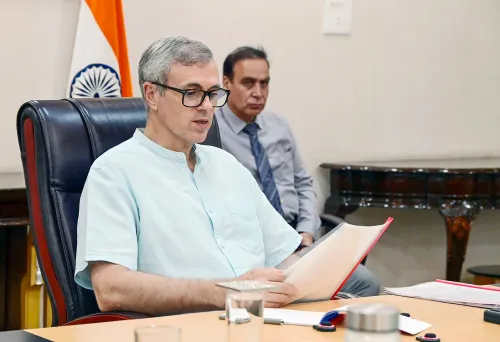
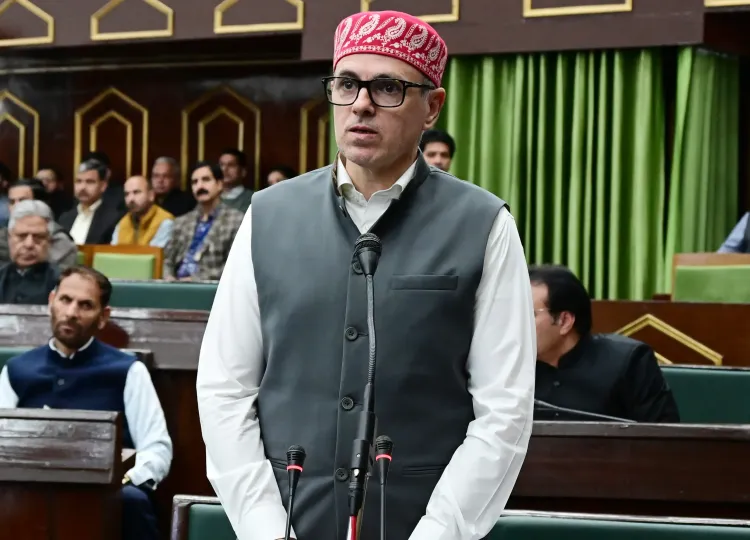
Jammu, Feb 18 (NationPress) The Chief Minister of Jammu and Kashmir, Omar Abdullah, informed the Legislative Assembly on Wednesday that there are currently more than one lakh daily wage earners and casual workers engaged with various government departments.
The Chief Minister reassured the Assembly that a legally sound approach is being pursued for their regularization.
In response to a combined inquiry from 15 members from both treasury and opposition, Omar Abdullah stated that a total of 100,501 workers have been documented through an online Aadhaar-based biometric identification and skill profiling system.
“This documented workforce consists of 69,696 casual workers, 8,836 daily rated employees, 8,534 seasonal laborers, 5,757 food and civil supplies aides, 2,153 part-time cleaners, and 1,929 individuals appointed through the hospital development fund. The highest number of workers, 38,585, is found in the Public Health Engineering and Irrigation & Flood Control Department, with others in Power Development (13,616), Education (12,646), Forest (8,317), and Public Works (R&B) (6,801),” he stated.
A notable 4,868 are also working in Health and Medical Education; Agriculture (4,776); Animal and Sheep Husbandry (2,170); and Housing and Urban Development (1,702), among other departments.
Out of the 57,390 registered workers in the Kashmir division, Srinagar has the largest share with 11,825, followed by Anantnag (8,823), Baramulla (7,724), Budgam (5,772), Kupwara (5,547), Ganderbal (4,056), Kulgam (3,321), and Bandipora (2,771).
In the Jammu zone, among the 40,077 registered workers, Jammu district leads with 13,425 workers, followed by Rajouri (5,191), Doda (3,856), Kathua (3,451), Reasi (3,210), Kishtwar (2,754), Udhampur (2,518), Poonch (2,455), Samba (1,722), and Ramban (1,495).
Addressing concerns regarding the long-delayed regularization, CM Abdullah mentioned a high-level committee was established on March 19 last year to thoroughly investigate the matter.
“The committee is conducting a comprehensive review in collaboration with relevant departments. The government will evaluate its recommendations and proceed appropriately, adhering to legal and financial standards,” the Chief Minister elaborated.
Reaffirming his government’s dedication to a fair and transparent procedure, the Chief Minister stated that the duration of the process reflects not administrative negligence but the necessity for a legally sound and financially viable strategy.
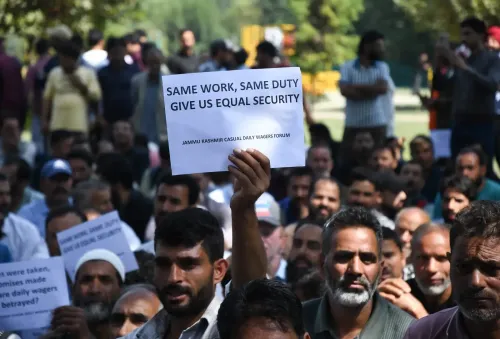
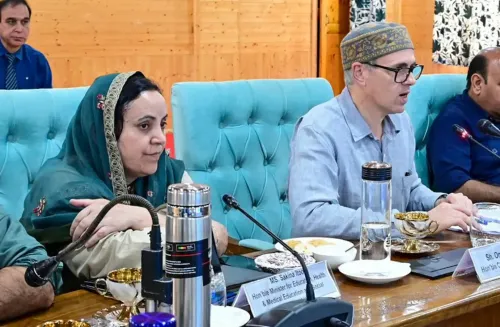
On Tuesday, CM Omar Abdullah expressed his understanding of the challenges faced by daily wage workers and suggested that instead of resorting to agitation, their representatives should engage in direct discussions with him to address their concerns.
Point of View
The revelation of over one lakh daily wage laborers in Jammu and Kashmir highlights the critical need for a structured approach to labor rights. The government's commitment to regularization reflects a necessary step towards stability and transparency in employment practices, fostering better relations between the state and its workforce.
NationPress
12 Oct 2026
Frequently Asked Questions
How many daily wage workers are there in J&K?
There are over 100,501 daily wage workers and casual laborers employed in various government departments in Jammu and Kashmir.
What steps are being taken for regularization?
The Chief Minister assured that a legally sustainable approach is being adopted for the regularization of these workers.
What is the distribution of workers across departments?
The largest number of workers are in the Public Health Engineering and Irrigation department, followed by Power Development, Education, Forest, and Public Works.
What is the significance of the high-level committee?
The high-level committee was set up to thoroughly examine the regularization process and offer recommendations based on legal and financial propriety.
How can workers address their concerns?
The Chief Minister suggested that instead of threatening agitation, representatives should directly engage with him to resolve issues.