South Korea, Canada deepen space and defence ties amid $39.7B submarine bid

Synopsis
With Canada set to name its preferred submarine bidder in late June, South Korea dispatched its presidential chief of staff to Toronto — not just to pitch a $39.7 billion contract, but to frame the entire bid as the launchpad for a broader Korea-Canada industrial alliance spanning space, defence, and hydrogen. Germany's Thyssenkrupp stands in the way.
Key Takeaways
South Korea and Canada held a defence and space business roundtable in Toronto on 2 June 2025 .
The Hanwha Ocean–HD Hyundai Heavy Industries consortium is competing with Germany's Thyssenkrupp Marine Systems for a 60 trillion-won (US$39.7 billion) Canadian submarine contract.
Canada is expected to announce its preferred bidder in late June 2025 .
Presidential chief of staff Kang Hoon-sik led the Korean delegation as Seoul's envoy for special economic cooperation.
Korean and Canadian companies signed three MoUs covering space and defence sector collaboration.
Hyundai Motor Co. unveiled a vision for a bilateral hydrogen partnership at the event.
South Korea and Canada have moved to strengthen bilateral cooperation in advanced industries — including space and defence — as Seoul intensifies its push to secure a landmark Canadian submarine procurement contract estimated at 60 trillion won (approximately US$39.7 billion). Seoul's Ministry of Trade, Industry and Resources confirmed the discussions on Tuesday, 2 June, following a high-level business roundtable held in Toronto the previous day.
High-Level Delegation and Roundtable
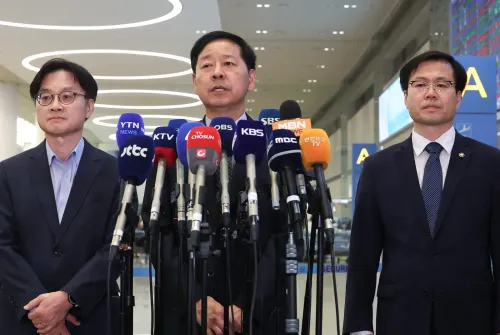
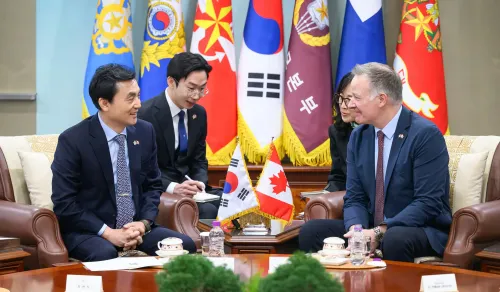
The business roundtable, jointly hosted by the Ministry of Trade, Industry and Resources and the Korea Trade-Investment Promotion Agency (KOTRA), brought together approximately 50 business leaders from both countries. The Korean delegation was led by presidential chief of staff Kang Hoon-sik, who is currently in Canada as Seoul's envoy for special economic cooperation, alongside Vice Industry Minister Moon Shin-hak and Minister of the Defence Acquisition Program Administration Lee Yong-cheol. The high-profile composition of the delegation is widely seen as a direct signal of Seoul's intent to win Ottawa's submarine contract.
The Submarine Bidding Race
At the heart of the visit is a fiercely contested procurement race. The Hanwha Ocean Co.–HD Hyundai Heavy Industries Co. consortium is currently competing against Germany's Thyssenkrupp Marine Systems for the submarine deal. Canada is expected to announce its preferred bidder in late June, making Seoul's diplomatic and commercial outreach this week a calculated last-minute effort. The contract, if won, would rank among the largest defence exports in South Korean history.
Proposals and Agreements Signed
During the roundtable, Hanwha outlined proposals to deepen space and defence collaboration between the two nations. Hyundai Motor Co. separately unveiled its vision for a bilateral hydrogen energy partnership. The session concluded with Korean and Canadian companies signing three memorandums of understanding (MoUs) covering cooperation in the space and defence sectors.
What Both Sides Stand to Gain
'If Canada's abundant resources and advanced technological capabilities are combined with Korea's world-class manufacturing capacity, the two countries will be able to lead the global market in advanced industries,' Kang Hoon-sik was quoted as saying. The remark underscores Seoul's broader pitch: that the submarine deal is not a one-off transaction but the foundation of a long-term industrial alliance. This comes amid growing Western interest in diversifying defence supply chains beyond traditional European contractors, a trend that has opened doors for South Korean shipbuilders in markets from Australia to Poland.
What Comes Next
Canada's preferred bidder announcement is anticipated before the end of June 2025, setting a tight timeline for both competing consortia. A South Korean win would mark a significant milestone for the country's defence export ambitions, which have accelerated sharply since 2022. The three MoUs signed in Toronto are expected to advance regardless of the submarine outcome, signalling that both governments are invested in a broader industrial relationship.
Point of View
But winning a contract of this scale against an established European player would be a qualitative leap. The three MoUs are smart hedging: whatever the submarine outcome, Seoul locks in a broader industrial relationship with Ottawa. The real question is whether Canada's procurement decision will be driven by price and capability alone, or whether geopolitical calculus — including the desire to diversify away from European contractors — tips the balance toward the Korean consortium.
NationPress
15 Oct 2026
Frequently Asked Questions
What is the Canadian submarine project South Korea is bidding for?
Canada is running a major submarine procurement programme valued at an estimated 60 trillion won (approximately US$39.7 billion ). The preferred bidder is expected to be announced in late June 2025, with South Korea's Hanwha Ocean–HD Hyundai Heavy Industries consortium competing against Germany's Thyssenkrupp Marine Systems.
Why did South Korea send such a high-level delegation to Canada?
The visit by presidential chief of staff Kang Hoon-sik , Vice Industry Minister Moon Shin-hak , and Defence Acquisition Minister Lee Yong-cheol is widely seen as a last-minute diplomatic push to support Seoul's submarine bid. It signals that South Korea views the contract as a strategic priority, not merely a commercial opportunity.
What agreements were signed at the Toronto roundtable?
Korean and Canadian companies signed three memorandums of understanding (MoUs) for collaboration in the space and defence sectors. Hanwha also proposed deeper bilateral cooperation in these areas, while Hyundai Motor Co. presented a hydrogen partnership vision.
Who are the competing bidders for Canada's submarine contract?
The two competing bids are the Hanwha Ocean Co.–HD Hyundai Heavy Industries Co. consortium from South Korea and Thyssenkrupp Marine Systems from Germany. Canada is expected to name its preferred bidder before the end of June 2025.
How significant would a Canadian submarine contract win be for South Korea?
Winning the estimated US$39.7 billion contract would be one of the largest defence export deals in South Korean history. It would further cement South Korea's emergence as a major global arms exporter, a trend that has accelerated significantly since 2022.