Should the Bhagavad Gita Be Included in School Curriculum?
Synopsis
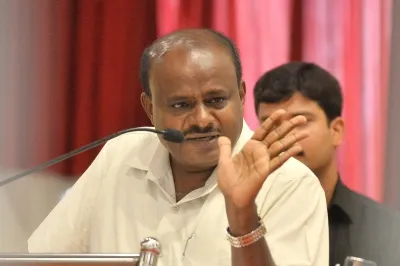
In a significant push for educational reform, Union Minister H.D. Kumaraswamy advocates for the Bhagavad Gita to be taught in schools. He emphasizes the scripture's enduring values that can inspire youth to become responsible citizens. This article explores Kumaraswamy's call to action and its potential impact on India’s education system.
Key Takeaways
Kumaraswamy calls for the Bhagavad Gita to be taught in schools.
The initiative aims to enhance value-based education .
Timeless teachings like 'Nishkama Karma' can inspire youth.
Support from local leaders and parents plays a crucial role.
Integration aligns with the National Education Policy .
Bengaluru, Dec 5 (NationPress) Union Minister for Heavy Industries and Steel, H.D. Kumaraswamy, has called for the incorporation of the revered Hindu scripture Bhagavad Gita into the educational curriculum in schools throughout the nation.
In a letter directed to Union Education Minister Dharmendra Pradhan, Union Minister Kumaraswamy expressed his request.
Utilizing the platform of social media X, he stated, "I have formally approached the Union Education Minister Dharmendra Pradhan to advocate for the inclusion of our land's sacred text, the Bhagavad Gita, in student education and urged that appropriate measures be implemented for this purpose."
He elaborated, "The enduring principles of 'Nishkama Karma', integrity, and moral fortitude can significantly enhance value-based education as per the National Education Policy (NEP). These teachings will inspire our youth to evolve into responsible citizens and achieve excellence on a global scale. In alignment with Prime Minister Narendra Modi’s commitment to rekindle the most noble and compassionate traditions of Indian heritage, I firmly believe that integrating the Bhagavad Gita into education is vital."
In his correspondence, he mentioned, "India has always been a cradle of saints, wisdom, and lasting civilizational ideals. Sanatana Dharma embodies the universal ethos of 'Vasudaiva Kutumbakam' (The World is One Family). As Shri Krishna, in his eight incarnations, Lord Vishnu conveyed the eternal wisdom of the Bhagavad Gita, emphasizing 'Nishkama Karma' and the significance of fulfilling one’s duties with earnestness and commitment. These teachings are exceedingly pertinent, particularly in today's global context."
He further remarked, "Recently, Prime Minister Narendra Modi participated in a Gita recitation event during his visit to Krishna Matha in Udupi, where he highlighted and reaffirmed the core tenets of Sanatana Dharma and the concept of 'Vasudaiva Kutumbakam'."
Union Minister Kumaraswamy added, "I had the fortune of attending a Gita recitation in Shivamogga, which was an uplifting experience. It provided a remarkable chance to recite the Gita and feel the deep energy and devotion it inspires."
In this context, numerous local leaders and parents have urged for the teachings of the Bhagavad Gita to be part of the school curriculum. The NEP strongly advocates for value-based education. Incorporating selected teachings from the Gita will foster moral strength, clarity of thought, and character among students, thus enhancing our demographic dividend and equipping our youth for global success," he stated.
"Therefore, I once again sincerely appeal for your consideration of this proposal and to provide the necessary directives so that the timeless teachings of the Bhagavad Gita can be effectively integrated within the educational framework for students nationwide," he concluded.
Point of View
I find H.D. Kumaraswamy's advocacy for the inclusion of the Bhagavad Gita in school curricula to be a commendable effort towards enriching value-based education in India. The teachings of the Gita align with the principles of moral integrity and duty, which are essential in nurturing responsible citizens. It is crucial that we consider the diverse perspectives within our educational framework while also recognizing the significance of our cultural heritage. This initiative is a timely reminder of the importance of integrating traditional wisdom into modern education.
NationPress
24 Sept 2026
Frequently Asked Questions
Why is the Bhagavad Gita being considered for school curriculum?
The Bhagavad Gita is being considered for inclusion in school curricula to instill timeless values such as 'Nishkama Karma', honesty, and moral strength, which can enrich value-based education.
Who is advocating for this inclusion?
Union Minister H.D. Kumaraswamy is advocating for the inclusion of the Bhagavad Gita in the school curriculum and has formally written to the Union Education Minister.
What are the expected benefits of including the Bhagavad Gita in education?
Including the Bhagavad Gita is expected to inspire youth, enhance moral character, and prepare them to become responsible global citizens.
What is the National Education Policy (NEP) and its relevance to this proposal?
The National Education Policy (NEP) emphasizes value-based education, making it a suitable framework for integrating teachings from the Bhagavad Gita.
How have local leaders and parents responded to this initiative?
Local leaders and parents have expressed strong support for the initiative, requesting that teachings from the Bhagavad Gita be incorporated into the school curriculum.