South Korea Memorial Day 2025: Lee Jae Myung honours fallen, pledges veterans' support
Synopsis
At Seoul National Cemetery on Memorial Day 2025, President Lee Jae Myung did more than pay tribute — he announced asset forfeitures targeting colonial-era collaborators, new benefits for independence fighters' families, and hospital expansion for veterans. The speech blended historical reckoning with a direct acknowledgement of present economic stress.
Key Takeaways
President Lee Jae Myung addressed South Korea's Memorial Day ceremony at Seoul National Cemetery on 6 June 2025 .
The ceremony was attended by 3,000 uniformed service members , officials, and bereaved families, including relatives of a Coast Guard officer killed on duty last year.
A new law expanding benefits for families of independence fighters is set to take effect next year .
The government will investigate and forfeit assets of pro-Japan colonial-era collaborators under a newly promulgated law.
Lee pledged to extend the veterans hospital network to Gangwon Province and Jeju Island .
The president cited Middle East conflict economic fallout as a current national challenge, expressing confidence in South Korea's resilience.
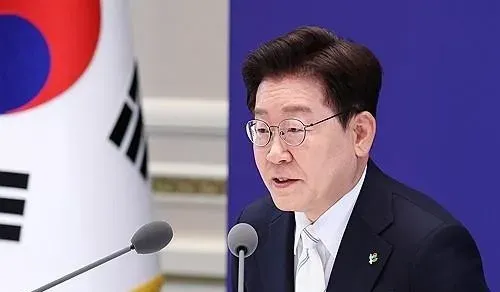
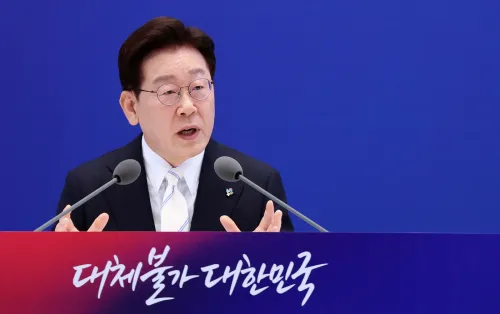
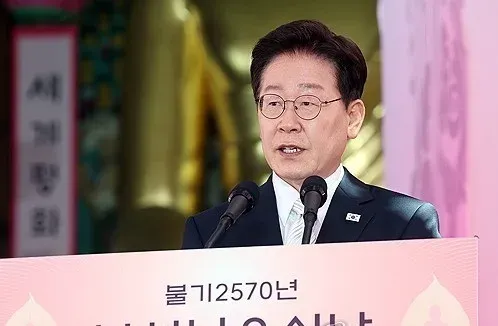
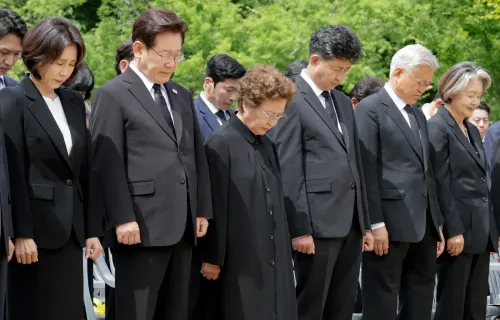
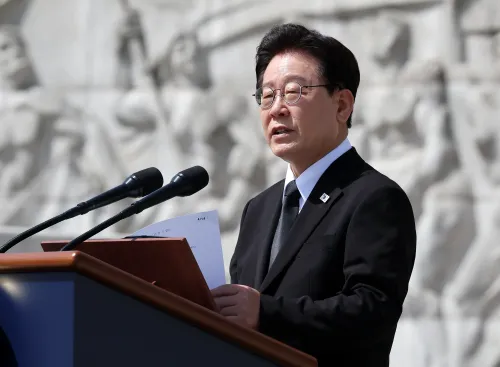
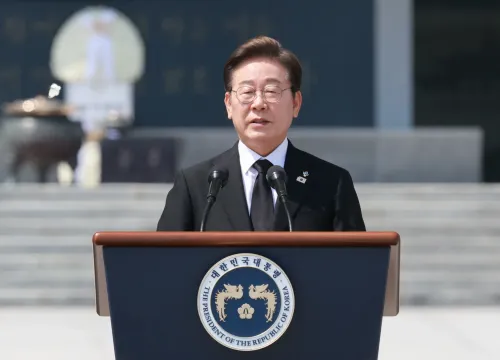
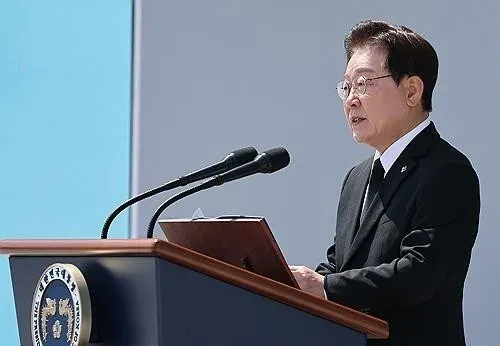
South Korean President Lee Jae Myung on Saturday, 6 June 2025 declared that honouring those who sacrificed their lives in service to the nation is a fundamental social duty, delivering a solemn address at the country's Memorial Day ceremony held at Seoul National Cemetery. The event, a national holiday commemorating patriots and service members who gave their lives for South Korea, drew 3,000 uniformed personnel, government officials, national merit recipients, and bereaved families.
Key Moments at the Ceremony
Among those present were family members of a 34-year-old Coast Guard officer killed last year while attempting to rescue a person from a tidal flat, and the families of two Army service members who died in a helicopter crash in February. Their presence underscored the ceremony's dual purpose: honouring recent sacrifices alongside historical ones.
'Commemorating the spirit of the patriots and paying them full respect is a social duty that we should faithfully uphold,' President Lee said in his address.
What the Government Pledged
Lee announced that a new law expanding benefits for families of independence fighters — those who resisted Japan's colonial rule of Korea from 1910 to 1945 — will come into effect next year. He also reaffirmed the government's commitment to providing financial support to the spouses of war veterans and pledged to extend the network of veterans hospitals into underserved regions, specifically naming Gangwon Province and Jeju Island.
The president further promised to improve the assistance framework for service members wounded during active duty, covering soldiers, firefighters, police officers, and Coast Guard personnel. 'Respect for devotion is the driving force that sustains and advances the national community,' Lee said, adding that the government 'will not fail to reward such noble devotion.'
Accountability for Colonial-Era Collaborators
In a notably sharp passage of his speech, Lee stressed that punishing those who betrayed the nation is as important as honouring those who served it. He announced that through a newly promulgated law, the government will investigate and confiscate assets illegally accumulated by pro-Japan collaborators from the colonial era, framing it as a precedent to prevent recurrence. This move signals a continued political reckoning with South Korea's colonial history, a subject that has long divided public opinion.
Economic Challenges and National Resolve
'Today, we are once again facing a wave of crises,' Lee acknowledged, citing the economic fallout from the ongoing conflict in the Middle East. He expressed confidence, however, that South Korea would overcome current pressures, drawing on what he described as the nation's historic capacity to unite in the face of adversity. 'I am confident that we will be able to sufficiently overcome any crisis, as we have always had the potential to unite as one whenever we have faced a national crisis,' he said.
As South Korea navigates both domestic political transitions and external economic headwinds, Lee's Memorial Day address sets a clear policy direction: expand recognition for past sacrifices while building a more robust support system for those in active service today.
Point of View
A question South Korean courts have wrestled with for decades. The hospital expansion and benefits commitments are meaningful but incremental; the harder test is whether they are funded in a budget cycle constrained by the very economic headwinds Lee acknowledged. Framing devotion and accountability as twin pillars of national unity is rhetorically effective — the question is whether the institutions exist to deliver on both simultaneously.
NationPress
21 Oct 2026
Frequently Asked Questions
What is South Korea's Memorial Day and why is it observed?
South Korea's Memorial Day, observed annually on 6 June, is a national holiday honouring those who died in service to the country, including soldiers, independence fighters who resisted Japan's colonial rule from 1910 to 1945, and other service personnel. The main ceremony is held at Seoul National Cemetery.
What key pledges did President Lee Jae Myung make at Memorial Day 2025?
President Lee pledged to expand veterans hospital coverage to Gangwon Province and Jeju Island, improve support for wounded service members, and provide financial assistance to war veterans' spouses. He also announced a new law expanding benefits for families of independence fighters, effective next year.
What is the new law targeting pro-Japan colonial-era collaborators?
A newly promulgated law authorises the South Korean government to investigate and confiscate assets illegally accumulated by individuals who collaborated with Japanese colonial authorities between 1910 and 1945. President Lee framed it as setting a legal precedent to deter future betrayals of the national community.
Who attended the Memorial Day ceremony at Seoul National Cemetery?
The ceremony was attended by 3,000 uniformed service members, government officials, national merit recipients, and their families. Notably present were relatives of a Coast Guard officer killed on duty last year and families of two Army personnel who died in a helicopter crash in February.
What economic concerns did President Lee raise at the ceremony?
Lee acknowledged that South Korea is facing economic repercussions from the conflict in the Middle East, describing it as a 'wave of crises.' He expressed confidence that the nation would overcome the challenges, citing South Korea's historical capacity to unite during periods of national difficulty.