Maharashtra scraps ₹200 registration fee on family agricultural land partition

Synopsis
Maharashtra has scrapped the ₹200 registration fee on family agricultural land partitions — a charge in place since 2016 — while simultaneously amending the Mamlatdars' Courts Act to allow email notices and mandatory police protection for farmers facing encroachments. Together, these reforms mark a significant administrative overhaul of how rural land disputes and partitions are handled in the state.
Key Takeaways
Maharashtra Revenue Minister Chandrashekhar Bawankule on 29 July abolished the ₹200 registration fee on agricultural land partition deeds among family members.
The fee had been in place since 2016 under a previous government order; the waiver applies under Section 85 of the Maharashtra Land Revenue Code, 1966 .
A new Section 14-A in the Mamlatdars' Courts Act, 1906 enables hearing notices to be served via email , speeding up land dispute resolution.
New Section 21(5) mandates free police protection to farmers if encroachers defy Tehsildar orders to clear farmland paths.
Powers to regularise land condition breaches have been delegated to District Collectors (up to ₹10 lakh ) and Divisional Commissioners (₹10 lakh–₹20 lakh), removing the need to approach Mumbai's State Secretariat.
The ordinance was based on recommendations by a committee led by Pune Divisional Commissioner Sheetal Teli-Ugale .
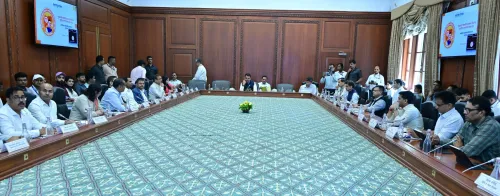
Maharashtra Revenue Minister Chandrashekhar Bawankule on Wednesday, 29 July announced the abolition of the registration fee on instruments of agricultural land partition executed among co-sharers and family members. The state government has issued a formal notification under Section 85 of the Maharashtra Land Revenue Code, 1966, directing that no registration fee will be levied on such partition deeds going forward. The move is part of a broader series of revenue department reforms aimed at simplifying land governance for farming families across Maharashtra.
What Changes for Farming Families
Until this decision, a fee of ₹200 was charged on instruments of agricultural land partition — including gift deeds — executed among family members, a practice in place since a 2016 government order. The scrapping of this fee is intended to make the family land partition process simpler, more transparent, and financially accessible, particularly for small and marginal farmers.
Minister Bawankule stated that the waiver is designed to eliminate financial friction and reduce procedural delays that have long burdened rural farming households. 'The waiver of the ₹200 registration fee on family agricultural land partitions is part of a broader push by the Maharashtra Revenue Department to streamline land governance, reduce procedural delays, and eliminate financial friction for farming families,' he said.
Amendments to Mamlatdars' Courts Act
Alongside the fee waiver, the Revenue Department has introduced key amendments to the Mamlatdars' Courts Act, 1906. A new Section 14-A has been inserted, enabling hearing notices to be served directly via email — addressing a long-standing problem where land route disputes dragged on due to deliberate evasion or non-receipt of notices.
Additionally, Section 21(5) has been introduced to deal with encroachers who fail to comply with a Tehsildar's order. Under the new provision, Tehsildars must explicitly specify in their orders that free police protection will be provided to the affected farmer upon application, should the encroacher refuse to vacate. The Home Department has issued strict instructions to all police stations ensuring that farmers are not denied protection due to minor technical oversights in the Tehsildar's order.
This ordinance was promulgated through a joint initiative of the Revenue and Home Departments, based on recommendations from a committee led by Pune Divisional Commissioner Sheetal Teli-Ugale.
Powers Delegated to District and Divisional Authorities
In another significant administrative shift, powers to regularise breaches of conditions for residential and agricultural lands — previously requiring approval at the State Secretariat in Mumbai — have now been delegated to local authorities. District Collectors can now handle cases involving penalties up to ₹10 lakh, while Divisional Commissioners will handle cases in the ₹10 lakh to ₹20 lakh range.
This decentralisation means citizens and farmers no longer need to travel to Mumbai for minor technical land violations or regularisation requests, significantly reducing administrative burden at the grassroots level.
Broader Reform Push by Maharashtra Revenue Department
The announcements collectively represent one of the more substantive rounds of land administration reform undertaken by the Maharashtra Revenue Department in recent years. The reforms touch three distinct pain points: the cost of family land partition, the speed of dispute resolution for farmland access, and the decentralisation of regulatory powers. Notably, the joint Revenue-Home Department approach to enforcing farmland path rights signals an intent to move beyond paper orders toward actual on-ground compliance. How effectively district machinery implements these changes will determine whether the reforms deliver tangible relief to Maharashtra's farming communities.
Point of View
But its abolition is symbolic of a deeper problem: India's land administration has historically layered small charges and procedural hurdles that cumulatively price out small farmers from formalising their own family arrangements. The more consequential reform here is the Mamlatdars' Act amendment — email-based notices and mandatory police protection shift the burden of compliance onto encroachers rather than victims, which is a structural correction long overdue. The real test will be implementation: whether Tehsildars actually invoke Section 21(5) and whether police stations comply with Home Department directives. Delegation of regularisation powers to District Collectors is also a meaningful decentralisation, but without digital tracking, it risks creating new local bottlenecks in place of the old state-level ones.
NationPress
28 Oct 2026
Frequently Asked Questions
What is the Maharashtra agricultural land partition fee waiver?
The Maharashtra government has abolished the ₹200 registration fee previously charged on instruments of agricultural land partition executed among co-sharers or family members, under Section 85 of the Maharashtra Land Revenue Code, 1966. The waiver was announced by Revenue Minister Chandrashekhar Bawankule on 29 July and is intended to reduce the financial burden on small and marginal farming families.
Who benefits from the Maharashtra land partition fee abolition?
The waiver directly benefits farming families — particularly small and poor farmers — who wish to formally partition agricultural land among co-sharers or relatives. It removes a charge that had been in place since 2016 and simplifies the process of formalising family land divisions.
What are the new amendments to the Mamlatdars' Courts Act in Maharashtra?
The Maharashtra Revenue Department has inserted Section 14-A into the Mamlatdars' Courts Act, 1906, allowing hearing notices to be served via email to speed up land dispute proceedings. Section 21(5) has also been introduced, making it mandatory for Tehsildars to order free police protection for farmers if encroachers fail to comply with clearance orders.
What powers have been delegated to District Collectors under Maharashtra's new land reforms?
District Collectors can now regularise breaches of conditions for residential and agricultural lands involving penalties up to ₹10 lakh, while Divisional Commissioners handle cases in the ₹10 lakh to ₹20 lakh range. Previously, such approvals required a visit to the State Secretariat in Mumbai.
Who led the committee that recommended these Maharashtra revenue reforms?
The reforms were based on recommendations by a committee led by Pune Divisional Commissioner Sheetal Teli-Ugale, and were promulgated through a joint initiative of the Maharashtra Revenue and Home Departments.