Mamata Banerjee skips Bengal bypoll: TMC symbol fight and INDIA bloc future at stake
Synopsis
Mamata Banerjee's refusal to contest the 6 October West Bengal by-elections — despite personal invitations from rivals — is less a retreat and more a calculated wait. With the TMC symbol fight unresolved, her grassroots base eroded, and the INDIA bloc fraying, she is betting that national Opposition politics offers more leverage than a risky by-poll that she could lose.
Key Takeaways
Mamata Banerjee will not contest the West Bengal Assembly by-elections on 6 October 2026 at Rejinagar and Nandigram , despite colleagues urging her to do so.
Her 15-year uninterrupted rule of West Bengal ended after the BJP won convincingly, with Suvendu Adhikari becoming Chief Minister.
Adhikari defeated Mamata in Bhabanipur by more than 15,000 votes , a seat she previously held.
Her faction is fighting a rival Trinamool group led by Ritabrata Banerjee for the original party name and twin-floret logo .
Mamata has reached out to the Left Front and Congress to rebuild the INDIA bloc , crediting herself with coining the alliance's acronym.
Both by-election seats are in Murshidabad district , where Muslims reportedly constitute approximately 70 per cent of the population, yet BJP finished second, ahead of Trinamool.
Former West Bengal Chief Minister and Trinamool Congress founder Mamata Banerjee has decided to stay out of the upcoming West Bengal Assembly by-elections scheduled for 6 October 2026, even as colleagues — both former and current — urged her to contest. The decision renews questions about her immediate political future and her larger national ambitions at a time when her party is fractured and her 15-year uninterrupted rule of West Bengal has ended.
The By-Election Context
By-elections will be held at Rejinagar and Nandigram Assembly constituencies in West Bengal after winners Humayun Kabir and incumbent Chief Minister Suvendu Adhikari resigned from their respective seats. Adhikari, once Mamata's close aide and now her bitterest political adversary, has opted to represent Bhabanipur, where he defeated Mamata Banerjee by more than 15,000 votes — a stark reversal from his earlier victory margin of under 10,000 votes over Trinamool's Pabitra Kar.
Kabir, representing the Aam Janata Unnayan Party (AJUP), had personally extended an invitation to Mamata Banerjee to contest from Rejinagar, claiming he could secure her win. Leaders of the rival Trinamool faction led by Ritabrata Banerjee indicated they would not field a candidate in Nandigram if Mamata chose to contest herself. Despite these overtures, Mamata declined. Kabir had won Rejinagar by a margin of more than 58,000 votes, capturing 51.62 per cent of the vote share. In Naoda, his margin was under 28,000 votes with approximately 39 per cent of mandates.
Notably, both seats fall in Murshidabad district, where Muslims reportedly comprise an estimated 70 per cent of the population. Despite this demographic composition, the Bharatiya Janata Party (BJP) finished second, pushing the Trinamool to third — a signal of the significant polarisation that defined the last election cycle.
The Fractured Party and the Symbol War
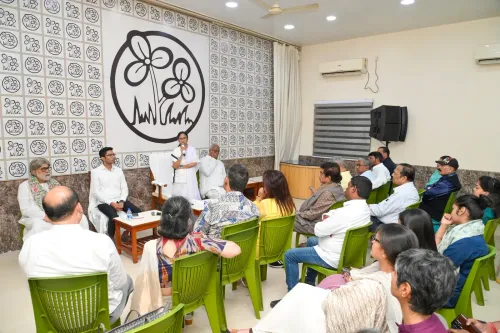
The Trinamool Congress that Mamata once led as an undisputed force now faces an internal civil war. Her faction is locked in a bitter legal and organisational battle with a rival Trinamool group led by Ritabrata Banerjee over the right to retain the original party name and its iconic twin-floret logo — which Mamata reportedly claims to have designed herself.
Meanwhile, allegations of fraud, embezzlement, bribery, extortion, and smuggling have plagued the party, damaging its grassroots credibility. Though Mamata occasionally asserted control — publicly reprimanding members and reconstituting leadership committees — critics within the party, including several turncoats, say she appeared increasingly sidelined as her nephew Abhishek Banerjee effectively assumed control of the organisation. Mamata herself has acknowledged that the demands of running the state government may have come at the cost of party organisation, and has promised to rebuild from the grassroots.
National Ambition and the INDIA Bloc Gambit
Even as her state-level position weakens, Mamata Banerjee has reoriented toward national politics, positioning herself as a central figure in the Indian National Developmental Inclusive Alliance (INDIA) bloc — an acronym her supporters credit her with coining. She has simultaneously reached out to long-standing political adversaries, including the Left Front and the Indian National Congress (Congress), the party from which she broke away in 1998.
Some analysts believe her push to strengthen the INDIA bloc is a calculated strategy to build a national Opposition identity, especially as she faces diminished leverage within Bengal. However, the alliance's coherence has frayed — the Aam Aadmi Party (AAP) led by Arvind Kejriwal and M.K. Stalin's Dravida Munnetra Kazhagam (DMK) have reportedly ended formal ties with the platform. Some leaders, however, believe Mamata's personal relationships with these figures could bring them back ahead of the 2029 Lok Sabha elections.
Many INDIA bloc constituents who resist a Congress-led formation see in Mamata a viable alternative anchor — one more rooted in regional politics than in projecting a strong pan-India footprint. This contradiction lies at the heart of her current political positioning.
What the By-Poll Results Could Mean
The 6 October by-elections represent a critical barometer for Mamata's faction. A strong performance could validate her ability to rebuild the party and reinforce her claims on the TMC name and symbol before electoral authorities. A poor showing, on the other hand, could accelerate the defection of ground-level workers and weaken her hand in both the symbol dispute and INDIA bloc negotiations.
With the Election Commission's decision on the party symbol still pending and the by-poll results imminent, the next few weeks will likely determine whether Mamata Banerjee reclaims centre stage in Bengal or pivots entirely toward a national Opposition role.
Point of View
But it rests on the assumption that regional leaders will follow her rather than the Congress; that assumption has not been tested and the exits of AAP and DMK suggest it may not hold. More critically, the party symbol battle is not merely symbolic — whichever faction wins before the Election Commission gains the electoral infrastructure and the voter recognition that the other loses overnight. Mamata's political survival in the medium term depends on winning that dispute, and the by-poll results will directly influence how electoral authorities and potential allies read her strength.
NationPress
14 Sept 2026
Frequently Asked Questions
Why has Mamata Banerjee decided not to contest the West Bengal by-elections?
Mamata Banerjee has chosen to stay out of the 6 October 2026 by-elections at Rejinagar and Nandigram, reportedly prioritising party rebuilding and national Opposition strategy over a potentially risky electoral contest. She declined personal invitations from rivals, including Humayun Kabir, who offered to back her candidacy from Rejinagar.
Where and when are the West Bengal by-elections being held?
By-elections in West Bengal are scheduled for 6 October 2026 at Rejinagar and Nandigram Assembly constituencies in Murshidabad district. The seats fell vacant after winners Humayun Kabir and Chief Minister Suvendu Adhikari resigned to contest and represent other constituencies.
What is the Trinamool Congress party symbol dispute about?
After the Trinamool Congress split, Mamata Banerjee's faction and a rival group led by Ritabrata Banerjee are fighting for the right to the original party name and its twin-floret logo. Mamata reportedly claims she personally designed the symbol, and whichever faction secures it from the Election Commission gains a critical organisational and electoral advantage.
How does Mamata Banerjee's INDIA bloc strategy fit into her current position?
With her Bengal base weakened, Mamata is repositioning as a national Opposition figure through the INDIA bloc, the platform whose acronym her supporters credit her with coining. She has reached out to long-standing rivals including the Left Front and the Congress, though the AAP and DMK have reportedly distanced themselves from the alliance.
How significant was Suvendu Adhikari's win over Mamata Banerjee in Bhabanipur?
Adhikari defeated Mamata Banerjee by more than 15,000 votes in Bhabanipur — a seat she previously held — in a result that symbolised the BJP's broader sweep of West Bengal and the end of Mamata's 15-year uninterrupted rule. His earlier victory margin over Trinamool's Pabitra Kar had been under 10,000 votes, making the Bhabanipur result a significant political inflection point.