PM Modi at 25: How Gujarat experiments became national programmes
Synopsis
As Modi completes 25 unbroken years in government, a striking policy trail emerges: SWAGAT became PRAGATI, Mukhyamantri Amrutam fed Ayushman Bharat, Nirmal Gujarat preceded Swachh Bharat, and Khel Mahakumbh seeded Khelo India. The Gujarat laboratory — for better or worse — became the blueprint for governing India.
Key Takeaways
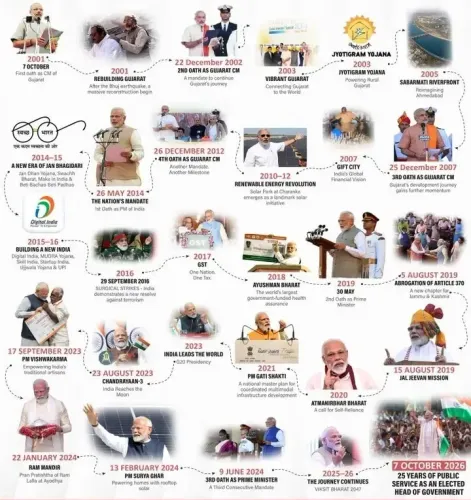
PM Narendra Modi completes 25 consecutive years as head of a government on 7 October 2026 , starting as Gujarat Chief Minister on 7 October 2001 .
The Union Cabinet passed a resolution on Tuesday citing SWAGAT and Jyotigram as Gujarat initiatives that informed national programmes.
SWAGAT (2003), a citizen grievance platform that won a UN Public Service Award in 2010 , inspired the national PRAGATI review mechanism.
Gujarat's Mukhyamantri Amrutam health scheme (2012) is seen as a precursor to Ayushman Bharat-PMJAY , launched nationally in 2018 .
Khel Mahakumbh (2010, 13 lakh participants ) preceded the national Khelo India sports talent programme.
The Gujarat-to-Centre pattern spans governance, healthcare, digital access, water, sanitation, girls' education, skilling, and sports.
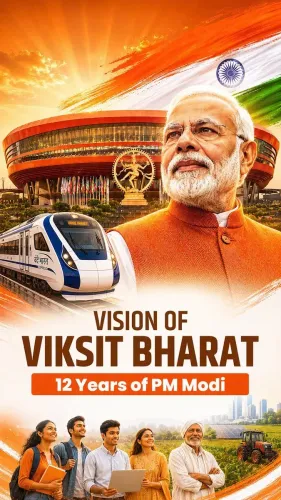
Prime Minister Narendra Modi on 7 October 2026 completes 25 consecutive years as the head of a government — a milestone that traces an unbroken arc from his oath as Gujarat Chief Minister on 7 October 2001 to his current standing as the country's longest-serving elected head of government. Across that quarter-century, several initiatives tested at the state level in Gujarat were later adapted, expanded, or given a national framework once Modi moved to New Delhi.
The Union Cabinet on Tuesday formally marked the occasion with a resolution, specifically highlighting the connection between Modi's Gujarat tenure and a number of national programmes. The resolution cited SWAGAT and Jyotigram as among the clearest examples of state-level approaches that were subsequently carried to the national stage.
SWAGAT to PRAGATI: Grievance Redressal Goes National
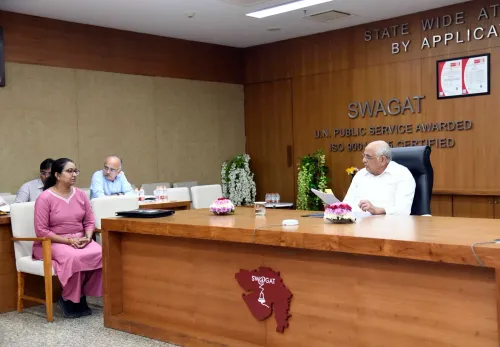
One of the most direct state-to-Centre transfers is the SWAGAT initiative — a technology-based grievance redressal system launched by then Chief Minister Modi in Gujarat in April 2003. The platform allowed citizens to raise grievances directly with the Chief Minister's office. It went on to receive the United Nations Public Service Award in 2010.
Modi later cited SWAGAT as the inspiration behind PRAGATI, the Prime Minister's platform for reviewing major infrastructure projects and resolving inter-governmental implementation bottlenecks. The structural logic — direct access, real-time review, accountability — carried over from state to national scale.
Digital Governance: e-Gram to Digital India
Gujarat's e-Gram Vishwagram project connected village panchayats through broadband and enabled access to government services at the grassroots level. Modi subsequently identified Gujarat's digital-governance experience, including e-Gram, as part of the foundation that informed the national Digital India programme — which has since expanded internet and e-services access across the country.
Health, Water and Electricity: The Social Infrastructure Thread
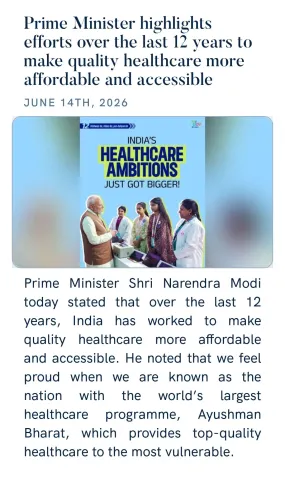
In healthcare, Gujarat's Mukhyamantri Amrutam (MA) scheme, launched in 2012 to shield poor families from catastrophic medical expenditure, is widely seen as a precursor to the much larger Ayushman Bharat-Pradhan Mantri Jan Arogya Yojana (PMJAY), launched nationally in 2018. Gujarat subsequently integrated MA with Ayushman Bharat under the combined PMJAY-MA framework.
Gujarat's Jyotigram Yojana provided 24-hour power to rural areas by separating agricultural feeders — a model for reliable rural electrification. On water, Gujarat's community-based Pani Samitis offered a participatory management model that Modi has linked to the national Jal Jeevan Mission, under which piped drinking water has been extended to rural households across India.
In sanitation, Gujarat's Nirmal Gujarat campaign — a state cleanliness drive — preceded the nationwide Swachh Bharat Mission, with Modi himself recalling the Gujarat programme when describing the national campaign's origins.
Education, Skills and Sports: Completing the Arc
Gujarat's Kanya Kelavani and Shala Praveshotsav campaigns emphasised girls' school enrolment and attendance. At the national level, the Modi-led government launched Beti Bachao Beti Padhao, which pursues similar objectives of protecting and educating the girl child. Gujarat's Kaushalya Vardhan Kendras formed part of the state's vocational-skilling infrastructure, preceding the creation of a dedicated national framework through the Ministry of Skill Development and Entrepreneurship.
The sports parallel is among the most direct. Modi launched Gujarat's Khel Mahakumbh in 2010 with 13 lakh participants across 16 sports. He later described Khel Mahakumbh as the 'seed' that grew into a larger national movement — a movement formalised at the Centre through Khelo India, the national platform for identifying and nurturing sporting talent.
A 25-Year Policy Trajectory
Across governance, healthcare, digital access, water, electricity, sanitation, girls' education, skills, and sports, the defining pattern of Modi's 25-year journey is the movement of state-level experiments from a Gujarat laboratory into national programmes — sometimes as direct inspiration, sometimes as a broader national adaptation of the same policy objective. Whether that trajectory represents genuine policy learning or the privileging of a single state's experience over others' is a question analysts and Opposition leaders continue to debate. What is not disputed is the scale of the replication: few Chief Ministers have drawn so direct a line from state to Centre.
Point of View
But it invites scrutiny. Every programme cited — from SWAGAT to Ayushman Bharat — was shaped by a much larger administrative machinery when it moved to the national scale, and the outcomes data are mixed. It is also worth noting that several states had parallel innovations in health insurance, digital governance, and sanitation that did not get the same federal amplification. The 25-year milestone is a genuine political landmark; whether it is also an unambiguous policy success story depends heavily on which metrics you choose to measure.
NationPress
7 Oct 2026
Frequently Asked Questions
What is the significance of PM Modi completing 25 years in government?
On 7 October 2026, Narendra Modi completes 25 consecutive years as the head of a government, beginning as Gujarat Chief Minister on 7 October 2001 and continuing as Prime Minister since 2014 — making him the country's longest-serving elected head of government. The Union Cabinet marked the occasion with a formal resolution on Tuesday.
What is SWAGAT and how did it influence national policy?
SWAGAT was a technology-based grievance redressal system launched by then Gujarat Chief Minister Modi in April 2003, allowing citizens to raise issues directly with the Chief Minister's office. It received the UN Public Service Award in 2010 and was later cited by Modi as the inspiration for PRAGATI, the national platform for reviewing major projects and resolving inter-governmental bottlenecks.
How is Gujarat's Mukhyamantri Amrutam scheme linked to Ayushman Bharat?
Gujarat's Mukhyamantri Amrutam (MA) scheme, launched in 2012 to protect poor families from catastrophic medical expenses, is widely regarded as a precursor to Ayushman Bharat-PMJAY, launched nationally in 2018. Gujarat subsequently integrated the two under a combined PMJAY-MA framework.
What was the Khel Mahakumbh and how does it relate to Khelo India?
Khel Mahakumbh was a state-level multi-sport event launched by Modi in Gujarat in 2010, with 13 lakh participants across 16 sports. Modi later described it as the 'seed' of a larger national movement, which found expression in the Centre's Khelo India programme for discovering and nurturing sporting talent.
Which other Gujarat schemes were scaled up to national programmes under Modi?
Several Gujarat initiatives followed this trajectory: Jyotigram Yojana (24-hour rural power) informed rural electrification efforts; Pani Samitis (community water management) fed into the Jal Jeevan Mission; Nirmal Gujarat (cleanliness) preceded Swachh Bharat Mission; and Kanya Kelavani (girls' enrolment) preceded Beti Bachao Beti Padhao at the national level.