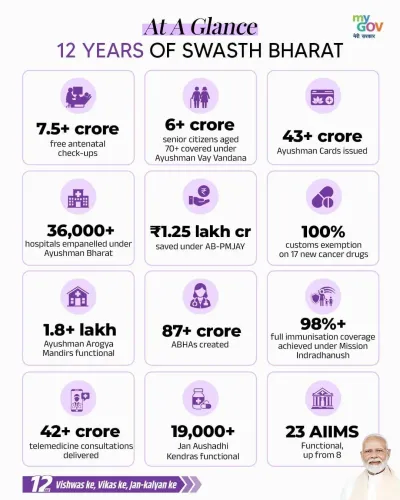
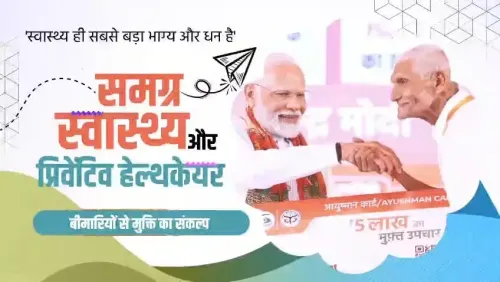
CM Gujarat Highlights PM Modi's 12 Years of Healthcare Reforms
Synopsis
Gujarat's Chief Minister's Office on June 14, 2026, amplified PM Modi's 12-year healthcare reform record under #12YearsOfSwasthBharat, spotlighting Ayushman Bharat, PM-JAY's Rs 5 lakh cover for over 10 crore families, and sustained investment in public health infrastructure to improve affordability and access across India.
Key Takeaways
The Chief Minister's Office of Gujarat shared a post on June 14, 2026 , amplifying PM Modi's 12-year healthcare reform record.
The campaign hashtag #12YearsOfSwasthBharat frames the period from Modi's Gujarat tenure through his Prime Ministership as a continuous health policy arc.
Ayushman Bharat , launched in 2018 , is the flagship scheme combining PM-JAY insurance and Health and Wellness Centres.
PM-JAY provides up to Rs 5 lakh annual health cover to over 10 crore poor families to reduce out-of-pocket spending.
The National Health Policy 2017 set a target of 2.5 per cent of GDP on health with universal access goals.
Future Union Budget allocations and NFHS-6 data will be key indicators of programme impact.
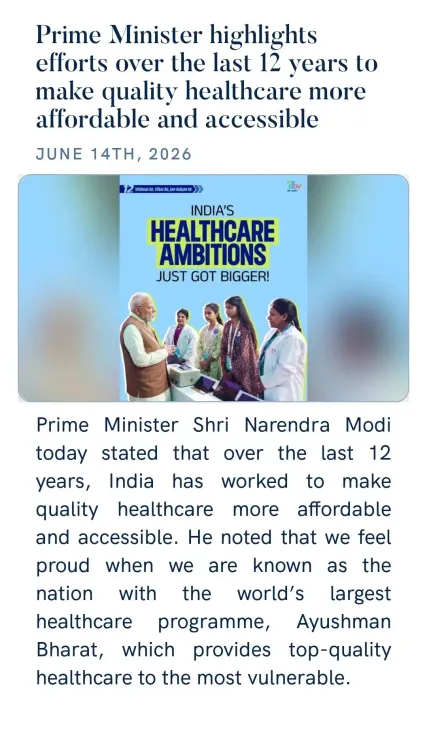
The Chief Minister's Office of Gujarat on Sunday, June 14, 2026, shared a post underscoring Prime Minister Narendra Modi's efforts over the last 12 years to make quality healthcare more affordable and accessible across India, amplifying the message via the NaMo App under the hashtag #12YearsOfSwasthBharat.
Context
The post, shared by the official handle of Gujarat's Chief Minister's Office, highlights a broader campaign marking 12 years of health-sector initiatives under PM Modi's leadership — first as Chief Minister of Gujarat and then as Prime Minister of India since 2014. The reference to the NaMo App indicates the content originates from the Prime Minister's own digital outreach platform, with state governments amplifying the message in a coordinated communication effort.
The hashtag #12YearsOfSwasthBharat — Swasth Bharat meaning 'Healthy India' — frames the period as a continuous arc of health policy reform, spanning both his tenure in Gandhinagar and subsequently in New Delhi.
Policy Backdrop
The centrepiece of the central government's health agenda since 2018 has been Ayushman Bharat, a flagship programme combining health insurance with infrastructure upgrades. Its insurance arm, Pradhan Mantri Jan Arogya Yojana (PM-JAY), provides up to Rs 5 lakh in annual health cover to over 10 crore poor and vulnerable families, aiming to reduce catastrophic out-of-pocket expenditure that has long pushed households into debt.
The National Health Policy of 2017 set a target of allocating 2.5 per cent of GDP to health and outlined goals for universal access. Alongside this, the National Health Mission — an ongoing central scheme — has received renewed focus and funding since 2014, directing resources toward strengthening primary and secondary public health facilities, particularly in rural areas. Gujarat has been among the states implementing these central schemes, with state health departments working alongside empanelled private hospitals to expand coverage.
Stakeholders and Impact
The primary beneficiaries of these policies are low-income families who previously depended almost entirely on out-of-pocket payments for hospitalisation and treatment. By combining demand-side insurance through PM-JAY with supply-side investments in Health and Wellness Centres, the central government has sought to address both affordability and availability of care simultaneously.
State health departments and empanelled hospitals — both public and private — are key operational stakeholders, as the success of schemes like Ayushman Bharat depends heavily on state-level administration, hospital empanelment rates, and claim-settlement efficiency. Variations in state-level adoption have meant that outcomes differ across India, with some larger states showing stronger utilisation metrics than others.
What's Next
The communication campaign around #12YearsOfSwasthBharat is likely to intensify in the coming days as state governments and the central government's digital machinery continue to amplify milestones and beneficiary stories. Analysts and policymakers will be watching upcoming Union Budget allocations for Ayushman Bharat and the National Health Mission as a measure of the programme's continued political and fiscal priority.
The release of NFHS-6 health outcome indicators will also provide an independent data point on whether improvements in affordability and access have translated into measurable gains in health outcomes for India's most vulnerable populations.
Point of View
Using state government handles to extend the reach of the Prime Minister's digital narrative. The framing of 12 years — deliberately bridging Modi's Gujarat and New Delhi tenures — constructs a seamless leadership legacy that transcends the typical five-year electoral cycle. For the BJP, health affordability is a politically potent metric because it speaks directly to the economic anxieties of the lower-middle class and Below Poverty Line voters who form a core constituency. The campaign's timing, ahead of potential budget discussions and with NFHS-6 data on the horizon, suggests a strategic effort to set the narrative on health outcomes before independent data enters public discourse.
NationPress
14 Sept 2026
Frequently Asked Questions
What is #12YearsOfSwasthBharat about?
#12YearsOfSwasthBharat is a campaign hashtag marking 12 years of health policy initiatives under PM Narendra Modi, covering his tenure as Gujarat Chief Minister and as Prime Minister since 2014, with a focus on affordability and access to quality healthcare.
What is Ayushman Bharat and who does it cover?
Ayushman Bharat is a flagship central government health programme launched in 2018. Its insurance component, PM-JAY, provides up to Rs 5 lakh in annual health cover to over 10 crore poor and vulnerable families to reduce out-of-pocket medical expenses.
Why did the Gujarat CMO post about PM Modi's healthcare record?
The Chief Minister's Office of Gujarat shared the post as part of a coordinated digital campaign amplifying the central government's health policy milestones via the NaMo App under the #12YearsOfSwasthBharat hashtag.
What is PM-JAY and how does it work?
PM-JAY, or Pradhan Mantri Jan Arogya Yojana, is the health insurance arm of Ayushman Bharat. It covers hospitalisation costs up to Rs 5 lakh per year for eligible low-income families at empanelled public and private hospitals across India.
What health targets did India set under the National Health Policy 2017?
The National Health Policy 2017 set a target of allocating 2.5 per cent of GDP to health expenditure and outlined goals for universal access to quality healthcare, forming the policy framework within which schemes like Ayushman Bharat were designed.