CM Bhupendra Patel Hails 12 Years of Modi Govt Health Reforms

Synopsis
Gujarat CM Bhupendra Patel marked 12 years of the Modi government's health agenda, highlighting PMJAY's free treatment, Jan Aushadhi's affordable medicines, expanded immunisation, and Jamnagar's WHO Global Centre for Traditional Medicine as cornerstones of a healthier, developed India.
Key Takeaways
Gujarat CM Bhupendra Patel credited PM Narendra Modi's 12 years in office with a 'epoch-making revolution' in India's health sector.
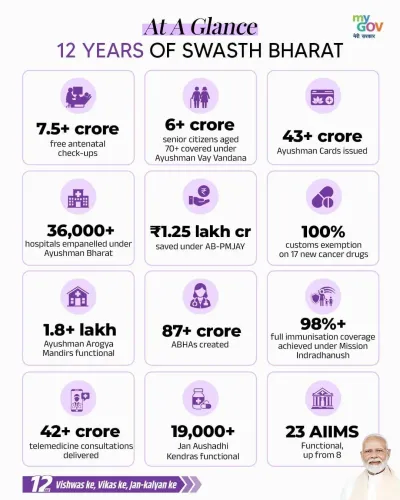
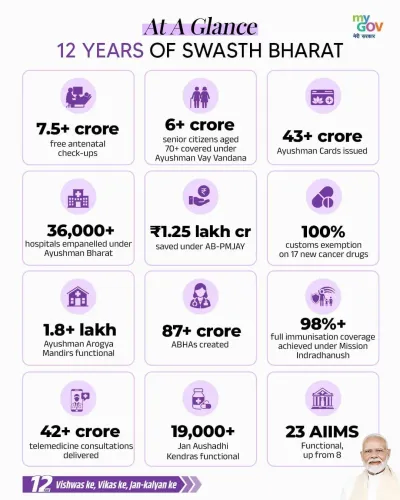
Ayushman Bharat PMJAY , launched in 2018 , offers up to Rs 5 lakh per family annually in cashless health insurance for low-income households.
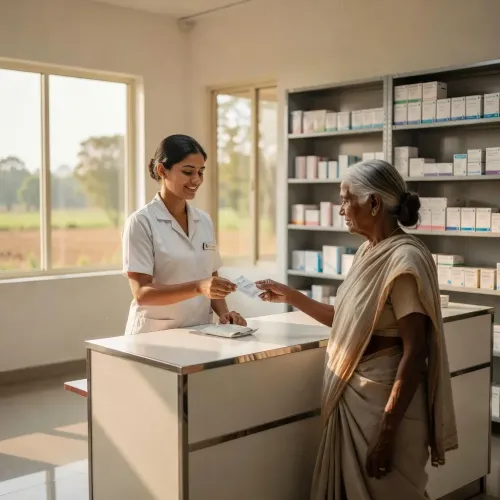
The Jan Aushadhi scheme provides affordable generic medicines, reducing out-of-pocket costs for ordinary citizens.
India's Universal Immunisation Programme was significantly expanded, including the large-scale COVID-19 vaccination drive from 2021 .
Jamnagar, Gujarat hosts the world's first WHO Global Centre for Traditional Medicine , established under the Ministry of AYUSH framework.
The post links health infrastructure directly to the #ViksitBharat goal of a developed India by 2047 .
Gujarat Chief Minister Bhupendra Patel on Sunday, June 14, 2026, credited Prime Minister Narendra Modi's twelve years in office with bringing what he called a 'epoch-making revolution' in India's healthcare sector, citing flagship schemes and the establishment of a landmark global institution in Gujarat as proof of transformative progress.
Context
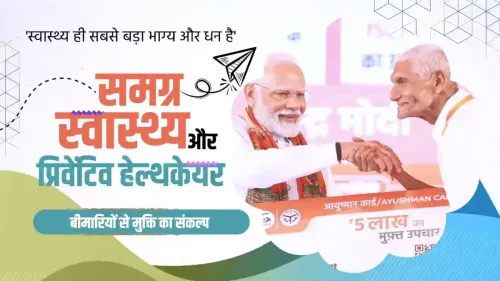
Posting on the occasion of #12YearsOfSwasthBharat, CM Patel wrote that under Modi's 'visionary leadership,' quality healthcare has been made 'every citizen's right.' He specifically highlighted Ayushman Bharat – Pradhan Mantri Jan Arogya Yojana (PMJAY), the Jan Aushadhi scheme, and a record health budget as the pillars of this transformation. The post, written in Hindi, stated: 'reckord swasthya budget, Ayushman Bharat #PMJAY ke tahat muft ilaaj aur Jan Aushadhi jaisi jan-hitaishi yojanaon se aaj desh ke aam aadmi ko shreshth swasthya suvidhaen mil rahi hain' ['A record health budget, free treatment under Ayushman Bharat PMJAY, and people-friendly schemes like Jan Aushadhi are today providing the best health facilities to the common citizen of the country.']
Policy Backdrop
Ayushman Bharat PMJAY, launched in 2018, provides health insurance coverage of up to Rs 5 lakh per family per year to economically vulnerable households, making it one of the world's largest publicly funded health insurance programmes. The Jan Aushadhi network dispenses affordable generic medicines through dedicated outlets, aimed at reducing out-of-pocket healthcare expenditure for ordinary families.
CM Patel also pointed to the expansion of India's Universal Immunisation Programme — further scaled during the nationwide COVID-19 vaccination drive from 2021 — as evidence of strengthened public health infrastructure. The National Health Policy 2017 had set the broader framework for universal health coverage and increased public spending that subsequent schemes built upon.
The post drew particular attention to Jamnagar, Gujarat, as the home of the world's first WHO Global Centre for Traditional Medicine — an institution that positions India as a global hub for the research, documentation, and mainstreaming of traditional medicine systems. The Ministry of AYUSH, created in 2014, laid the groundwork for integrating traditional medicine alongside modern healthcare at the national level.
Stakeholders and Impact
The schemes cited by CM Patel directly benefit common citizens, rural patients, and low-income families who historically faced high out-of-pocket medical costs. PMJAY's cashless hospitalisation model has been especially significant for families below the poverty line, reducing the risk of medical expenditure pushing households into debt. The Jan Aushadhi network has expanded access to affordable medicines in smaller towns and rural areas.
For Gujarat specifically, the Jamnagar WHO centre carries both symbolic and substantive weight — it places the state at the centre of a global conversation about integrative medicine, potentially attracting international research collaborations and health tourism. CM Patel's post frames these national achievements as directly relevant to Gujarat's own development trajectory.
What's Next
The messaging aligns with the broader #ViksitBharat vision — the government's stated goal of India becoming a developed nation by 2047 — with health infrastructure positioned as a foundational pillar of that ambition. Observers will watch whether Gujarat expands its own state-level top-up coverage under PMJAY, and what research and international partnerships emerge from the Jamnagar WHO Global Centre for Traditional Medicine. Health budget allocations in the next Union Budget will also be a key indicator of whether the 'record spending' narrative is sustained with fresh commitments.
Point of View
Timed to the symbolic milestone of twelve years of the Modi government's health agenda. By weaving together insurance coverage, affordable medicines, immunisation, and the Jamnagar WHO centre into a single narrative, it positions Gujarat not merely as a beneficiary of central schemes but as a flagship proof-point of the Viksit Bharat vision. The invocation of the WHO centre is particularly strategic — it elevates a state-specific achievement to a global register, lending international credibility to domestic health policy claims. The post reflects a broader pattern in BJP state-level communication: anchoring local governance wins within the prime ministerial brand to reinforce both central and state political capital simultaneously.
NationPress
23 Sept 2026
Frequently Asked Questions
What is Ayushman Bharat PMJAY and who benefits from it?
Ayushman Bharat PMJAY is a central government health insurance scheme launched in 2018 that provides cashless hospitalisation coverage of up to Rs 5 lakh per family per year to economically vulnerable households, benefiting low-income and below-poverty-line families across India.
Where is the WHO Global Centre for Traditional Medicine located in India?
The world's first WHO Global Centre for Traditional Medicine is located in Jamnagar, Gujarat. It was established to promote research, documentation, and mainstreaming of traditional medicine systems globally.
What is the Jan Aushadhi scheme?
Jan Aushadhi is a government scheme that operates a network of outlets dispensing affordable generic medicines to reduce out-of-pocket healthcare costs for ordinary citizens, particularly in smaller towns and rural areas.
What is Viksit Bharat and how does health policy connect to it?
Viksit Bharat is India's national vision to become a developed nation by 2047. The government frames strong health infrastructure — including universal insurance coverage, affordable medicines, and expanded immunisation — as a foundational pillar of achieving that goal.
What did Gujarat CM Bhupendra Patel say about Modi's health reforms?
CM Bhupendra Patel said that under PM Modi's visionary leadership over the past 12 years, an epoch-making revolution has come to India's health sector, making quality healthcare every citizen's right through schemes like PMJAY, Jan Aushadhi, and the establishment of the WHO Traditional Medicine Centre in Jamnagar.