IPL 2026: Munaf Patel Commends Lungi Ngidi's Bowling Acumen

Synopsis
Delhi Capitals' bowling coach, Munaf Patel, praises Lungi Ngidi for his intelligent bowling and adaptability to Indian conditions. Ngidi's skillful use of slower balls has been pivotal for the team, showcasing his strategic understanding of the game.
Key Takeaways
Lungi Ngidi is praised for his adaptability to Indian conditions.
Munaf Patel emphasizes the importance of variations in modern bowling.
Strong communication between coaches and players is pivotal.
Wickets taken during the powerplay are critical for T20 success.
Coaching focuses on enhancing individual strengths and adapting strategies.
New Delhi, April 7 (NationPress) The bowling coach of Delhi Capitals (DC), Munaf Patel, has showered accolades on South African pace bowler Lungi Ngidi, characterizing him as an astute and self-aware bowler who adeptly navigates Indian conditions. He is regarded as one of the most manageable overseas players within the dressing room.
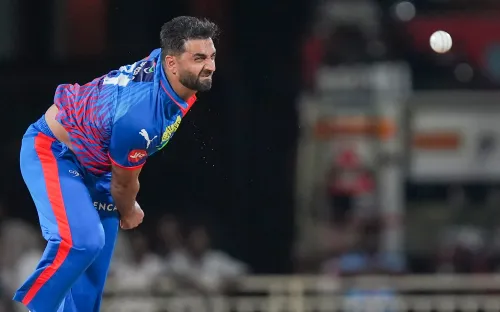
Ngidi has effectively stepped into the role previously held by Mitchell Starc, utilizing his cunning slower balls that deceive batters with a late dip. This was evident during DC’s six-wicket victory against the Mumbai Indians, where Ngidi successfully trapped Suryakumar Yadav lbw for 51 as he attempted to accelerate.
Ngidi's slower deliveries have earned him 11 wickets at a commendable economy rate of 6.8 and a strike rate of 14. “To excel as a bowler in today's game, mastering various deliveries is essential. His slower balls are a testament to that, and he remains an active player for South Africa, having participated in this year’s Men’s T20 World Cup in India.
“He possesses insights into bowling on these pitches. Having been part of the IPL for a significant duration, he has accumulated experience with different teams, including last season. He has a clear understanding of how to adapt his variations to suit the conditions of Indian pitches. Unlike many bowlers who aim for speeds of 150 kmph and often get hit, he maintains his own strategy, utilizing his slower deliveries and yorkers when necessary,” Munaf stated during the pre-match press conference before DC faced the Gujarat Titans at the Arun Jaitley Stadium on Wednesday.
Munaf, who has played 13 Tests, 70 ODIs, and three T20Is for India, also highlighted the strong rapport he has developed with Ngidi at DC. “When it comes to Lungi, he excels in his bowling domain. I can confidently say he is an exceptional bowler for his style. I engage with him daily, as my role is to communicate with bowlers and enhance their skills, whether it involves introducing a slower ball or a yorker. Lungi is a great individual; he is straightforward to manage, unlike some foreign players who can be challenging,” he remarked.
Discussing left-arm seamer T Natarajan, who has excelled with slower balls during death overs, Munaf mentioned that their focus in the IPL is to fortify the pacer's strengths.
“I believe consistent bowling practice is crucial. He faced injuries last year and was primarily engaged in day and one-day matches. The injury was extensive, preventing him from participating in both formats. Hence, he has opted to focus solely on T20 for now. However, I anticipate that next year, he will return to playing in longer formats based on his performance,” he said.
“I don't work with him year-round since he participates in domestic circuits and collaborates with his coaches. During this 2-3 month period, I concentrate on his bowling, as we have trainers dedicated to his fitness. I continually advise him to bowl based on his strengths, especially his slower deliveries and yorkers, as he specializes in death overs,” he added.
Regarding Mukesh Kumar, Munaf noted clear advancements after focusing specifically on his new-ball discipline. “I have collaborated with Mukesh for several months to address his line and length issues from last year, which were heavily scrutinized. Whenever he plays, his new ball effectiveness has markedly improved, and his test match lengths are commendable. My training with Mukesh is centered around honing his variations and ensuring he utilizes the new ball effectively, as he primarily operates as a new-ball bowler. He is expected to deliver substantial overs during the power play,” he explained.
Munaf also expressed his perspective on the critical elements that differentiate successful and unsuccessful teams in T20 cricket, emphasizing the significance of taking wickets during the powerplay—a facet DC has executed proficiently thus far.
“I perceive T20 cricket in a specific light—if you secure wickets within the first six overs, no team can achieve a score of 200. When partnerships flourish and the power-play phase is effectively utilized, crossing 200 is feasible; otherwise, it becomes unachievable. Currently, teams managing to restrict scores below 200 demonstrate that the power play is pivotal,” he stated.
“If two to three wickets are taken early and the opposition is limited to 40-42 runs, it becomes exceedingly challenging to reach 200 unless poor bowling occurs in the final six overs. Therefore, I firmly believe that any team that leverages the power play effectively will prevent their opponents from surpassing the 200 mark,” he elaborated.
In his role as a bowling coach, Munaf, a member of India’s 2011 ODI World Cup-winning squad, emphasized that his responsibility revolves around guiding bowlers rather than imposing directives. “My objective is to help them comprehend and execute their bowling strategies. Ultimately, the majority of the work lies with the bowlers themselves, such as assessing the batsman or delivering Test match lengths.
“Understanding when and how much to bowl based on the situation is crucial. Consistent bowling in the same manner, even when being hit, is not feasible. For instance, if the new ball swings, longer spells are possible; if not, variations must be employed,” he mentioned.
Discussing his broader coaching philosophy, Munaf pointed out that international bowlers generally require less supervision compared to their domestic counterparts. “Engagement with the players is essential. We must discuss wicket conditions and strategies. Take Lungi Ngidi, for instance, who hails from South Africa but has prior World Cup experience.
“Our discussions cover the strengths and weaknesses of opposing batters, although weaknesses are becoming scarce as batters adopt more shots in the T20 format. My duty is to prepare bowlers for matches; some may practice prior to match day while others rest, depending on their needs. Ultimately, it’s the trainers who manage their conditioning.
“International bowlers typically need less time investment, whereas domestic players require guidance on handling pressure and executing effective bowling during the initial and final overs. It’s beneficial that Axar serves as an all-rounder, with both Kuldeep and Axar available to mentor emerging players like Vipraj Nigam during middle overs, which proves advantageous,” he concluded.
Point of View
I view Munaf Patel's insights on Lungi Ngidi as a testament to the depth of talent in international cricket, particularly in the IPL context. Ngidi's strategic prowess and adaptability highlight the evolving nature of the game and the critical role of coaching in maximizing player potential.
NationPress
16 Sept 2026
Frequently Asked Questions
What makes Lungi Ngidi a valuable player for DC?
Lungi Ngidi's ability to understand Indian conditions and his skillful use of slower balls make him a significant asset for Delhi Capitals.
How does Munaf Patel contribute to player development?
Munaf Patel focuses on guiding bowlers to enhance their skills and adapt their strategies according to game situations.
What is the importance of the powerplay in T20 cricket?
Taking wickets in the powerplay is crucial as it limits the opposition's scoring potential, making it harder to reach high totals.
How does Munaf Patel view the role of international bowlers?
Munaf believes that international bowlers require less guidance than domestic players, as they typically have more experience in handling pressure.
What strategies does Munaf emphasize for bowlers?
Munaf emphasizes the need for bowlers to understand the situation and adapt their bowling styles, using variations effectively.