JP Nadda targets Congress over Election Commission influence at Ahmedabad rally
Synopsis
At a 'Save Democracy' rally in Ahmedabad, BJP chief JP Nadda turned the Opposition's Election Commission critique on its head — producing a roll-call of former poll officials who allegedly received plum posts under Congress governments, from Rajya Sabha berths to governorships, while invoking the Emergency, 100 Article 356 dismissals, and the CAG row to argue that institutional erosion is the Congress's legacy, not its grievance.
Key Takeaways
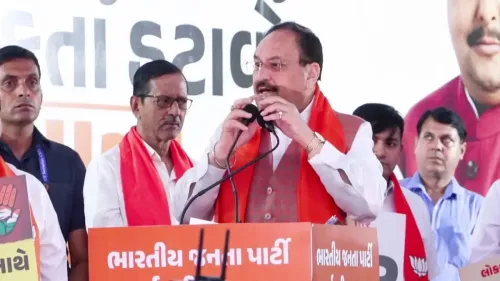
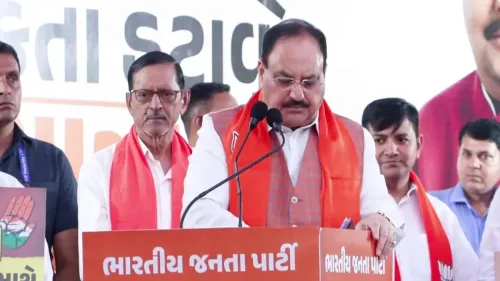
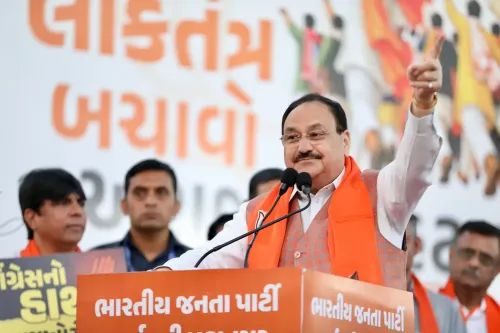
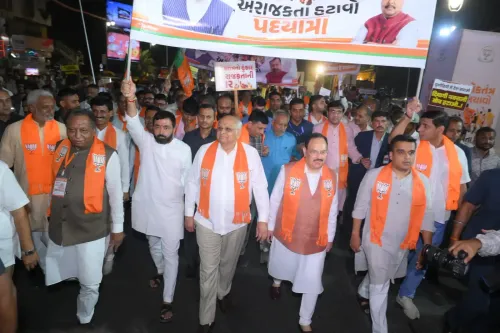
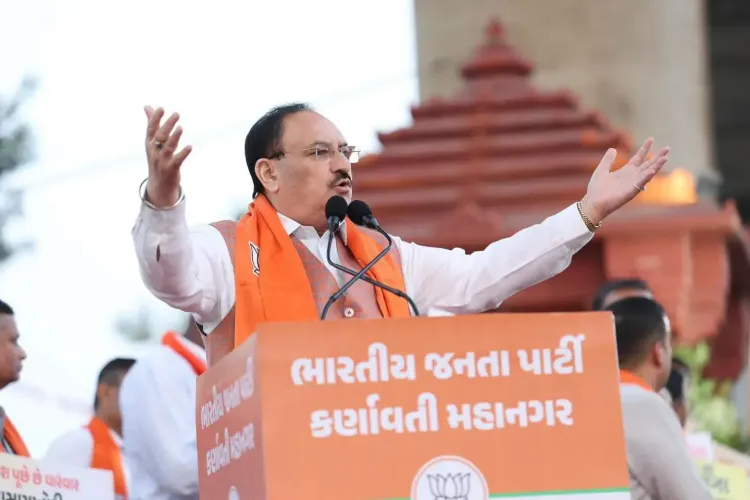
JP Nadda addressed the BJP's 'Save Democracy, Remove Anarchy' rally in Ahmedabad on 27 October 2026 .
He alleged Congress systematically rewarded former election officials with posts — citing T.N.
Ramadevi , and others.
Nadda defended PM Modi's reform of including the Leader of the Opposition in the ECI appointment process, per a Supreme Court directive.
He alleged Congress dismissed elected state governments on 100 occasions , with Indira Gandhi responsible for 50 .
Around 1.3 lakh people were allegedly jailed without trial during the Emergency under Congress, he claimed.
The rally is part of the BJP's nationwide campaign countering the INDIA bloc's criticism of the Election Commission .
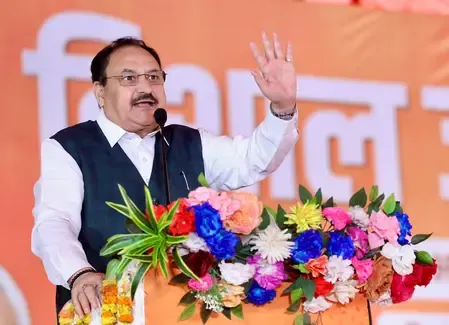
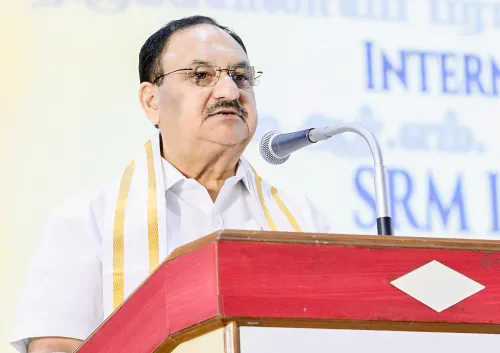
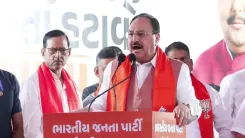
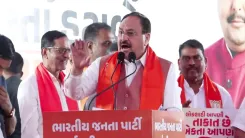
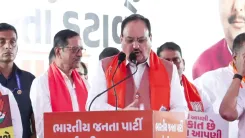
Bharatiya Janata Party national president and Union Health Minister Jagat Prakash Nadda on Tuesday, 27 October launched a sharp attack on the Indian National Congress at the 'Save Democracy, Remove Anarchy' rally in Ahmedabad, accusing the party of systematically attempting to bring the Election Commission of India (ECI) under its influence through strategic post-retirement appointments during its years in power. His remarks came as the Opposition ramped up criticism of the ECI over the ongoing Special Intensive Revision (SIR) of electoral rolls.
Key Allegations Against Congress
Addressing the rally — attended by Gujarat Chief Minister Bhupendra Patel and Deputy Chief Minister Harsh Sanghavi — Nadda cited a series of former election officials who, he alleged, subsequently received official positions under Congress-led governments. He pointed to former Chief Election Commissioner T.N. Seshan, who contested against BJP veteran L.K. Advani from Gandhinagar on a Congress ticket, and former Chief Election Commissioner M.S. Gill, who was nominated to the Rajya Sabha and later served as Union Sports Minister.
Nadda further cited the appointments of former Election Commissioner Sukumar Sen as vice-chancellor of Burdwan University, K.V.K. Sundaram as an adviser to the Union Home Minister, and Nagendra Singh as India's representative to the United Nations General Assembly. He also referred to V.S. Ramadevi's appointments as Governor of Himachal Pradesh and Karnataka as further evidence of what he described as a deliberate pattern.
Additionally, Nadda alleged that former Rajasthan Chief Minister Ashok Gehlot had allotted six acres of land to Naveen Chawla for an educational trust, calling it another instance of institutionalised favour.
BJP's Defence of the Appointment Process
Defending the current government's approach, Nadda said: Prime Minister Narendra Modi had, in accordance with a Supreme Court judgment, included the Leader of the Opposition in the Lok Sabha in the process of selecting the Chief Election Commissioner and Election Commissioners. He argued this reform demonstrated the BJP's commitment to institutional transparency — a contrast, he contended, to the Congress's record.
Broader Attack on Congress's Democratic Record
Nadda accused the Congress of habitually attacking constitutional institutions whenever their decisions went against the party — citing the judiciary, the Comptroller and Auditor General (CAG), and the ECI. He alleged that Congress leaders had threatened CAG officials over the 2G spectrum and coal allocation reports.
He recalled former Prime Minister Rajiv Gandhi's reported description of the Planning Commission as a 'group of buffoons', noting that Manmohan Singh was its chairman at the time. He also referred to Rahul Gandhi publicly tearing up an ordinance brought by the Manmohan Singh government, and criticised the establishment of the National Advisory Council (NAC), which he said had been placed on a footing comparable to the Prime Minister's Office.
On the use of Article 356, Nadda alleged that Congress governments had dismissed elected state governments on 100 occasions, with former Prime Minister Indira Gandhi responsible for 50 of those instances. He also invoked the Emergency, alleging that around 1.3 lakh people had been imprisoned under the Maintenance of Internal Security Act and the Defence of India Rules without trial.
Rallying the BJP Base Ahead of 2029
Nadda urged Congress to reflect on its electoral performance rather than blaming the ECI and electronic voting machines for electoral defeats. He asserted that elections were decided by voters and not by rallies or protests, and declared that the BJP would seek another mandate under PM Modi in 2029. The Ahmedabad event was part of the BJP's nationwide campaign against what the party describes as attempts by the Congress and the INDIA bloc to undermine democratic institutions.
The rally signals an intensification of the BJP's counter-offensive as the Opposition continues to press its case against the SIR process — a dispute that is likely to define the political narrative in the run-up to the next general election cycle.
Point of View
But its persuasive force depends on accepting equivalence between past appointments — many of which were routine or legally unremarkable — and a deliberate conspiracy to capture the ECI. The BJP's own reform of including the Leader of the Opposition in the appointment panel is a genuinely significant institutional change, yet Nadda deployed it primarily as a rhetorical contrast rather than a substantive policy achievement. More tellingly, the speech sidesteps the Opposition's immediate concern: the SIR process and its implications for electoral roll integrity ahead of future elections. Framing a live procedural controversy through the lens of historical grievances is effective political messaging, but it does not resolve the underlying institutional trust deficit that both sides are now exploiting.
NationPress
27 Oct 2026
Frequently Asked Questions
What did JP Nadda allege about Congress and the Election Commission?
Nadda alleged that Congress systematically attempted to influence the Election Commission by offering post-retirement appointments — including Rajya Sabha nominations, governorships, and cabinet posts — to former election officials during its time in power. He cited figures including former Chief Election Commissioners T.N. Seshan and M.S. Gill as examples.
What is the Special Intensive Revision (SIR) that triggered the rally?
The Special Intensive Revision (SIR) is an ongoing process of updating and reviewing electoral rolls conducted by the Election Commission of India. The Congress and the INDIA bloc have criticised the SIR, prompting the BJP to organise nationwide 'Save Democracy' rallies in response.
How did the BJP defend changes to the ECI appointment process?
Nadda stated that PM Modi, in line with a Supreme Court judgment, included the Leader of the Opposition in the Lok Sabha in the panel that selects the Chief Election Commissioner and Election Commissioners. He argued this made the process more transparent and independent compared to the Congress era.
What historical examples did Nadda cite against Congress on democratic institutions?
Nadda cited the imposition of the Emergency — under which he alleged around 1.3 lakh people were jailed without trial — the use of Article 356 to dismiss elected state governments 100 times (50 by Indira Gandhi alone), alleged threats to CAG officials over 2G and coal allocation reports, and Rahul Gandhi publicly tearing up a government ordinance.
Who attended the Ahmedabad BJP rally with Nadda?
The rally was attended by Gujarat Chief Minister Bhupendra Patel and Deputy Chief Minister Harsh Sanghavi, alongside Nadda. It was part of the BJP's broader nationwide campaign against what the party describes as the Congress and INDIA bloc's attempts to undermine democratic institutions.