Pakistan inflation rooted in credit misallocation, not money supply: Study

Synopsis
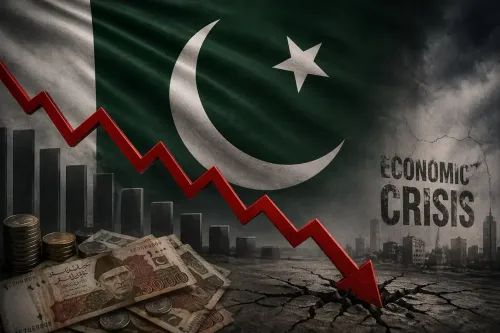
A new economic analysis turns conventional wisdom on its head: Pakistan's stubborn 11% inflation isn't a money-supply story — it's a credit-allocation story. With banks funnelling liquidity into government bonds instead of productive industry, Pakistan is generating demand without supply, while China's state-directed credit model keeps inflation near 1% despite similar M2 growth. The implication is stark — rate hikes alone won't fix it.
Key Takeaways
Pakistan's headline inflation stood at approximately 11 per cent in 2026 , against China's 1 per cent , despite broadly similar M2 growth in both countries.
A recent economic analysis argues Pakistan's inflation is driven by credit misallocation — specifically, banks channelling liquidity into Treasury Bills and Pakistan Investment Bonds to finance the fiscal deficit.
China's state-directed banking system steers credit toward manufacturing , infrastructure , and state-owned enterprises , expanding supply alongside demand.
Government borrowing in Pakistan is reportedly crowding out private sector credit , suppressing investment, hiring, and productivity growth.
Repeated public sector pay revisions have widened the income gap between government employees and informal private-economy workers, compounding demand-side pressures.
The analysis suggests interest rate policy alone cannot resolve Pakistan's inflation without structural reform of credit allocation.
Pakistan's persistent inflation problem cannot be resolved through interest rate adjustments alone, according to a recent economic analysis that compares the country's monetary system with China's. The study, cited by The Express Tribune, argues that the root cause lies in how credit is allocated within the economy — not in the pace of money supply growth.
The Pakistan-China Divergence
Both Pakistan and China have expanded their broad money supply (M2) significantly in recent years, yet their inflationary outcomes have diverged sharply. Pakistan's headline inflation hovered around 11 per cent in 2026, while China recorded inflation of roughly 1 per cent over the same period — despite broadly comparable M2 growth rates. According to the analysis, this gap is not a coincidence of scale; it reflects a structural difference in where newly created money flows.
How Credit Allocation Drives Inflation
The analysis explains that inflation emerges when money supply expands faster than an economy's capacity to produce goods and services. When fresh liquidity is directed toward expanding productive capacity — through manufacturing, infrastructure, and exports — supply keeps pace with demand and price pressures remain contained.
China's state-directed banking system channels a large share of credit toward businesses, state-owned enterprises, and infrastructure projects. Banking regulators steer lending into sectors that expand industrial capacity, while a high household savings rate suppresses the velocity of money, limiting consumer-driven price increases.
Pakistan's Fiscal Deficit Problem
In contrast, Pakistan's banking system directs much of its additional liquidity toward financing the government's fiscal deficit. Banks have increasingly invested in Treasury Bills and Pakistan Investment Bonds, which fund debt servicing, subsidies, and public sector salaries rather than productive investments that could expand industrial output or export capacity.
The analysis argues this pattern injects demand into the economy without a corresponding increase in supply — creating the structural conditions for persistent inflation. Government wage bills and consumption by higher-income households become major demand drivers, while weak private investment limits productivity growth and job creation.
Crowding Out Private Investment
Government borrowing, the study contends, crowds out private sector credit, leaving businesses with fewer financing options and slowing both investment and hiring. Private sector wages consequently remain subdued even as inflation erodes purchasing power.
Notably, repeated pay revisions for government employees — financed through the federal budget — have reportedly widened the income gap between public sector workers and those in the largely informal private economy. This divergence compounds the inflationary pressure by boosting consumption among a segment insulated from market wages.
What This Means for Policy
The analysis implies that rate hikes by the State Bank of Pakistan can only address the symptom, not the cause. Without redirecting credit flows toward productive sectors and curbing government borrowing from commercial banks, monetary tightening risks slowing growth without meaningfully reducing inflation. Structural reform of credit allocation — rather than the blunt instrument of interest rate policy — is presented as the more durable fix. Whether Pakistan's fiscal constraints allow for such a pivot remains an open question.
Point of View
Not to factories or exporters. What makes this particularly intractable is that Pakistan's fiscal deficit is itself the engine of the misallocation; you cannot redirect credit without first shrinking the deficit that banks are being asked to fund. The China comparison is instructive but imperfect — Beijing's model carries its own distortions — yet the core insight holds: supply-side credit deployment is a more durable inflation anchor than demand-side rate squeezes.
NationPress
26 Oct 2026
Frequently Asked Questions
Why is Pakistan's inflation so high compared to China despite similar money supply growth?
According to a recent economic analysis, the difference lies in how newly created money enters the economy. Pakistan's banks channel liquidity into government securities that fund consumption and debt servicing, injecting demand without expanding supply. China's banking system directs credit toward manufacturing and infrastructure, keeping supply in step with demand and inflation near 1 per cent.
What is credit misallocation and how does it cause inflation in Pakistan?
Credit misallocation occurs when bank lending flows to unproductive uses rather than capacity-expanding investments. In Pakistan's case, banks increasingly invest in Treasury Bills and Pakistan Investment Bonds to finance the fiscal deficit, which funds salaries and subsidies rather than industrial output — generating demand without a corresponding increase in supply, which sustains inflation.
Can Pakistan's State Bank reduce inflation by raising interest rates?
The analysis argues that interest rate policy alone is insufficient to address Pakistan's inflation. Because the root cause is structural — credit flowing to the fiscal deficit rather than productive sectors — monetary tightening can slow growth without meaningfully reducing price pressures. Structural reform of credit allocation is presented as the more effective long-term solution.
How does government borrowing affect Pakistan's private sector?
According to the analysis, government borrowing crowds out private sector credit, leaving businesses with fewer financing options. This slows private investment and hiring, keeps wages subdued, and limits productivity growth — even as inflation erodes purchasing power for workers in the informal economy.
How has public sector pay revision worsened Pakistan's inflation problem?
Repeated pay revisions for government employees, financed through the federal budget, have reportedly widened the income gap between public sector workers and those in the informal private economy. This boosts consumption among a segment insulated from market-wage pressures, adding to demand-side inflation without a corresponding increase in productive output.