Pakistan's $600 Million Loan Signals Economic Vulnerability: Analysis

Synopsis
Pakistan's recent acquisition of a $600 million loan highlights its precarious financial situation, with notable challenges in external financing and economic stability. This report delves into the factors contributing to the nation's fiscal struggles.
Key Takeaways
Pakistan's recent $600 million loan underscores its economic fragility.
Only $54 million of the $3.1 billion in budgeted foreign commercial loans has been received this fiscal year.
Public debt has soared to approximately PKR 78.5 trillion, representing 68% of GDP.
Exports have declined by 7% in the first seven months of the fiscal year.
Economic stability remains reliant on external financing and effective institutional oversight.
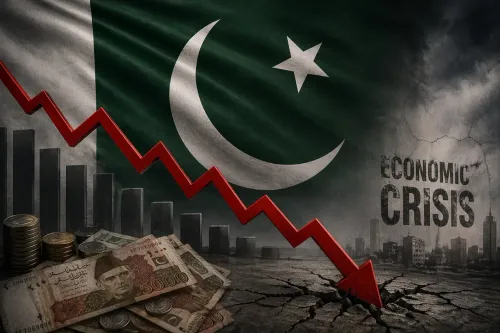
New Delhi, April 9 (NationPress) The economy of Pakistan is currently facing significant strain, as the recent move to acquire a $600 million short-term loan from Standard Chartered Bank has underscored the nation's vulnerable external financing situation amidst escalating fiscal and external hurdles, according to a recent report.
The Asian News Post report reveals that the loan is set at SOFR plus 2.6 percent, which equates to an interest rate of approximately 6.3 percent. This financial aid aims to bolster foreign exchange reserves that have been pressured by a shortfall in anticipated foreign commercial investments.
With the loan being drawn to cover energy imports, this financial assistance comes at a crucial juncture, as Pakistan has only received $54 million of the $3.1 billion budgeted for foreign commercial loans this fiscal year, as highlighted in the report.
Moreover, it was noted that out of the projected $26 billion in total external borrowing, merely $5.7 billion has been realized thus far, including funds from the International Monetary Fund (IMF).
Simultaneously, the country has recently settled a $700 million loan with the China Development Bank, resulting in foreign exchange reserves plummeting to $15.5 billion as of February 10.
The government is anticipated to seek refinancing for this amount in June, alongside an additional $1 billion commercial loan.
Analysts have pointed to “budgetary fiction” as a principal driver of the financial disarray, according to the report.
Despite intentions to generate $400 million through sovereign bond issuance in the current fiscal year, no such actions have yet occurred.
Similarly, a proposed $250 million Panda bond issuance has seen minimal advancement.
The overarching macroeconomic context remains bleak. Exports have diminished by 7 percent during the first seven months of this fiscal year, while foreign direct investment has plummeted by over 41 percent, totaling $981 million.
The government aims to achieve foreign exchange reserves of $18 billion by June, relying on enhanced remittances, new borrowing, and continued deposits of $12.5 billion from Saudi Arabia, the UAE, and China.
Economists have raised alarms about escalating public debt and fiscal discrepancies. Pakistan's public debt has surged to approximately PKR 78.5 trillion, representing 68 percent of GDP, while interest payments have soared by 43 percent to PKR 6.4 trillion.
They have noted that fundamental issues such as poor revenue generation, reliance on overly optimistic budget forecasts, and increased supplementary expenditures continue to weaken fiscal discipline.
In the absence of robust institutional oversight, analysts contend that Pakistan remains reliant on external financing to sustain macroeconomic stability, with short-term borrowing increasingly becoming a recurring necessity.
Point of View
I recognize the pressing nature of Pakistan's economic landscape. The acquisition of a $600 million loan not only reflects immediate financial needs but also signals deeper structural issues that must be addressed. A nation-first approach requires a comprehensive strategy to stabilize and strengthen the economy.
NationPress
10 Oct 2026
Frequently Asked Questions
Why did Pakistan secure a $600 million loan?
Pakistan secured the loan to bolster its foreign exchange reserves, which are under strain due to a shortfall in expected foreign commercial inflows.
What are the challenges facing Pakistan's economy?
Pakistan's economy is grappling with declining exports, reduced foreign direct investment, and rising public debt, which are exacerbating fiscal imbalances.
What is the interest rate on the loan?
The loan is priced at SOFR plus 2.6 percent, translating to an interest rate of approximately 6.3 percent.
How much of the planned external borrowing has been realized?
Out of the projected $26 billion in total external borrowing, only $5.7 billion has been materialized so far.
What steps is the government taking to improve the financial situation?
The government aims to achieve foreign exchange reserves of $18 billion by June through improved remittances and new borrowing.