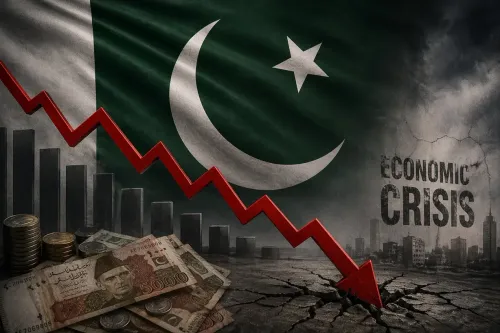
Pakistan's $140bn debt crisis: No oversight, rampant write-offs, IMF alarm
Synopsis
Pakistan's debt crisis has crossed a threshold where individual loan defaults are being absorbed as national liabilities — with $140 billion in external debt, no parliamentary oversight, and the IMF tightening its grip. A Business Recorder report warns the choice is now between moratorium, default, or a painful structural overhaul starting July 2026.
Key Takeaways
Pakistan's external debt stands at approximately $140 billion , with the entire federal budget consumed by debt servicing and defence spending.
The country was debt-free until October 1958 ; six decades of unchecked borrowing have produced the current crisis.
A Business Recorder report finds no parliamentary oversight on borrowing, no loan retirement framework, and rampant write-offs.
The IMF has begun imposing stricter conditionalities before releasing funds, signalling creditor fatigue.
The report recommends halting all new borrowing from 1 July 2026 , negotiating a five-year interest payment suspension , and forming a parliamentary debt control committee .
Under the NFC award , a major share of federal tax revenues is transferred to provinces, further squeezing the Centre's fiscal space.
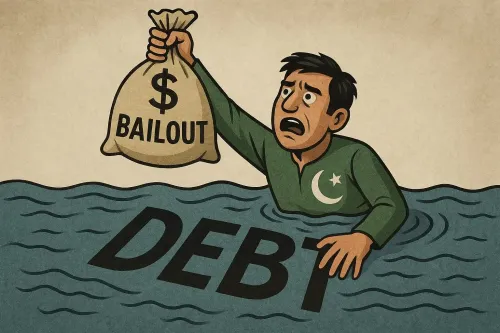
Pakistan's spiralling debt burden — with an external component alone of around $140 billion — has reached a point where individual borrowing has effectively become a national liability, as loan defaults, write-offs, and kickback-driven projects go largely unchecked, according to a report published in Business Recorder. The International Monetary Fund (IMF), the country's lender of choice, has reportedly begun imposing stricter conditionalities before releasing funds, signalling that global patience with Islamabad's fiscal habits is running thin.
How Individual Debt Became a National Crisis
The Business Recorder report argues that Pakistan may be unique among nations in the degree to which private borrowing has been absorbed into the public balance sheet. Borrowers routinely default or receive loan write-offs, while kickback projects — infrastructure and state ventures built on borrowed capital — carry no structured repayment framework. The result is a cascading accumulation of liabilities that ultimately falls on the state.
Notably, till October 1958, Pakistan was effectively debt-free. The transformation from a solvent republic to one mired in sovereign debt has unfolded over six decades of unchecked borrowing and weak institutional accountability.
No Parliamentary Oversight, No Debt Retirement Plan
The report is particularly sharp in its criticism of legislative inaction. "There is no parliamentary oversight or debate; only rules of procurement are defined — need assessment, and loan retirement is not considered," it states. The IMF has echoed this concern, observing that there is no effective check on government spending.
Under the National Finance Commission (NFC) award, a significant share of federal tax revenues is transferred to the provinces, further constraining the Centre's fiscal headroom. The report laments that "the entire federal budget is consumed by debt servicing and defence expenditure," leaving no resources to sustain a non-performing state apparatus.
What the Report Recommends
The Business Recorder analysis lays out a set of urgent corrective measures. It calls for all future borrowing to be halted in the next budget, beginning 1 July 2026. A five-year suspension of interest payments should be negotiated with creditors. The import and export bills must be consolidated and tracked to achieve balance of payments stability. A massive cut in state expenditure is also recommended.
On governance, the report advocates for the creation of a parliamentary committee for debt control, arguing that the choice Pakistan now faces is "between moratorium and default or a combination of both — but business as usual cannot continue."
IMF's Tightening Grip
The IMF's increasingly conditional approach to Pakistan's bailouts reflects a broader creditor fatigue. "Loan yes, leaving alone no — it is indeed getting serious now," the report notes, capturing the bind Islamabad finds itself in: dependent on external financing yet increasingly constrained by the terms attached to it. This comes amid Pakistan's repeated recourse to IMF programmes, with the country having entered more bailout arrangements than almost any other emerging economy in recent decades.
The Road Ahead
The report frames Pakistan's debt as a "major fault line" that demands structural correction rather than cosmetic fixes, pointedly observing that "driving luxury automobiles on borrowed money is, indeed, shameful." Whether Islamabad's political establishment has the will to implement the recommended austerity and oversight measures remains the central question. With the IMF tightening conditionalities and external debt at record levels, the window for voluntary correction is narrowing.
Point of View
From individual write-offs to sovereign kickback projects. The IMF's tightening conditionalities are less a punishment and more a belated recognition that unconditional lending has enabled, not resolved, the crisis. What mainstream coverage misses is the structural trap: the NFC award locks in provincial transfers regardless of federal solvency, making expenditure compression politically near-impossible. Without a constitutional fix to fiscal federalism alongside a debt moratorium, the recommended reforms risk remaining aspirational.
NationPress
20 Sept 2026
Frequently Asked Questions
How much is Pakistan's external debt in 2025?
Pakistan's external debt component alone is approximately $140 billion, according to a report in Business Recorder. The total public debt burden is significantly higher when domestic liabilities are included.
Why has individual debt become Pakistan's national burden?
Borrowers in Pakistan routinely default or receive loan write-offs, while state-backed kickback projects built on borrowed money carry no repayment framework. These liabilities are ultimately absorbed by the government, making private defaults a public burden.
What has the IMF said about Pakistan's fiscal management?
The IMF has observed that there is no effective check on government spending in Pakistan and has begun imposing stricter conditionalities before releasing funds, reflecting growing creditor concern over Islamabad's fiscal discipline.
What reforms does the Business Recorder report recommend for Pakistan?
The report recommends stopping all new borrowing from 1 July 2026, negotiating a five-year suspension of interest payments with creditors, achieving balance of payments stability, cutting state expenses sharply, and establishing a parliamentary committee for debt control.
When did Pakistan first accumulate significant debt?
Pakistan was debt-free until October 1958. The accumulation of sovereign debt began thereafter and has compounded over six decades of borrowing without adequate repayment frameworks or legislative oversight.