Navigating Tensions: Philippines' ASEAN Chairmanship Under Scrutiny
Synopsis
As Southeast Asia grapples with rising tensions, the Philippines' leadership in ASEAN is poised for a critical evaluation. The focus shifts from new initiatives to effective diplomacy and crisis management amidst geopolitical challenges.
Key Takeaways
Effective diplomacy is essential for ASEAN stability.
Challenges include the South China Sea and Myanmar peace process.
Maintaining unity and centrality in ASEAN is a priority.
Dialogue with major powers, particularly China, is crucial.
Institutional continuity through the ASEAN Troika is vital for policy execution.
Kuala Lumpur, March 6 (NationPress) As regional tensions escalate in Southeast Asia, the Philippines' leadership in ASEAN will be assessed not through new proclamations but by its adeptness in stabilizing the bloc via cautious diplomacy, fostering dialogue among divided stakeholders, and ensuring the forum remains relevant in tackling shared issues, a recent report indicated.
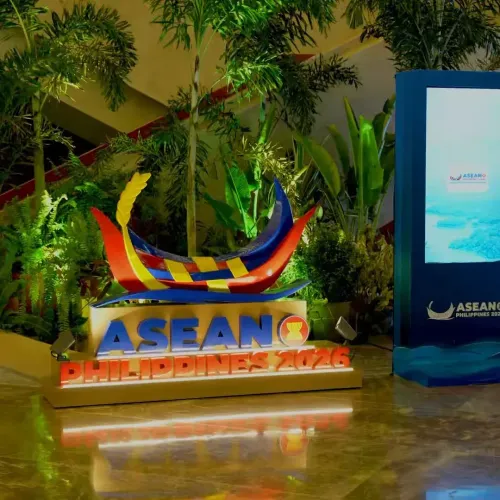
“As the Philippines embarks on its role as ASEAN Chair in 2026, the unresolved peace talks in Myanmar, ongoing disputes in the South China Sea, and renewed conflicts along the Cambodia–Thailand border will challenge Manila’s ability to navigate some of the region's most precarious geopolitical landscapes,” the report from Malaysia's leading news agency, Bernama, elaborated.
“The maritime situation is regarded as the initial test of credibility, especially considering the Philippines’ dual identity as both ASEAN Chair and a claimant in the South China Sea—this dual role necessitates both diplomatic caution and regional leadership,” it further explained.
According to the report, analysts suggest that Manila's chairmanship will likely be defined not by ambitious new initiatives but by its capacity to handle crises and expectations while balancing competing pressures and preserving ASEAN's unity and centrality.
Siti Darwinda Mohamed Pero, Deputy Dean (Research and Innovation) at Universiti Utara Malaysia's School of International Studies, pointed out that the current scenario could place Manila in a precarious balancing act amidst evolving major-power dynamics.
“This situation raises concerns about impartiality and consensus-building, especially considering the Philippines' increasingly visible security partnership with the United States. A crucial challenge will be how effectively the Philippines can foster open communication with China while encouraging Beijing to speed up discussions on the Code of Conduct (COC) amid the intensifying US–China strategic rivalry in the region,” Bernama quoted Siti Darwinda as stating.
She added that while progress on the long-awaited COC is expected to be gradual, “keeping lines of dialogue open and preventing escalation” is essential to uphold ASEAN’s role as a convening entity.
In addition to maritime issues, the tensions along the Thailand–Cambodia border present a distinct diplomatic challenge that, according to analysts, requires ongoing “preventive engagement rather than high-profile interventions.”
“Although Manila enjoys relatively strong relations with Bangkok, its interactions with Phnom Penh are more recent, marked by high-level reciprocal visits commencing only in 2025. This underscores both the opportunities and limitations it faces in addressing a volatile bilateral matter while ensuring ASEAN cohesion,” Siti Darwinda added.
The report highlighted the importance of institutional continuity, particularly through the ASEAN Troika framework—comprising the past, current, and future chairs—to help Manila maintain momentum in ongoing regional activities and ensure effective policy implementation beyond a single chairmanship term.
Point of View
It is crucial to recognize the delicate balance Manila must maintain amid rising regional tensions. The focus will be on effective diplomacy and crisis management rather than new initiatives. This approach underscores the importance of unity and collaboration within ASEAN.
NationPress
29 Sept 2026
Frequently Asked Questions
What challenges does the Philippines face as ASEAN Chair?
The Philippines faces challenges such as the stalled peace process in Myanmar, tensions in the South China Sea, and conflicts along the Cambodia-Thailand border.
How will the Philippines' chairmanship be evaluated?
The evaluation will focus on the Philippines' ability to stabilize the bloc through effective diplomacy and crisis management rather than new declarations.
What role does the ASEAN Troika play?
The ASEAN Troika, consisting of past, current, and incoming chairs, helps maintain momentum in regional efforts and ensures policy execution beyond a single chairmanship term.
How important is dialogue with China for the Philippines?
Maintaining dialogue with China is vital for the Philippines, particularly in expediting negotiations on the Code of Conduct amid US-China tensions.
What is the significance of the maritime domain for the Philippines?
The maritime domain is crucial as it serves as a test of credibility for the Philippines, given its dual role as ASEAN Chair and a claimant in the South China Sea.