Did PM Modi Share Serbian President’s Views on AI and His Affection for India?
Synopsis
Prime Minister Modi recently highlighted Serbian President Vucic's article on AI, expressing admiration for India's growing role in the field. Vucic's reflections on their nations' relationship and India's advancements make this a compelling read for those interested in international cooperation and technological progress.
Key Takeaways
PM Modi shared an article from Serbian President Vucic.
Vucic admires India's advancements in AI .
The AI Impact Summit 2026 highlights India's global role.
Serbia seeks to enhance ties with India in technology.
Bilateral trade shows growth but has untapped potential.
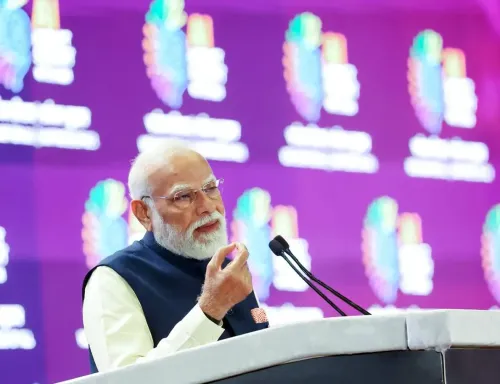
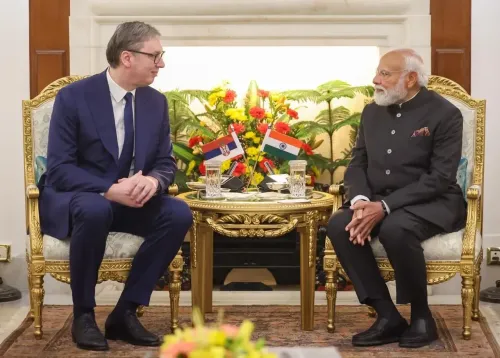
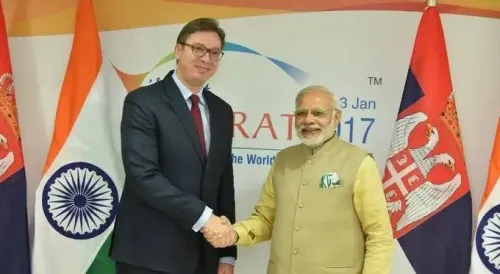
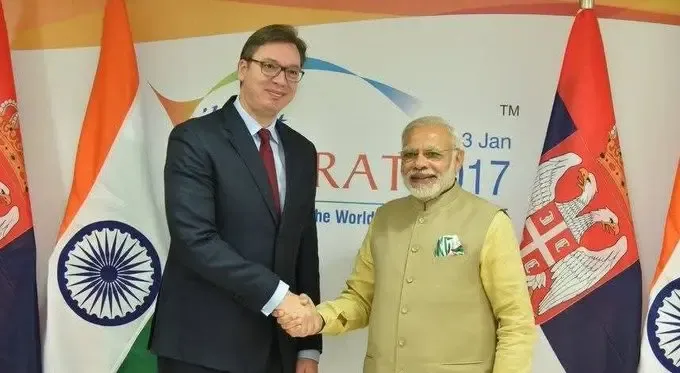
New Delhi, Feb 18 (NationPress) Prime Minister Narendra Modi recently shared an article penned by President Aleksandar Vucic of Serbia, wherein the Serbian leader discusses the impact of artificial intelligence, India’s increasing significance in the global AI landscape, and his profound respect for the nation.
On the social media platform X, PM Modi characterized the article as both insightful and warm in its appreciation of India.
“An excellent article by President Aleksandar Vucic of the Republic of Serbia, where he elaborates on AI while also expressing his admiration for India, India's advancements in AI, and robust India-Serbia relations,” PM Modi remarked.
In conjunction with his post, PM Modi also shared a message from President Vucic on X, where he expressed his pleasure in participating in the AI Impact Summit 2026 in India.
“Happy to be in India for the AI Impact Summit 2026. President of Serbia writes: AI Summit places India at the centre of the global discourse | The Indian Express,” Vucic shared.
The article by the Serbian President, featured in The Indian Express, intertwines personal anecdotes with broader geopolitical and economic insights. It emphasizes Serbia’s ambition to enhance its collaboration with India, particularly in technology and innovation.
Vucic opened his article by expressing his excitement upon arriving in Delhi for the ambitious AI Impact Summit, which he regards as globally significant.
“As I reach Delhi for the ambitious India AI Impact Summit, I feel an overwhelming sense of exhilaration. This feeling stems from witnessing a nation I have long admired flourish and carve its path to success,” he remarked.
He commended India’s capability to uphold unity amid its vast diversity, labeling the country as a living model of pluralism.
“India’s capacity to maintain unity in diversity has always intrigued me. As one of the world’s largest republics, with a multitude of languages, religions, cultures, and traditions, India is the epitome of dynamic pluralism,” he noted.
Vucic elaborated on how his admiration for India strengthened during his stay in London in the 1990s, when he held a position far from politics and diplomacy.
“What truly solidified my affection for India was my first encounter with its people during an earlier phase of my life when I worked in London in the 1990s,” he reflected, adding that those experiences significantly shaped his character and worldview.
The Serbian President recounted his long working hours and physically demanding routine, which he described as a lesson in humility and discipline.
“Each day, I started work before dawn and left only after twelve hours on my feet, often concluding the day by mopping the floors. It was arduous, honest work that served as an early lesson in discipline and humility,” he mentioned.
He noted that among his colleagues, the individuals he observed working the hardest were Indians, including a Sikh manager from Punjab and the Sagar family.
“The only ones who worked even harder were the Indians I befriended: my manager, a Sikh gentleman from Punjab, and the Sagar family. The Sagars worked with relentless purpose. They were generous, spoke little of themselves, yet imparted profound lessons about perseverance and dignity,” he wrote.
Vucic remarked that during a time when many Europeans underestimated India and its people, the work ethic and determination he witnessed led him to think differently.
“At a time when many Europeans around me were inclined to underestimate India and Indians, the quiet resolve and diligence of my colleagues and friends made me reconsider,” he added.
He also recalled discussions from this year’s World Economic Forum in Davos, where some voices suggested that India may remain in a “second tier” among global AI leaders.
He expressed disagreement with that viewpoint, asserting that India’s strategy is rooted in practical application and inclusive innovation.
“I was reminded of this belief at this year’s World Economic Forum in Davos. Among the various perspectives in a conversation about artificial intelligence was a viewpoint suggesting that India might occupy a ‘second tier’ among global AI powers. I must respectfully disagree,” he stated.
He emphasized that India’s AI strategy focuses less on creating flashy models and more on deploying technology for tangible results in sectors like healthcare, agriculture, education, and financial inclusion.
“India’s approach to AI prioritizes real-world application, ethical standards, and inclusive innovation,” he remarked, referencing comments made by Union Minister Ashwini Vaishnaw at Davos.
The Serbian President described the India AI Impact Summit as more than just a conference, labeling it a platform that positions India centrally in global discussions regarding artificial intelligence.
“The India AI Impact Summit is therefore more than a conference. It firmly places India at the heart of the global conversation on artificial intelligence,” he noted.
He articulated that the summit aims to comprehend how AI can be responsibly, inclusively, and at scale, utilized to address real-world challenges.
According to him, the summit reflects PM Modi’s vision to democratize technological access and ensure that AI is not confined to a privileged few.
“Driven by Prime Minister Narendra Modi’s ambition to democratize access to the benefits of new technology, it aims to ensure that AI is not solely for the privileged but serves as an engine for inclusive development and collective progress,” he asserted.
Vucic also highlighted the enduring relationship between Serbia and India, noting that their ties are built on cooperation, mutual respect, and an expanding economic partnership.
“Currently, relations between Serbia and India are grounded in a rich history of collaboration, mutual esteem, and growing economic ties,” he wrote.
He recalled the 2018 commemorative stamps jointly issued by the two nations to celebrate 70 years of diplomatic relations, featuring Swami Vivekananda and Nikola Tesla.
“In 2018, to commemorate seventy years of diplomatic relations, our two countries jointly issued stamps showcasing Swami Vivekananda and Nikola Tesla—symbols of spiritual insight and scientific brilliance that transcend borders,” he remarked.
Vucic appreciated India’s unwavering support for Serbia’s territorial integrity and sovereignty.
“India has consistently supported Serbia’s territorial integrity and sovereignty, particularly regarding Kosovo, maintaining a principled stance of non-recognition of its unilateral declaration of independence in 2008,” he added.
The Serbian President noted that bilateral trade between Serbia and India, currently around $400 million, has seen growth, yet he emphasized there is significant untapped potential.
“While bilateral trade between Serbia and India—currently around $400 million—has continued to grow, there remains vast untapped potential,” he said.
He pointed out that Indian companies are already engaged in Serbia in areas like IT, manufacturing, and automotive components, but asserted that both nations must aspire for more.
“These are positive signs, but we can and must aim higher,” he stated.
Vucic advocated for stronger connectivity, simplified trade protocols, and continuous investment in innovation-driven partnerships. He spotlighted high-growth sectors such as information technology, pharmaceuticals, and renewable energy as critical areas for deeper collaboration.
“Our shared goal should be to broaden and intensify economic engagement through enhanced connectivity, simplifying and streamlining trade arrangements, and encouraging sustained investment in innovation-focused partnerships,” he said.
Beyond trade and technology, Vucic also mentioned the vast potential for cultural exchange between the two countries.
“There is immense potential for cultural and creative exchange as well,” he remarked.
He expressed enthusiasm for seeing Indian films shot in Serbia, stating such collaborations could showcase Serbia’s beautiful landscapes to a global audience while strengthening people-to-people connections.
“I would be thrilled to see Indian films shot in Serbia, showcasing our stunning landscapes and weaving stories that resonate far beyond our borders,” he concluded.
In his closing remarks, the Serbian President returned to the lessons he learned decades ago while working in London, particularly the essence of grit, self-belief, and perseverance.
“As I ponder the extraordinary opportunities before us, I reflect on the lesson I first encountered decades ago on a London shop floor: that grit, equanimity, and self-belief are often the most powerful catalysts for progress,” he stated.
Vucic affirmed that India possesses these qualities in abundance and characterized PM Modi as a partner who embodies them through action rather than mere words.
“Having observed him over the years, I can confidently say that in Narendra Modi, we have a partner who exemplifies these virtues—not just in words, but in unwavering action,” he remarked.
He concluded by asserting that India is no longer a nation waiting for its turn in the global order, but one that is actively shaping the future.
“Those who still perceive India as a nation biding its time would do well to reconsider. India is not merely arriving at the future; it is playing a crucial role in defining it,” he ended.
Point of View
I recognize the importance of international dialogue, especially in the realm of technology and innovation. The sentiments shared by President Vucic reflect a broader narrative of collaboration and respect that is vital for both India and Serbia. This partnership is not only pivotal for bilateral relations but also instrumental in shaping global discussions on AI.
NationPress
16 Sept 2026
Frequently Asked Questions
What did PM Modi share regarding Serbia?
PM Modi shared an article by Serbian President Aleksandar Vucic discussing AI and expressing admiration for India.
What is the AI Impact Summit 2026?
The AI Impact Summit 2026 is an event in India focusing on the global discourse surrounding artificial intelligence.
How does Vucic view India’s role in AI?
Vucic views India as a key player in the AI sector, emphasizing its practical approach and inclusive innovation.
What are the historical ties between Serbia and India?
Serbia and India share a long-standing relationship built on cooperation, mutual respect, and expanding economic engagement.
What potential does Vucic see in Serbian-Indian relations?
Vucic believes there is significant untapped potential in trade and cultural exchange between Serbia and India.