Ravi Shankar Prasad Critiques Opposition's Actions in Lok Sabha, Calls Out Rahul Gandhi's Behavior
Synopsis
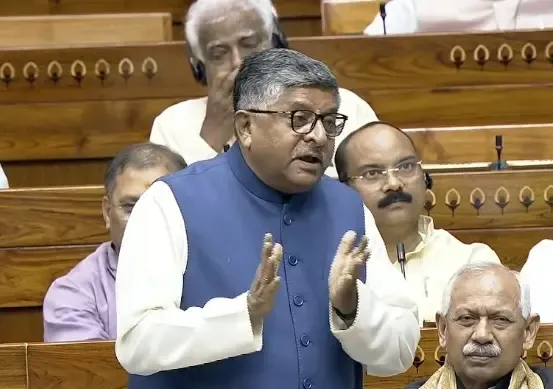
In a heated session, BJP MP Ravi Shankar Prasad criticized the Opposition for misusing parliamentary tools against Lok Sabha Speaker Om Birla. He specifically called out Rahul Gandhi's conduct, urging adherence to decorum while recalling historical challenges faced by Parliament.
Key Takeaways
Ravi Shankar Prasad warns against exploiting parliamentary tools.
Calls out Rahul Gandhi's conduct in Parliament.
Historical context provided for Parliament's dignity.
Emphasizes the importance of adherence to decorum.
Disputes surrounding Speaker's chairmanship highlighted.
New Delhi, March 11 (NationPress) BJP MP Ravi Shankar Prasad on Wednesday lambasted the Opposition during the discussion on the no-confidence motion against Lok Sabha Speaker Om Birla, warning that such parliamentary measures should not be exploited for political or personal agendas.
Engaging in the Lok Sabha debate, Prasad emphasized that the motion aimed at the Speaker should not be manipulated as a means to settle political disputes or to appease the “ego of a leader from a certain faction.”
“It is crucial that the instrument of opposition against the Speaker is not turned into a weapon to gratify the ego of a leader from a specific group,” he asserted while addressing the assembly.
The seasoned BJP leader also criticized Leader of Opposition Rahul Gandhi, questioning his behavior both within Parliament and during his international trips. He suggested that Congress leader K.C. Venugopal should provide guidance on parliamentary decorum to Gandhi.
“Venugopal ji ought to enlighten Rahul Gandhi on the responsibilities of the LoP,” he commented.
Prasad reproached Gandhi for referencing excerpts from an “unpublished memoir” of a former Army Chief, which prompted the Opposition to raise slogans in response to Prasad's comments.
Reflecting on parliamentary history, Prasad noted that the institution has endured various turbulent times yet has consistently maintained its dignity and risen above challenges.
“This Parliament has experienced many highs and lows; nevertheless, each time, the institution has reached new heights,” he remarked.
He recalled past controversies to illustrate his point, mentioning instances when Members of Parliament faced expulsion for misconduct.
“Just yesterday, discussions arose about the expulsion of 11 MPs for accepting bribes to ask questions, and even instances of black chili being thrown in the House. Nonetheless, Parliament has always managed to uphold its dignity,” Prasad stated.
He also referred to the “painful era” during the Emergency, accusing the Congress of undermining democratic institutions during that period.
“All Opposition members were imprisoned, and the duration of the House was extended from five to six years in the absence of several prominent leaders. The privileges under Article 105 were stripped away,” he noted.
Prasad further spoke of Justice H.R. Khanna, who dissented in a significant ruling during the Emergency concerning the suspension of fundamental rights.
“The courageous judge H.R. Khanna, who declared that the fundamental rights of individuals cannot be revoked during the Emergency, received global acclaim for his dissent. However, this very Congress party prevented him from becoming Chief Justice for even 45 days. Do they truly champion democracy?” Prasad questioned.
He also remembered the plight of socialist leader Jayaprakash Narayan during the Emergency, highlighting his severe health complications while incarcerated.
“Jayaprakash Narayan was diagnosed with severe kidney failure in October 1975 while detained at PGI Chandigarh during the Emergency and required lifelong dialysis,” he explained.
Prasad mentioned that even after Narayan was transferred to Jaslok Hospital in Bombay for treatment, he faced restrictions.
“While receiving treatment at Jaslok Hospital, Bombay, doctors advised that he should sit in the sun for an hour each day. However, this was prohibited due to concerns that supporters might gather. After navigating the legal process, he was finally permitted to sit in the sun for an hour,” Prasad recounted.
As he delivered these remarks, Opposition MPs, including members from the Samajwadi Party, began to chant slogans in the House.
In response to the disruptions, Prasad stated, “Who will remind them that even Mulayam Singh Yadav was imprisoned during that time?”
The debate surrounding the motion against the Speaker had already ignited intense exchanges in the Lok Sabha on Tuesday, particularly regarding who would preside over the House in Speaker Om Birla's absence.
The Opposition contended that the members of the panel who oversee proceedings are appointed by the Speaker himself and should not chair discussions pertinent to the motion against him.
While addressing Dilip Saikia, who was chairing at the time, Prasad defended the constitutional provisions governing such scenarios.
“Whenever it was questioned how the Chair could preside? Who appointed you?” he said, referencing Articles 93, 94, 95, and 96 of the Constitution.
“According to the Constitution, the Speaker and Deputy Speaker are elected. A Speaker can also be removed through a no-confidence motion. Several members questioned your presence there. I would like to clarify that it is because the Constitution permits it,” Prasad explained.
During his address, Prasad also cited specific excerpts from the Lok Sabha rulebook to reinforce the procedural framework guiding the operations of the House.
Point of View
The ongoing debate highlights the importance of maintaining parliamentary integrity. Ravi Shankar Prasad’s remarks serve as a reminder of the responsibilities that come with leadership positions, urging all parties to engage in constructive dialogue.
NationPress
30 Sept 2026
Frequently Asked Questions
What was the context of Ravi Shankar Prasad's criticism?
Ravi Shankar Prasad criticized the Opposition during the no-confidence motion against Lok Sabha Speaker Om Birla, warning against the misuse of parliamentary instruments.
What specific behavior of Rahul Gandhi was addressed?
Prasad questioned Rahul Gandhi's conduct in Parliament and during international visits, suggesting he needed guidance on parliamentary decorum.
What historical references did Prasad make?
He referred to past controversies and the Emergency period, emphasizing how Parliament has consistently upheld its dignity.
What did Prasad say about Justice H.R. Khanna?
Prasad praised Justice H.R. Khanna for his dissent during the Emergency, highlighting the Congress's actions that prevented him from becoming Chief Justice.
What was discussed regarding the Speaker's chairmanship?
The Opposition argued that members presiding over the House should not be those appointed by the Speaker, leading to intense debates.