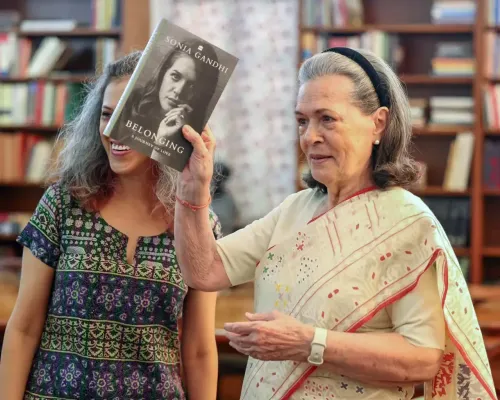
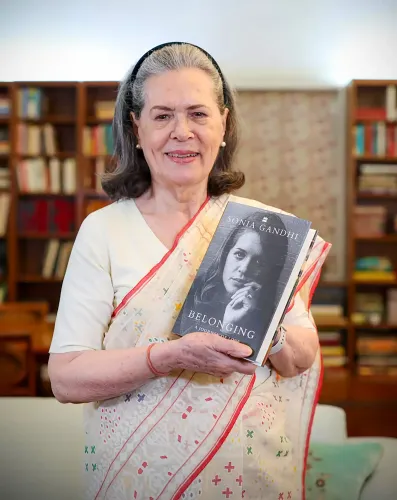
Sonia Gandhi memoir confirms Siddhartha Shankar Ray's role before 1975 Emergency
Synopsis
Sonia Gandhi's memoir has done what decades of historical accounts could not quite settle — placed Siddhartha Shankar Ray physically beside Indira Gandhi at the presidential meeting that preceded the 1975 Emergency proclamation. As a first-person account from inside the inner circle, it may finally close the debate about whether Ray was peripheral or central to one of independent India's most controversial decisions.
Key Takeaways
Sonia Gandhi's memoir 'Belonging: A Journey of Love' names Siddhartha Shankar Ray as present when Indira Gandhi met President Fakhruddin Ali Ahmed on the afternoon of 24 June 1975 , hours before the Emergency was proclaimed.
The memoir quotes Sonia Gandhi describing Ray as a 'legal luminary' who, along with law minister H.
Gokhale , was consulting constitutional experts and urging firm government action.
Historical accounts credit Ray with recommending Article 352 — the 'internal disturbance' ground — as the constitutional vehicle for declaring the Emergency.
Sonia Gandhi's book states President Ahmed signed the proclamation willingly , directly challenging longstanding claims that he acted under coercion.
Ray also served as Chief Minister of West Bengal (1972–77) , Governor of Punjab (1986–89) , and Ambassador to the United States (1992–96) .
The memoir is expected to reignite scholarly debate about accountability for the Emergency, one of India's most contested political episodes.
Congress Parliamentary Party Chairperson Sonia Gandhi's memoir 'Belonging: A Journey of Love' has shed fresh light on the events preceding the proclamation of the Emergency in June 1975, with a historically significant reference to Siddhartha Shankar Ray accompanying Indira Gandhi when she briefed then President Fakhruddin Ali Ahmed on the afternoon of 24 June 1975. The disclosure reinforces longstanding accounts of Ray's central role in providing the legal and constitutional scaffolding for one of independent India's most consequential political decisions.
What Sonia Gandhi's Book Reveals
In the memoir, Sonia Gandhi writes: 'One of Mrs Gandhi's chief ministers, legal luminary Siddhartha Shankar Ray, and her law minister, H. R. Gokhale, were consulting with constitutional experts. They were unanimous in urging that the situation needed to be tackled firmly; the government had been too soft and permissive, and the situation had got out of hand.' She further notes that Sanjay Gandhi joined these deliberations — a man she describes as being just thirty years old at the time, yet someone whose name became synonymous with the Emergency itself.
Crucially, Sonia Gandhi also writes: 'As we later learned from my mother-in-law, she had met the president with S. S. Ray and briefed him in person in the afternoon of the twenty-fourth (June, 1975).' This direct reference places Ray physically at the decisive pre-proclamation meeting — a detail that had remained on the margins of mainstream historical accounts.
Ray's Role: Legal Architect of the Emergency
At the time of the Emergency, Siddhartha Shankar Ray was serving as the Chief Minister of West Bengal (1972–77) and was widely regarded as one of Indira Gandhi's most trusted legal minds. Several historical accounts, including memoirs by other political leaders, hold that it was Ray who suggested invoking Article 352 of the Constitution to declare a National Emergency on the ground of 'internal disturbance'. One narrative has even recounted that Indira Gandhi herself acknowledged she had not been fully aware of the provision until Ray brought it to her attention.
With political opposition intensifying around Jayaprakash Narayan's movement and the Allahabad High Court verdict having invalidated Indira Gandhi's 1971 election, Ray reportedly argued that constitutional emergency powers could be invoked to restore order. Critics have long maintained that in doing so, he provided the roadmap that enabled the suspension of civil liberties and the concentration of power in the Prime Minister's Office.
On President Ahmed's Decision
Sonia Gandhi's book also offers a pointed clarification about President Fakhruddin Ali Ahmed's role. She describes him as 'a lawyer by profession' who 'had signed the proclamation of a State of Emergency — willingly, and not, as later rumours had it, under coercion.' This directly contests the long-circulated narrative that Ahmed signed the proclamation under pressure, lending the memoir additional historical weight.
Ray's Broader Career and Contested Legacy
Ray's career extended well beyond the Emergency. He served as Union Minister for Education and Social Welfare (1971–72), Governor of Punjab (1986–89) — a tenure marked by accusations of excesses — and later as Ambassador to the United States (1992–96). He was also dispatched as counsel to the Supreme Court of Pakistan, underscoring his stature as a legal practitioner with rare diplomatic reach.
His defenders maintain that he operated strictly within the constitutional framework available at the time and was responding to what was perceived as a grave political crisis. However, the debate over his moral and political culpability has never fully subsided, and Sonia Gandhi's memoir adds a new primary-source dimension to it.
Historical Significance of the Memoir's Account
Most established narratives of the Emergency have focused principally on Indira Gandhi, Sanjay Gandhi, and President Ahmed. Ray's comparative obscurity in popular retellings has meant that the precise contours of his advisory role have remained contested. The memoir, written by someone who was present in Indira Gandhi's inner circle, now provides a first-person account that is difficult to dismiss. As Sonia Gandhi frames it, the Emergency was not conceived by any single individual acting alone — it emerged from a small, closed circle of legal, constitutional, and political advisers, with Ray occupying a central seat at that table.
The book's account is widely expected to reignite scholarly and political debate over accountability for the Emergency — a period that remains deeply contested in India's democratic memory.
Point of View
And its account of Ray's presence at the presidential meeting carries a weight that secondary histories cannot match. Yet the book's framing — presenting these events through the eyes of someone deeply loyal to the Gandhi family — also invites scrutiny: it rehabilitates the Emergency's architects as crisis-responders rather than democracy-subverters. The claim that President Ahmed signed 'willingly' is particularly pointed, arriving in a political environment where Congress remains defensive about its Emergency record. What the memoir cannot resolve is the normative question: whether acting within constitutional provisions during the Emergency constitutes legal conduct or an abuse of legal form — a distinction that continues to divide Indian constitutional scholars fifty years on.
NationPress
16 Nov 2026
Frequently Asked Questions
What does Sonia Gandhi's memoir reveal about the 1975 Emergency?
Sonia Gandhi's memoir 'Belonging: A Journey of Love' reveals that Siddhartha Shankar Ray accompanied Indira Gandhi when she personally briefed President Fakhruddin Ali Ahmed on the afternoon of 24 June 1975, shortly before the Emergency was proclaimed. The book also states that Ray and law minister H. R. Gokhale were consulting constitutional experts and urging firm government action in the days leading up to the proclamation.
Who was Siddhartha Shankar Ray and what was his role in the Emergency?
Siddhartha Shankar Ray was the Chief Minister of West Bengal from 1972 to 1977 and one of Indira Gandhi's most trusted legal advisers. He is widely credited in historical accounts with recommending the use of Article 352 of the Constitution — specifically the 'internal disturbance' ground — as the legal basis for declaring the National Emergency. Critics have long argued he provided the constitutional roadmap for suspending civil liberties.
Did President Fakhruddin Ali Ahmed sign the Emergency proclamation under pressure?
According to Sonia Gandhi's memoir, President Ahmed signed the proclamation willingly and not, as later rumours suggested, under coercion. This account directly contests the long-circulated narrative that he was pressured into signing the Emergency declaration on 25 June 1975.
Why is Sonia Gandhi's memoir considered historically significant on the Emergency?
The memoir is a first-person account from someone present in Indira Gandhi's inner circle, making it a primary source that is difficult to dismiss. It places Ray physically at the decisive pre-proclamation presidential meeting — a detail absent from most mainstream accounts — and adds a new layer of documentation to the contested history of who conceived and enabled the Emergency.
What other positions did Siddhartha Shankar Ray hold apart from Chief Minister of West Bengal?
Beyond his role as Chief Minister of West Bengal (1972–77), Ray served as Union Minister for Education and Social Welfare (1971–72), Governor of Punjab (1986–89), and Ambassador to the United States (1992–96). He was also sent as counsel to the Supreme Court of Pakistan, reflecting his stature as a senior legal and diplomatic figure.